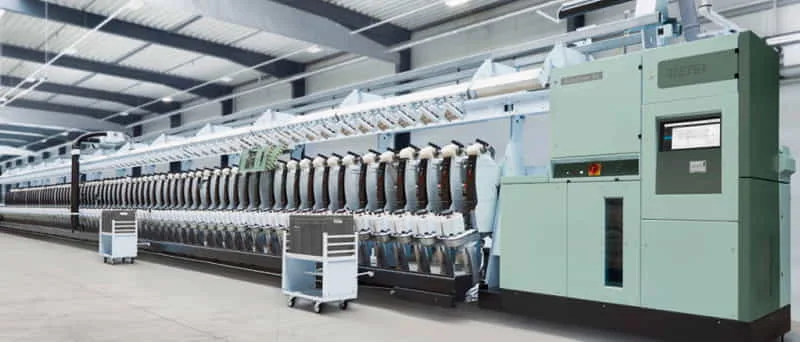
The roving frame sits between the draw frame and the ring spinning frame. It takes drawn sliver, which has no twist, drafts it into a thinner strand, adds a small amount of twist to hold the fibers together, and winds this roving for ring spinning. The step is needed because sliver is too thick and too weak to be spun directly, and the quality of the roving directly affects the yarn.
Introduction to Roving Frames in Ring Spinning
Roving frames play a critical role in the ring spinning process, serving as an essential intermediary step that transforms prepared fibers into a form suitable for final yarn production. As a cornerstone of textile manufacturing, roving frames bridge the gap between carding/combing and ring spinning, producing a lightly twisted, attenuated strand known as roving. This process ensures that fibers are aligned, uniform, and ready for the high-draft twisting of the ring spinning frame, ultimately contributing to the production of high-quality yarns used in apparel, home textiles, and technical fabrics. With the textile industry’s increasing focus on sustainability, modern roving frames incorporate energy-efficient technologies and support eco-friendly fibers, aligning with the demand for sustainable textiles. This comprehensive article explores the function, components, operation, advancements, and sustainability aspects of roving frames in ring spinning systems, providing valuable insights for students, professionals, and textile enthusiasts.
Understanding Roving Frames in Ring Spinning Systems
The roving frame is a specialized machine in the yarn production sequence that processes drawn slivers—loose, rope-like strands of aligned fibers—into roving, a thinner, slightly twisted strand that serves as the input for ring spinning. The roving process reduces the sliver’s diameter, aligns fibers further, and adds a minimal twist to maintain cohesion, preparing the material for the final drafting and twisting stages in the ring spinning frame. This step is crucial because direct spinning of slivers would be impractical due to their thickness and lack of strength.
Roving frames are integral to the ring spinning system, which is renowned for producing yarns with superior strength, uniformity, and softness compared to other methods like open-end or air-jet spinning. The roving frame’s output directly influences yarn quality, making its precision and efficiency critical. Modern roving frames, such as those manufactured by Rieter, Saurer, and Lakshmi Machine Works, incorporate automation, digital controls, and energy-saving features to enhance productivity and support sustainable textile production.
The Roving Frame Process: Step-by-Step
The roving frame process involves drafting, twisting, and winding to transform drawn slivers into roving. Below is a detailed breakdown of the process, including the machinery and techniques involved.
Input: Drawn Sliver
The roving frame begins with drawn slivers, which are produced during the drawing process. Drawing combines multiple carded or combed slivers, aligning fibers and improving uniformity through attenuation in a draw frame. The drawn sliver is stored in cans and fed into the roving frame.
Characteristics:
- Thickness: Drawn slivers are too thick (typically 5–10 g/m) for direct spinning.
- No twist: Slivers lack cohesion, requiring slight twisting in the roving frame.
- Fiber Types: Suitable for cotton, wool, polyester, or blends, including sustainable options like organic cotton or recycled polyester.
Sustainability Note: Using organic or recycled fibers at this stage reduces environmental impact, aligning with certifications like GOTS and OEKO-TEX®.
Drafting
Drafting is the process of attenuating the drawn sliver to reduce its thickness, preparing it for twisting.
Process:
- The sliver is fed into the roving frame’s drafting zone, which consists of a series of rollers rotating at increasing speeds.
- The draft ratio (typically 5:1 to 20:1) determines the degree of attenuation, reducing the sliver’s linear density to 0.5–2 g/m.
- Modern drafting systems, such as 3-over-3 or 4-over-4 roller configurations, ensure precise fiber alignment and minimal irregularity.
Machinery:
- Drafting Rollers: Top and bottom rollers, often with rubber or synthetic cots, grip and stretch the sliver.
- Aprons: Synthetic or leather aprons guide fibers, reducing breakage and ensuring uniformity.
- Condensers: Funnel-shaped devices align fibers before drafting, improving roving quality.
Sustainability Note: Energy-efficient drafting systems with variable speed drives reduce power consumption by up to 10%, supporting eco-friendly production.
Twisting
Twisting imparts a slight twist to the drafted sliver, creating roving with enough cohesion to withstand handling and further processing in the ring spinning frame.
Process:
- The drafted sliver passes through a flyer mechanism, which rotates to add twist (typically 1–3 twists per inch, TPI).
- The twist direction (Z or S) is set based on the intended yarn application, with Z-twist common for ring-spun yarns.
- The flyer’s rotation ensures uniform twist distribution, maintaining roving strength without compromising flexibility.
Machinery:
- Flyer: A rotating arm with a hollow spindle that guides the roving and imparts twist.
- Presser Arm: Controls roving tension, ensuring consistent twist and winding.
- Spindle: Rotates the flyer at speeds of 800–1,500 RPM, depending on the machine and fiber type.
Sustainability Note: Modern flyers with lightweight, composite materials reduce energy use by minimizing rotational inertia.
Winding
The twisted roving is wound onto bobbins, forming a compact package for transfer to the ring spinning frame.
Process:
- The roving is guided through the flyer’s hollow arm and wound onto a bobbin, which rotates independently of the flyer.
- A building mechanism ensures even winding, creating a stable, conical bobbin shape.
- Tension control prevents roving breakage or stretching during winding.
Machinery:
- Bobbin and Spindle: The bobbin rotates at a controlled speed to collect roving, with modern systems using automated doffing for efficiency.
- Building Mechanism: Oscillates the roving to form a uniform package, reducing waste.
Sustainability Note: Automated doffing systems reduce labor and energy costs, while precise winding minimizes material waste.
Components of a Roving Frame
The roving frame comprises several key components, each contributing to its efficiency and output quality:
- Creel: Holds sliver cans, ensuring smooth feeding into the drafting zone.
- Drafting System: Includes rollers, aprons, and condensers for precise fiber attenuation.
- Flyer and Spindle: Imparts twist and guides roving to the bobbin.
- Bobbin Drive: Controls bobbin rotation for winding, often with variable speed drives for energy efficiency.
- Control Systems: Modern frames feature digital interfaces for monitoring draft, twist, and speed, reducing defects by up to 15%.
- Stop Motions: Sensors detect sliver breaks or irregularities, halting the machine to prevent waste.
Types of Roving Frames
Roving frames vary based on design and application:
- Simplex Frames: Traditional roving frames for cotton and blends, offering high versatility.
- Speed Frames: High-speed models with automated features, producing up to 1,500 m/min of roving.
- Compact Roving Frames: Integrate compact spinning technology to reduce hairiness in the final yarn.
- Specialty Frames: Designed for specific fibers like wool or flax, with modified drafting and twisting systems.
Advancements in Roving Frame Technology
Modern roving frames have evolved to enhance productivity, quality, and sustainability:
- Automation: Automated doffing and sliver feeding reduce labor costs by 20% and improve consistency.
- Digital Controls: IoT-enabled systems monitor real-time data, optimizing draft and twist settings to minimize defects.
- Energy Efficiency: Variable frequency drives and lightweight flyers reduce energy consumption by 10–15%.
- Compact Roving: Integrates compacting devices to produce smoother, stronger roving, enhancing yarn quality.
- High-Speed Spindles: Speeds up to 2,000 RPM increase output without compromising quality.
Sustainability in Roving Frames
Roving frames contribute to sustainable textile production through several innovations:
- Eco-Friendly Fibers: Support for organic cotton, hemp, and recycled polyester reduces pesticide use and waste. For example, recycled polyester roving saves 7,000 plastic bottles per ton of yarn.
- Energy Efficiency: Modern frames with energy-saving motors and drives lower power consumption by up to 15%.
- Waste Reduction: Automated stop motions and precise drafting minimize fiber waste, with some systems achieving 98% fiber utilization.
- Circular Economy: Roving frames process recycled fibers from textile waste, supporting closed-loop production.
- Low-Impact Processes: Enzymatic pre-treatments for natural fibers reduce chemical and water use in preparation stages.
Advantages of Roving Frames
- Improved Yarn Quality: Precise drafting and twisting ensure uniform, strong roving for high-quality yarns.
- Versatility: Suitable for various fibers and yarn counts, from coarse (Ne 6) to fine (Ne 60).
- Sustainability: Supports eco-friendly fibers and energy-efficient operations.
- Flexibility: Adjustable draft and twist settings cater to diverse applications.
- Durability: Modern frames with robust components ensure long-term reliability.
Challenges and Solutions
- Low Productivity: Roving frames are slower (1–2 m/min) than other processes. Solution: Use high-speed frames and compact roving technology to boost output by 10–20%.
- Energy Consumption: High spindle speeds increase power use. Solution: Implement variable frequency drives and lightweight flyers.
- Fiber Breakage: Sensitive fibers like flax may break during drafting. Solution: Use specialized aprons and lower draft ratios.
- Cost of Sustainability: Eco-friendly fibers are expensive. Solution: Leverage economies of scale and government incentives for green manufacturing.
Applications of Roving Frames
Roving frames support a wide range of textile applications by producing roving for ring-spun yarns:
- Apparel: Fine rovings (Ne 30–60) create soft, strong yarns for shirts, dresses, and denim.
- Home Textiles: Medium-count rovings (Ne 20–40) produce durable yarns for bed linens, towels, and curtains.
- Technical Textiles: Coarse rovings (Ne 6–20) are used in canvas, ropes, and geotextiles.
- Sustainable Fashion: Roving from organic cotton or recycled polyester supports eco-friendly apparel, aligning with consumer demand for green textiles.
Case Studies
Case Study 1: Rieter’s Eco-Friendly Roving Frame
Rieter implemented a high-speed roving frame with automated doffing and energy-efficient drives in a Brazilian textile mill. Using recycled cotton, the frame produced Ne 40 roving for sustainable T-shirts, reducing energy use by 12% and fiber waste by 10%, achieving GOTS certification.
Case Study 2: Organic Wool Roving in Europe
A European mill adopted a compact roving frame to process organic wool for high-end knitwear. The system’s precise drafting and low-impact pre-treatments reduced water use by 25% and improved yarn quality, increasing market competitiveness.
Future Trends in Roving Frames
The future of roving frames is shaped by technological and sustainability advancements:
- AI and IoT Integration: Real-time monitoring and AI-driven optimization will reduce defects by 20% and enhance energy efficiency.
- Compact Roving: Wider adoption will improve roving quality, reducing hairiness and increasing yarn strength.
- Sustainable Fibers: Increased use of bio-based fibers like seaweed and bamboo for eco-friendly roving.
- Automation: Fully automated roving frames will reduce labor costs and improve productivity by 15–20%.
- Smart Textiles: Roving frames will process conductive fibers for wearable technology applications.
Choosing the Right Roving Frame
When selecting a roving frame, consider:
- Fiber Type: Choose frames optimized for cotton, wool, or blends, with support for sustainable fibers.
- Production Goals: High-speed frames for large-scale production or compact frames for premium yarns.
- Sustainability: Prioritize energy-efficient models and eco-friendly fibers to meet GOTS or Bluesign® standards.
- Automation Level: Automated doffing and digital controls enhance efficiency and quality.
- Budget: Balance initial costs with long-term savings from energy efficiency and waste reduction.
Conclusion
Roving frames are indispensable in ring spinning systems, transforming drawn slivers into high-quality roving for yarn production. Their precise drafting, twisting, and winding processes ensure yarns with superior strength and uniformity, supporting applications in apparel, home textiles, and technical fabrics. By integrating sustainable fibers, energy-efficient technologies, and automation, roving frames align with the textile industry’s eco-friendly goals. As AI, compact roving, and bio-based fibers advance, these machines will continue to drive innovation and sustainability. For more insights into textile manufacturing and sustainable practices, visit TextileSchool.com, a leading resource for industry professionals and learners.
Citations
- “Ring Spinning, the Most Widely Used Yarn Formation Technique.” TextileSchool.com, www.textileschool.com/315/ring-spinning-the-most-widely-used-yarn-formation-technique/. Accessed 9 Aug. 2025.
- “Roving Frame: Function, Mechanism, and Importance in Spinning.” TextileLearner.net, textilelearner.net/roving-frame/. Accessed 9 Aug. 2025.
- “Spinning Process in Textile Manufacturing.” TextileMentor.com, textilementor.com/spinning-process-in-textile-manufacturing/. Accessed 9 Aug. 2025.
- “The Journey of Yarn: Understanding the Ring Spinning Process.” TheTextileThinkTank.in, www.thetextilethinktank.in/the-journey-of-yarn-understanding-the-ring-spinning-process/. Accessed 9 Aug. 2025.
- “Textile Spinning: The Process of Yarn Manufacturing.” TextileEngineering.net, textileengineering.net/textile-spinning-the-process-of-yarn-manufacturing/. Accessed 9 Aug. 2025.
- “Roving Frame and Its Impact on Yarn Quality.” TextileValueChain.in, www.textilevaluechain.in/in-depth-analysis/articles/textile-articles/roving-frame-and-its-impact-on-yarn-quality/. Accessed 9 Aug. 2025.