

Apparel
Pattern Making and Grading: Methods, Grade Rules and a Worked Example
Pattern making draws a garment as flat pieces in one base size; grading makes every other size from it with grade rules taken from the size chart.
Article
Design intent to production readiness. BOMs, PP meetings, approvals, pilot runs, and risk mitigation checklists. This section explains practical decision criteria, typical test methods, and failure modes that matter in real production. Readers get checklists, calculation steps, and case examples connecting specifications to cost, reliability, and compliance. Links map core concepts to upstream inputs and downstream processes so choices remain consistent across sourcing, manufacturing, and end-use performance. Each article includes definitions, diagrams where helpful, and plain-language notes to help newcomers ramp quickly while giving experienced professionals the depth needed to troubleshoot and optimize. Standards references are cited with context, and whenever trade-offs exist, we make them explicit so you can defend decisions.
Apparel
Pattern making draws a garment as flat pieces in one base size; grading makes every other size from it with grade rules taken from the size chart.
Article

Production
A factory layout is a layout that includes everything that is required for the manufacture of goods or the delivery of services. A facility is an object that makes it easier to complete any task. A machine tool, a work center, a production cell, a machine shop, a department, a warehouse, and so on are […]
Article

Merchandizing
This project work deals with the productivity and quality enhancement in a garment manufacturing unit through a practical study conducted in the stitching department.
Article
Merchandizing
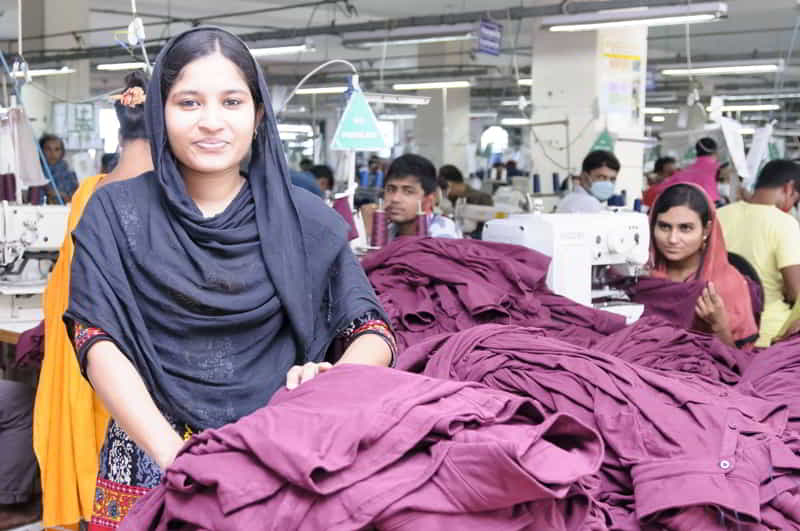
More than 60% of the export share of Bangladesh is now contributed by ready-made garments. Due to the advent of containerization multimodal transport has created a new era in international trade.
Article

Merchandizing
SPINNING A Yarn is usually of substantial length & of a small cross-section. In the cross-section of yarn, there are usually multiple numbers of Staple fibers (short fibers) or Filaments (long fibers) of unlimited length. Spinning is the process of creating yarn (or thread, rope, cable) from various raw fiber materials. Several fibers are twisted […]
Article

Post-Production
Garment production is an organized activity consisting of sequential processes such as laying, marking, cutting, stitching, checking, finishing, pressing, and packaging. This is a process of converting raw materials into finished products. It will be difficult to maintain the industry if production is not, up to the mark if the preproduction phase of preparation of material is not properly carried out.
Ready-to-wear apparel or garment manufacturing involves many processing steps, beginning with the idea or design concept and ending with a finished product. The apparel manufacturing process involves Product Design, Fabric Selection, and Inspection, Patternmaking, Grading, Marking, Spreading, Cutting, Bundling, Sewing, Pressing or Folding, Finishing, and Detailing, Dyeing, and Washing, QC, etc.
Article

Post-Production
INTRODUCTION Method study is a systematic method of analysing the method of doing a job including human movements involved in it. So, it is the process of analysing the methods involved in a workflow to increase productivity. It deals with doing the work in a better way, with less time and effort. That is why […]
Article

Merchandizing
Textile products are crafted analyzing numerous internal and external factors bound to the end products. Before, during, and after designing a product, a series of factors such as the market trends, market research, quality testing, trials, design patterns, etc. to be arranged or considered by the designer. Here we discuss a few of them.
Article

Merchandizing
Apparel testing is essential before shipment to foreign countries like the US and EU. Selection of a suitable testing lab is required to get the right result. In order to achieve this, the lab has to equip themselves with equipment, calibration, proficiency testing, training etc. Such aspects have been critically reviewed in this paper.
Article

Apparel
Establishing good practices can significantly improve working conditions, increase workplace safety and raise productivity. The following are some simple good practices for the apparel industry. They are cost-efficient and easy to implement.
Article
Every record in these registers was sent in by somebody. Submissions are reviewed before they are published.
1,496 machines in the register.Tell us about a missing one 306 event series in the register.Submit a trade fair or conference 3,038 standards tracked in the register.Get the changes by email each week