A manufacturing execution system (MES) is the software that runs the shop floor between a company’s ERP and its machines. It schedules the ERP’s orders onto spinning frames, looms, knitting machines, dyeing machines or sewing lines, follows each lot, roll, batch or bundle through the plant, records stops, speeds and counts as they happen, and reports what was made back to the ERP. ISA-95, published internationally as IEC 62264, calls this layer Level 3, manufacturing operations management, between business planning (Level 4) and machine control (Levels 1 and 2); MESA International’s model lists eleven MES functions, from resource allocation and scheduling to product tracking and performance analysis. In MES for textile and apparel manufacturing they become yarn-quality alarms in spinning, loom and knitting-machine monitoring with OEE, recipe management tied to the dye kitchen, and bundle tracking with operator efficiency on the sewing floor. Implementing one means mapping how orders and data move today, choosing the functions the process needs, defining the ERP interface, connecting the machines, agreeing what counts as a stop, and piloting before rolling out.
Last verified: 12 October 2026. Systems named here are examples described on their makers’ own pages on that date, not recommendations or a ranking. Worked examples use assumed inputs in the site’s calculators. Sources are linked in the text and listed at the end.
MES for textile and apparel manufacturing at a glance
| Process | What the MES follows | What it records and controls | A documented example |
|---|---|---|---|
| Spinning | Lots, machine by machine | Production, efficiency, yarn-quality alarms, energy, maintenance | Rieter ESSENTIAL; BMSvision SpinMaster |
| Weaving | Articles, warp beams, fabric pieces | Loom status, speed, stops by cause, schedule, piece tickets, yarn stock | BMSvision WeaveMaster; Picanol PicConnect |
| Knitting | Machine orders, rolls, yarn lots | Running and stops, yarn feed, OEE | BMSvision KnitMaster |
| Dyeing and finishing | Batches and their recipes | Batch schedule, recipes, dye-kitchen weighing and dosing, water, energy and chemicals per batch | SETEX OrgaTEX |
| Cutting and sewing | Bundles or single garments | Operations per operator, work in progress, off-standard time, quality, pay inputs | JUKI JaNets; Eton Systems ETONingenious |
What is a manufacturing execution system?
The analyst firm Advanced Manufacturing Research coined “MES” in 1990 for software that carries out manufacturing by joining a company’s planning and control systems (van Dyk and van Schaar, 2001). Textile mills were logging machine data earlier: BMSvision, which began inside the Barco group, dates its first textile system, SYCOTEX, and its first machine data units to 1975 (BMSvision). Two bodies gave MES the definitions used today.
ISA-95 / IEC 62264. The International Society of Automation describes ISA-95, “also known as ANSI/ISA-95 or IEC 62264”, as “an international set of standards aimed at integrating logistics systems with manufacturing control systems”. Its five levels run from the physical process (Level 0) through sensing (1) and supervisory control (2) to manufacturing operations management (3) and business planning and logistics (4). ISA states that Level 3 “describes manufacturing execution systems (MES) and other systems such as supervisory control and data acquisition (SCADA)”, and that the standard deals mainly with the interface between Levels 3 and 4 (ISA). The international edition, IEC 62264-1:2013, describes the Level 3 domain and its interfaces with Level 4 (IEC); the site keeps a record for IEC 62264-1.
MESA’s function model. MESA International’s white paper “MES Functionalities and MRP to MES Data Flow Possibilities” (revised March 1997) defined eleven MES functions (MESA white paper 2); they are mapped to a textile plant in the table below. MESA ceased operating on 30 June 2026, and its educational content passed to ISA (ISA, 30 June 2026).
MES, ERP and machine control: who does what
The layers are told apart by the clock. The OPC Foundation’s summary of ISA-95 gives Level 2 “real-time responses measured in sub-seconds”, Level 3 “time frames of days, shifts, hours, minutes, and seconds” and Level 4 “months, weeks, and days”; for Level 3, real time means “information available a few seconds after shop floor events occur” (OPC 10030, 4.2.3).
| ERP (Level 4) | MES (Level 3) | Machine control (Levels 1 and 2) | |
|---|---|---|---|
| Works in | Months, weeks, days | Days, shifts, hours, minutes, seconds | Sub-seconds |
| Holds | Sales orders, purchasing, stock value, costing | Schedules, work orders, lots, recipes in use, stops, counts, quality results | Set points, motor and valve control, sensor signals |
| Answers | What has the customer ordered, what yarn must we buy, what will it cost? | Which article is on which loom, which batch goes in next, why did the line stop? | Hold this loom at its speed; follow this dyeing machine’s temperature curve |
Both kinds of system are sold with planning modules, so the test is the clock, not the label. ERP is covered on its own page, ERP software for textile manufacturing; the connected mill as a whole is in Industry 4.0 in textiles and, stage by stage, in digital transformation in textile manufacturing.
The eleven MES functions, mapped to a textile plant
Function names and descriptions follow MESA’s white paper as reproduced by van Dyk and van Schaar (2001, table 2). The examples are features each maker lists on its own product page, read on 12 October 2026; a feature listed is not a feature tested.
| MESA function | What it does | In a textile or apparel plant | Documented example |
|---|---|---|---|
| Resource allocation and status | Machines, tools, skills and materials needed before work starts, with their status | Which looms are free and set for the next article; who can do which sewing operation | BMSvision PlantView (real-time machine status); JaNets operator and style management |
| Operations/detail scheduling | Sequences work to minimise set-ups, MESA’s example being “colour sequencing” | Dye lots in shade order; loom orders grouped by warp | OrgaTEX APS Scheduler; BMSvision Planboard |
| Dispatching production units | Releases jobs, batches and lots, and changes the flow as events occur | Next batch to a dyeing machine; garments routed to free stations | OrgaTEX drag-and-drop batches; Eton unit production system |
| Document control | Work instructions, recipes, procedures, shift-to-shift notes | Operation sheets at sewing stations; lab recipes passed to the dyehouse | JaNets videos and PDFs on terminals; OrgaTEX recipe transfer from Datacolor Match Textile |
| Data collection/acquisition | Collects production and process data from the operation | Stops, speeds and counts from machine controllers; bundle scans; lab results | BMSvision Data Units; OPC 40444 for textile testers |
| Labour management | Personnel status, time and attendance, certifications | Attendance, skills, incentive and piece-rate inputs | JaNets time and attendance, incentives, payroll interface |
| Quality management | Real-time analysis of measurements to flag problems | Yarn alarm bobbins, fabric defects by roll, in-line checks | Rieter ESSENTIAL; BMSvision QualiMaster; JaNets quality module |
| Process management | Monitors production and corrects it or guides the operator | Dyeing deviations; yarn feed on knitting machines | OrgaTEX deviation analysis; KnitMaster LFA monitoring |
| Maintenance management | Preventive and periodic maintenance, alarms, history | Preventive maintenance on frames and knitting machines; cleaning slots in the dyehouse plan | BMSvision SpinMaster; OrgaTEX maintenance display |
| Product tracking and genealogy | Where work is, who worked on it, materials by supplier and lot | Which yarn lot went into which roll and dye lot; where each bundle is | WeaveMaster traceability; OrgaTEX lot tracking |
| Performance analysis | Results against history and standards: utilisation, availability, cycle time | OEE per machine; line efficiency against standard minutes | Picanol PicConnect; KnitMaster OEE reports |
What an MES does in each textile process
Spinning: alarms and every machine’s output
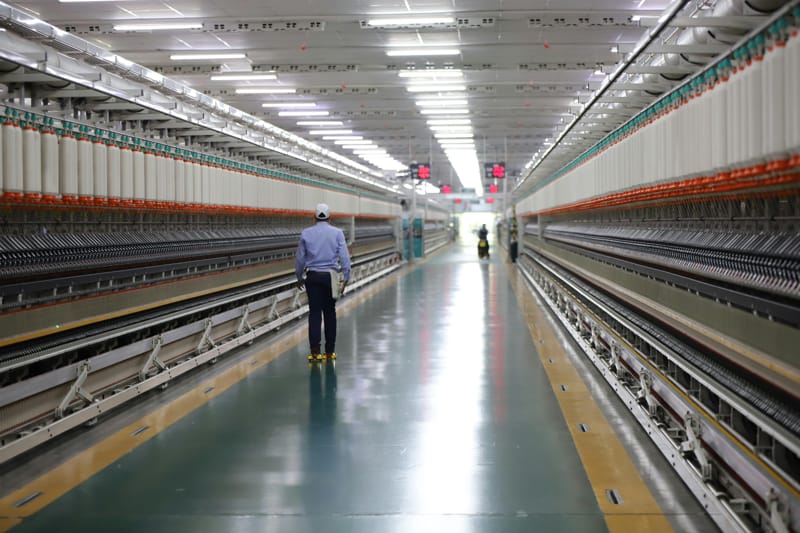
In spinning, much of the MES is about machines and yarn quality. Rieter says ESSENTIAL “records and connects all relevant data – from production and efficiency to energy consumption and quality – in real time”, flags slubs in the sliver from cards, combers and draw frames before they reach the yarn, and, with Ring Winder Connect, uses winding data to find alarm and off-standard bobbins so the spinning position can be stopped (Rieter). BMSvision lists production and quality monitoring, scheduling, preventive maintenance and an ERP interface for SpinMaster (BMSvision). Laboratory testers are being joined up too: OPC 40444, “OPC UA for Textile Testing Devices” (version 1.0.0, 1 March 2025), aims at “a straightforward integration of different kinds of textile testing devices into MES and other IT systems” (OPC Foundation).
Weaving: articles, set-ups and stops by cause
MES in fabric manufacturing earns its keep in weaving, because the order mix keeps changing. The EU-funded TexWIN project (2010 to 2013) described weaving mills where almost half the orders were for individual article variants, with up to 100 machine parameters to adjust at a set-up, and reported weaving efficiencies from 40% on high-quality, low-quantity orders to more than 95% on mass products (CORDIS, TexWIN final report). That is why a weaving MES reports by article as well as by loom. BMSvision says WeaveMaster “monitors and synchronizes all manufacturing and logistic processes within the weaving mill, from yarn purchasing and inventory up to the shipment of the finished fabric”, listing scheduling, ticket printing, yarn inventory and traceability (BMSvision). Loom makers offer monitoring themselves: in Picanol’s PicConnect, operators enter stop declarations on the loom’s display so the mill can “analyze efficiency losses according to the OEE standards” (Picanol).
Knitting: machine orders, rolls and yarn feed
In knitting, the losses an MES counts are machine stops and the faults found at greige inspection. BMSvision lists real-time data collection, scheduling, yarn inventory, “LFA (yarn feed consumption) monitoring” and OEE reports for KnitMaster, with machines connected through its Data Units or “through their built-in Ethernet interface” (BMSvision). The worked example runs one knitting machine’s shift through OEE.
Dyeing and finishing: recipes, batches and the dye kitchen
In a dyehouse the unit of work is the batch, and the MES carries its recipe. SETEX says OrgaTEX makes “water, energy and chemical consumption visible for every batch”, and that even its basic edition “automatically records run times, stoppages and consumption for every machine”. The professional edition adds a batch scheduler, rule-based recipe management, recipe transfer from Datacolor’s Match Textile, and lot tracking with barcodes “for accurate weighing and dosing”; integration modules connect dye-kitchen dosing, weighing and dissolving stations, ERP and colour-matching systems (SETEX; OrgaTEX Professional). The site’s shade sequencing and right-first-time dyeing cost calculators work on the same decisions.
Cutting and sewing: bundles, pieces and operators
MES solutions for apparel manufacturing track people as much as machines, because a line’s output is the sum of many short manual operations. In a bundle system, cut parts move in ticketed bundles and operators record the bundles they finish; in a unit production system, garments travel one by one on an overhead line. JUKI describes JaNets as a “shop floor control system” “based on the BlueCherry Shopfloor Control System”, with off-standard reporting, work-in-progress reporting, time and attendance, a quality module, line balancing, bundle overrides, incentives and a payroll interface among its packages (JUKI). Eton Systems says its ETONingenious software turns “every product into an information carrier”, with real-time WIP tracking that “works with your ERP” (Eton Systems).
Every sewing efficiency figure rests on the standard minute value (SMV) of each operation, set by time study (method study in the garment industry; SAM calculator). Where operators are paid by the piece, the same bundle records feed pay, which working-time law and minimum-wage rules (statutory, or set by collective agreement) govern; the piece-rate wage calculator shows the arithmetic.
Worked example: what the MES calculates from one shift
Every input below is an assumption; the results are what the site’s calculators return. The point is what the MES must record for the figures to exist.
A circular knitting machine: OEE from stops, counts and inspection
Assumed machine: 30-inch, 28-gauge single jersey, 2,640 needles, 96 feeders, 28 rpm, 2.8 mm stitch length, 30s Ne cotton. At 100% efficiency the circular knitting production calculator gives 23.47 kg an hour (187.73 kg in 8 hours), an ideal rate of 0.391 kg a minute. Assumed shift: 480 minutes planned, 52 minutes of stops, 157 kg knitted, 4.5 kg graded defective.
| Input or result | Where the MES gets it | Value |
|---|---|---|
| Planned time (assumed) | Shift calendar, minus planned breaks | 480 min |
| Unplanned stops (assumed) | Machine stop signal, with the operator’s reason code | 52 min |
| Ideal rate | Article master data | 0.391 kg/min |
| Fabric knitted (assumed) | Revolution count or roll weights | 157 kg |
| Defective fabric (assumed) | Greige inspection, linked to roll and machine | 4.5 kg |
| Availability | (480 − 52) ÷ 480 | 89.17% |
| Performance | (157 ÷ 0.391) ÷ 428 min run | 93.82% |
| Quality | (157 − 4.5) ÷ 157 | 97.13% |
| OEE | availability × performance × quality | 81.26% |
| Losses (availability, performance, quality) | stops; slow running; defects at the ideal rate | 52.0, 26.5, 11.5 min |
Calculator: textile OEE, set to this shift. Read the minutes: stops cost about twice as much as slow running and over four times as much as defects, so the stop reasons are the first report to read, and without reason codes the MES can say only that the machine stopped. OEE is catalogued in ISO 22400-2 as the “overall equipment effectiveness index”, one of 34 KPIs for manufacturing operations management in the 2014 edition (Kikolski, 2020), which ISO expects to replace with a revised edition (ISO). The loom version is worked on the digital transformation page.
A sewing line: efficiency from bundle scans and off-standard time
Assumed line: 34 operators on a polo shirt with an SMV of 10.5, 2 absent, one 8-hour shift, 1,000 shirts counted by bundle scans, and 620 minutes of off-standard time (breakdowns, waiting, rework) entered at the operators’ terminals.
| Result | Working | Value |
|---|---|---|
| Attended minutes | 32 present × 8 h × 60 | 15,360 |
| On-standard minutes | 15,360 − 620 | 14,740 |
| Earned minutes | 1,000 × 10.5 | 10,500 |
| Overall efficiency | earned ÷ attended | 68.36% |
| Performance on standard | earned ÷ on-standard | 71.23% |
| Utilisation | on-standard ÷ attended | 95.96% |
Calculator: sewing line efficiency, set to this line. The split is why off-standard time is worth recording: the line was available for 96% of the time paid for and worked at 71% of standard while it was. Without it a supervisor sees only 68% and cannot tell method from machines. Balancing the line is the next step (line balancing calculator).
How to implement an MES in a textile or apparel plant
Textile cases are hard to find in the literature. The one used here, a Korean study in an open peer-reviewed journal, compared six earlier MES systems in its review, and none of them was in textiles or apparel. It built a cloud-based MES for the personalised-sportswear value chain, applied first to one design, one fabric, one printing and one sewing company, then extended to 11 companies (Ko, Lee and Cho, 2022). Steps 1 to 4 and 6 follow that case and the standards; steps 5 and 7 are general practice.
- Map how orders and data move today. The Korean “AS-IS” analysis found that materials and orders could not be traced, which left high work in progress and hid where defects arose, and that work orders were issued on paper, so records were “inaccurate, inconsistent, and lagged”.
- Choose the functions the process needs, using MESA’s eleven as the checklist. The Korean system implemented ten and left out performance analysis.
- Define the ERP interface in ISA-95 terms. IEC 62264-1 aims to “reduce the risk, cost, and errors associated with implementing these interfaces” (IEC). ISA-95 names four kinds of information to exchange: material, equipment, physical assets and personnel (OPC 10030). Decide which system owns each: article master, yarn lots, recipes, operator skills.
- Connect the machines. Mixed fleets are normal: older machines through add-on data units, newer ones through their own network port, testers through standard interfaces such as OPC 40444.
- Agree the definitions first. Planned time, stop reasons, each article’s ideal rate and each operation’s SMV decide every figure the system will print. Fix them in writing and keep them the same across plants and months.
- Pilot, then extend, starting where the loss is largest and the data easiest to trust, as the Korean system grew from four companies to 11.
- Train the people who enter the data. Stop reasons, bundle scans and quality results come from operators and supervisors; the system is only as good as those entries.

Challenges organisations face when adopting an MES
- Cost and staff in small firms. The Korean partners were mostly small businesses, and the sewing companies used no ICT management system; the authors concluded that cost and manpower limits made a cloud-based MES necessary. They reported improvement in 7 of 13 processes and a process automation ratio of 50% or more, but no quality or delivery figures yet.
- Averages without the article. With weaving efficiencies from 40% to over 95% depending on the order (TexWIN), a plant-wide average says little. Report by article, machine type and shift.
- Vendor benefit claims. BMSvision’s pages give “between 3 and 10% efficiency increase” for WeaveMaster and KnitMaster; JUKI says medium-sized factories typically see a return on JaNets “in just 12-24 months”. These are the makers’ own figures. Ask how each was measured, against what baseline and on which machines.
- Know-how the MES does not hold. Monitoring shows that a set-up was slow, not what the best settings are. TexWIN reported that mills could find the best loom setting for a new article only by trial and error, at best after more than a week of running, and built a case-based layer that “complements existing manufacturing execution systems”.
How to choose an MES: questions to ask
When comparing shop-floor control software for textile manufacturing, start from your process, then your plant size. Put these questions to every supplier, and ask to see the answer working on your own machines.
| Ask about | The question |
|---|---|
| Process fit | Which of our processes does it cover with its own modules, and which only by customisation? Textile MES products are built around one unit of work: lot, piece, roll, batch or bundle. |
| Machine connection | Which of our machine makes and generations does it connect, by what route, and at what cost per machine? |
| ERP interface | Which ERP does it already exchange orders, stock and results with, and in which direction? |
| Recipes (dyehouses) | Does it hold recipes, send them to the machine controllers and connect weighing and dosing? |
| People and pay (sewing) | How are bundles or pieces scanned, how is off-standard time entered, and does it feed payroll? |
| Definitions | How does it define planned time, stops and OEE, and can we change those definitions? |
| Size and support | Cloud or on-premise, what staff does it need, and who answers when a line stops on a night shift? |
| Evidence | Which plants with our process and size use it, and how were the benefits measured? |
Questions people ask
What MES solutions are used for apparel manufacturing?
On the sewing floor, shop-floor control systems that track bundles or single garments by operator and operation, such as JUKI’s JaNets and Eton Systems’ ETONingenious. Fabric suppliers use textile MES products such as BMSvision’s WeaveMaster and KnitMaster, or SETEX’s OrgaTEX in the dyehouse. These are examples, not a ranking.
What is a manufacturing execution system for textiles?
The software layer between a mill’s ERP and its machines, Level 3 in ISA-95 / IEC 62264. It schedules orders onto machines, tracks lots, rolls, batches or bundles, collects stops and counts as they happen, holds recipes and quality results, and reports production back to the ERP.
Can one system manage production workflow, quality control and production metrics in a textile mill?
Yes; that combination is what an MES is. Scheduling and dispatching, quality management and performance analysis are all among MESA’s eleven functions. Check that a product does all three for your process: several makers sell a separate product per process, such as BMSvision’s SpinMaster, WeaveMaster and KnitMaster.
How is an MES different from an ERP?
By the clock and by what it holds. ERP works in months, weeks and days and holds orders, purchasing, stock and costs; an MES works in days, shifts, hours, minutes and seconds and holds schedules, lots, recipes, stops and counts. The ERP says what to make; the MES runs the making and reports what was made.
How do you connect production equipment to an MES?
Through the machine’s own network interface where it has one, or through a data unit fitted to older machines that reads running, stopped and counts. Standard interfaces help with mixed brands; for textile laboratory testers there is OPC 40444, OPC UA for Textile Testing Devices (2025).
Sources
- Standards: ISA, ISA-95; IEC, IEC 62264-1:2013; ISO, ISO 22400-2:2014; OPC Foundation, OPC 10030, 4.2.3 and OPC 40444; the site’s records for IEC 62264-1 and ISO 22400-2.
- MESA: White Paper 2, MES Functionalities and MRP to MES Data Flow Possibilities (1997); ISA, assumption of MESA content (30 June 2026).
- Peer-reviewed: L. van Dyk and C. D. van Schaar, “Realising the potential of manufacturing execution systems”, South African Journal of Industrial Engineering 12(1), 2001 (doi); M. Ko, C. Lee and Y. Cho, “Design and Implementation of Cloud-Based Collaborative Manufacturing Execution System in the Korean Fashion Industry”, Applied Sciences 12, 9381, 2022 (doi); M. Kikolski, “Determination of ISO 22400 Key Performance Indicators using Simulation Models: The Concept and Methodology”, MODELSWARD 2020 (doi).
- Research: European Commission, CORDIS, TexWIN final report summary (FP7, 2010 to 2013).
- Makers’ pages, read 12 October 2026: Rieter ESSENTIAL; BMSvision SpinMaster, WeaveMaster, KnitMaster and history; Picanol PicConnect; SETEX OrgaTEX; JUKI JaNets; Eton Systems.
How this page is kept
Last verified: 12 October 2026. Definitions come from the standards bodies (ISA, IEC, OPC Foundation) and from MESA’s white paper as reproduced in a peer-reviewed article. System descriptions are the makers’ own, read on that date and attributed to them; they are examples, not endorsements, and are replaced when a product changes or is withdrawn. Implementation steps draw on the cited peer-reviewed case and the standards, and the pitfalls also use the EU research report; steps 5 and 7 are general practice. No vendor case study is used. The worked examples use the site’s calculators as they stood on that date, and each prefilled link was opened to check the figures quoted.
Change log. 12 October 2026: rewritten in full and narrowed to the MES itself. The earlier version cited no source. Its three case studies (an Asian mill cutting downtime by 35%, a European facility gaining 25% OEE, a conglomerate gaining 30% efficiency) named no company or source and are withdrawn. It called OEE “Overall Equipment Efficiency”; the term is overall equipment effectiveness. It dated early MES to the mid-20th century without a source; the term was coined in 1990, and the earliest textile machine-data system described here dates from 1975.
Found an error? Please tell us through the contact page, naming the section and the source that disagrees.