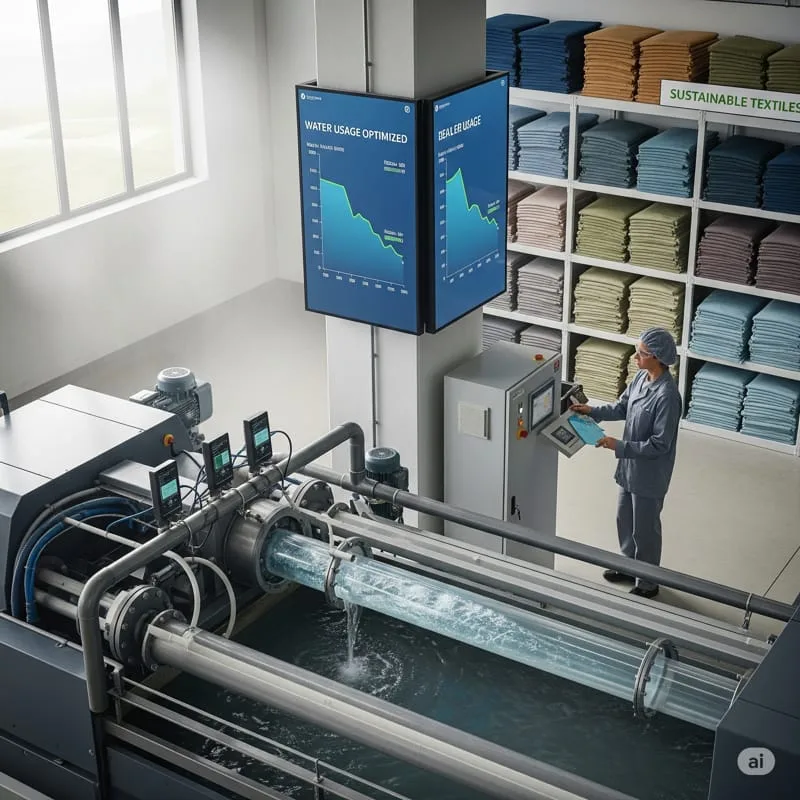
Textile mills reduce water use mainly in wet processing such as scouring, bleaching, dyeing and finishing. The main methods are flow reduction (fixing leaks, automatic shutoff valves, and low wet pick-up application by padding or spraying, which can cut dyeing water by up to 50%), reusing rinse water, cooling water, dye liquors and steam condensate, low-water dyeing technologies, data analytics and good housekeeping.
Textile manufacturing is one of the most water-intensive industries, with processes like dyeing, scouring, and finishing consuming vast quantities of water. Producing a single cotton T-shirt can require over 2,600 liters of water from cultivation to final product, according to the United Nations Environment Programme (https://www.unep.org/news-and-stories/story/tackling-textile-industrys-environmental-footprint). This high water usage, coupled with wastewater pollution, poses significant environmental challenges. As the global demand for sustainable fashion grows, optimizing water usage in textile manufacturing is essential for reducing environmental impact, lowering costs, and enhancing sustainability. This article provides a comprehensive analysis of water-saving strategies, integrating global innovations, regional efforts such as India’s initiatives, and addressing challenges and future directions for a water-efficient textile industry.
The Water Footprint of Textile Manufacturing
The textile industry’s water footprint is substantial, particularly in wet processing stages like dyeing, bleaching, and finishing. Cotton cultivation alone accounts for significant water use, with one kilogram of cotton requiring up to 20,000 liters of water in water-scarce regions. Wet processing further exacerbates the issue, generating wastewater laden with dyes, chemicals, and salts that pollute rivers and groundwater. The Ellen MacArthur Foundation highlights that the industry’s linear model exacerbates resource depletion, with less than 1% of textiles recycled into new garments, amplifying water waste (https://ellenmacarthurfoundation.org/a-new-textiles-economy). Optimizing water usage is critical to mitigating these impacts and aligning with circular economy principles.
Flow Reduction Techniques
Flow reduction techniques are a cornerstone of water optimization in textile manufacturing. By addressing inefficiencies at each process stage, manufacturers can significantly reduce water consumption. Fixing leaks in pipes and machinery, installing automatic shutoff valves, and using low wet pick-up technologies—such as padding or spraying systems—minimize unnecessary water use. For example, low wet pick-up methods apply dyes or chemicals with minimal excess liquid, reducing water use by up to 50% in dyeing processes. These techniques are cost-effective and can be implemented across various scales of production, making them accessible to both large and small manufacturers (https://textilevaluechain.in/in-depth-analysis/articles/water-management-in-textile-industry).
Water Reuse Systems
Water reuse systems are a powerful solution for reducing fresh water intake. By recycling rinse water, cooling water, and dye liquors, factories can cut water consumption significantly. For instance, rinse water from mercerizing can be reused in scouring or bleaching baths, while steam condensate from dyeing operations can be collected and repurposed. Counter-current washing, where clean water flows opposite to the fabric’s movement, allows water to be reused across multiple washing stages, reducing overall consumption. These systems not only conserve water but also reduce wastewater treatment costs. Companies like Levi Strauss & Co. have implemented water reuse programs, achieving up to 50% water savings in their facilities (https://www.levistrauss.com/sustainability/planet/water/).
Low-Water and Waterless Dyeing Technologies
Innovative dyeing technologies are transforming water usage in textile manufacturing. Foam dyeing, which uses air to apply dyes, reduces water consumption by up to 90% and eliminates wastewater. Digital printing applies dyes precisely, minimizing waste and supporting small-batch production. Supercritical CO₂ dyeing, pioneered by companies like DyeCoo, uses carbon dioxide in a closed-loop system to dye fabrics without water, eliminating wastewater entirely (https://www.dyecoo.com/). These technologies also reduce energy use and chemical discharge, enhancing overall sustainability. While adoption is growing, high initial costs and technical complexity remain barriers for smaller manufacturers.
Data Analytics and Process Monitoring
Data analytics and process monitoring are emerging tools for optimizing water usage. Platforms like DataCalculus enable manufacturers to analyze water consumption patterns, identify inefficiencies, and implement targeted conservation strategies (https://www.datacalculus.com/). By integrating sensors and smart controls, mills can monitor real-time water flow and adjust operations dynamically to prevent waste. For example, automated systems can optimize water use in dyeing baths by adjusting flow rates based on fabric type and load. These technologies enhance efficiency and provide actionable insights, enabling manufacturers to meet sustainability goals while reducing costs.
Good Housekeeping Practices
Good housekeeping practices offer a low-cost, high-impact approach to water optimization. Regular audits of water usage, staff training on conservation techniques, and routine equipment maintenance can lead to 10–30% water savings without significant investments. For instance, ensuring that dyeing machines are properly calibrated prevents overuse of water, while training workers to follow water-saving protocols fosters a culture of sustainability. Brands like H&M have integrated housekeeping practices into their sustainability strategies, achieving measurable reductions in water use (https://hmgroup.com/sustainability/circularity/).
Circular Design and Recycling
Circular design principles support water optimization by reducing waste and extending material lifespans. Mono-material garments, made from a single fiber type like 100% cotton or polyester, simplify recycling and reduce water-intensive processing. Zero-waste pattern cutting optimizes fabric layouts to minimize scraps, conserving resources at the production stage. Designers like Zero Waste Daniel use this approach to create garments with minimal environmental impact (https://zerowastedaniel.com/). Recycling technologies, such as mechanical and chemical processes, further reduce water use by repurposing textiles. Companies like Worn Again Technologies are advancing chemical recycling for blended fabrics, minimizing the need for virgin materials (https://wornagain.co.uk/).
Regional Initiatives: India’s Water-Saving Efforts
India, a major textile producer, is implementing water-saving strategies to address its water-scarce regions. In the Garo Hills, waste-to-wealth programs repurpose agricultural byproducts like banana and pineapple fibers into textiles, reducing water use in fiber production (https://www.nesfas.org/). Organizations like Saahas Zero Waste manage textile waste through recycling and upcycling, minimizing wastewater from disposal (https://saahaszerowaste.com/waste-types/textile-cloth-waste-management/). The Indian government’s National Technical Textiles Mission promotes water-efficient technologies, supporting manufacturers in adopting low-water dyeing and reuse systems (https://texmin.nic.in/). These initiatives align environmental and economic goals, positioning India as a leader in sustainable textile production.
Policy Frameworks and Industry Standards
Policy frameworks are critical for scaling water optimization efforts. Extended Producer Responsibility (EPR) schemes, such as those in the European Union’s Strategy for Sustainable and Circular Textiles, encourage manufacturers to minimize water use throughout the product lifecycle (https://ec.europa.eu/environment/strategy/textiles-strategy_en). In India, the Solid Waste Management Rules 2016 promote wastewater management and recycling partnerships, laying the groundwork for water-efficient practices (https://cpcb.nic.in/solid-waste-management-rules-2016/). Industry standards like the Global Organic Textile Standard (GOTS) ensure that water-intensive processes meet environmental criteria, fostering accountability (https://www.global-standard.org/).
Challenges to Water Optimization
Despite progress, water optimization in textile manufacturing faces challenges. High initial costs for technologies like supercritical CO₂ dyeing and water reuse systems can deter adoption, particularly for small and medium-sized enterprises. Infrastructure gaps, especially in developing regions, limit access to advanced equipment and wastewater treatment facilities. Regulatory disparities across countries complicate global adoption, with regions like the EU advancing faster than others. Consumer awareness also remains a barrier, as many prioritize affordability over sustainability, sustaining water-intensive fast fashion models.
The Role of Consumers and Brands
Consumers play a pivotal role in driving water optimization. By supporting brands with water-efficient practices, choosing second-hand platforms like ThredUp, or embracing repair programs, consumers can reduce demand for water-intensive textiles (https://www.thredup.com/). Campaigns like Fashion Revolution’s “Who Made My Clothes?” raise awareness about sustainable production, encouraging accountability (https://www.fashionrevolution.org/).
Brands must lead by investing in water-saving technologies and transparent supply chains. Collaborations with organizations like the Sustainable Apparel Coalition, which developed the Higg Index, help brands measure and reduce water usage (https://apparelcoalition.org/higg-index/). Companies like Patagonia and Eileen Fisher set benchmarks by integrating water optimization into their sustainability strategies (https://www.patagonia.com/stories/water/; https://www.eileenfisher.com/renew).
The Future of Water Optimization in Textiles
The future of water optimization lies in continued innovation and collaboration. Emerging technologies, such as enzymatic processing and AI-driven water management, promise to enhance efficiency. For example, Carbios’ enzymatic recycling reduces water use in textile recycling by breaking down fibers biologically (https://www.carbios.com/). 3D knitting technologies enable on-demand production, minimizing water-intensive processes. Policy interventions, such as EPR and incentives for water-efficient technologies, will accelerate adoption. Consumer demand, particularly among Gen Z and Millennials, is driving growth in sustainable models like rental platforms (https://www.renttherunway.com/). Collaborative efforts across brands, policymakers, and consumers will shape a water-efficient textile industry.
Conclusion
Optimizing water usage in textile manufacturing is essential for reducing environmental impact and advancing sustainable fashion. Strategies like flow reduction, water reuse, low-water dyeing, data analytics, and good housekeeping practices offer practical solutions, while circular design and regional initiatives like India’s waste-to-wealth programs enhance long-term sustainability. Despite challenges like cost and infrastructure gaps, innovation, policy, and consumer engagement provide a path forward. By embracing these strategies, the textile industry can significantly reduce its water footprint, paving the way for a greener, more sustainable future.
Citations
- United Nations Environment Programme. “Tackling the Textile Industry’s Environmental Footprint.” UNEP, www.unep.org/news-and-stories/story/tackling-textile-industrys-environmental-footprint. Accessed 18 July 2025.
- Ellen MacArthur Foundation. “A New Textiles Economy: Redesigning Fashion’s Future.” Ellen MacArthur Foundation, www.ellenmacarthurfoundation.org/a-new-textiles-economy. Accessed 18 July 2025.
- Textile Value Chain. “Water Management in Textile Industry.” Textile Value Chain, textilevaluechain.in/in-depth-analysis/articles/water-management-in-textile-industry. Accessed 18 July 2025.
- Levi Strauss & Co. “Sustainability: Water Conservation.” Levi Strauss, www.levistrauss.com/sustainability/planet/water/. Accessed 18 July 2025.
- DyeCoo. “Waterless Dyeing Technology.” DyeCoo, www.dyecoo.com/. Accessed 18 July 2025.
- DataCalculus. “Data Analytics for Industrial Efficiency.” DataCalculus, www.datacalculus.com/. Accessed 18 July 2025.
- H&M Group. “Sustainability: Circularity.” H&M Group, hmgroup.com/sustainability/circularity/. Accessed 18 July 2025.
- Zero Waste Daniel. “Zero Waste Fashion.” Zero Waste Daniel, zerowastedaniel.com/. Accessed 18 July 2025.
- Worn Again Technologies. “Chemical Recycling for Textiles.” Worn Again, wornagain.co.uk/. Accessed 18 July 2025.
- North East Slow Fashion Network. “Sustainable Textiles in India.” NESFAS, www.nesfas.org/. Accessed 18 July 2025.
- Saahas Zero Waste. “Textile and Cloth Waste Management.” Saahas Zero Waste, saahaszerowaste.com/waste-types/textile-cloth-waste-management/. Accessed 18 July 2025.
- Ministry of Textiles, Government of India. “National Technical Textiles Mission.” Texmin, texmin.nic.in/. Accessed 18 July 2025.
- European Commission. “EU Strategy for Sustainable and Circular Textiles.” European Commission, ec.europa.eu/environment/strategy/textiles-strategy_en. Accessed 18 July 2025.
- Central Pollution Control Board. “Solid Waste Management Rules 2016.” CPCB, cpcb.nic.in/solid-waste-management-rules-2016/. Accessed 18 July 2025.
- Global Organic Textile Standard. “GOTS: The Leading Organic Textile Standard.” GOTS, www.global-standard.org/. Accessed 18 July 2025.
- Patagonia. “Water Conservation in Textiles.” Patagonia, www.patagonia.com/stories/water/. Accessed 18 July 2025.
- Eileen Fisher. “Renew: Circular Design.” Eileen Fisher, www.eileenfisher.com/renew. Accessed 18 July 2025.
- ThredUp. “Secondhand Fashion Marketplace.” ThredUp, www.thredup.com/. Accessed 18 July 2025.
- Fashion Revolution. “Who Made My Clothes?” Fashion Revolution, www.fashionrevolution.org/. Accessed 18 July 2025.
- Sustainable Apparel Coalition. “Higg Index.” Sustainable Apparel Coalition, apparelcoalition.org/higg-index/. Accessed 18 July 2025.
- Carbios. “Enzymatic Recycling Technology.” Carbios, www.carbios.com/. Accessed 18 July 2025.
- Rent the Runway. “Fashion Rental for Sustainability.” Rent the Runway, www.renttherunway.com/. Accessed 18 July 2025.