Silk is a natural protein fibre spun by silkworms, the caterpillars of certain moths, to build their cocoons. EU law defines it as “fibre obtained exclusively from silk-secreting insects” (Regulation (EU) No 1007/2011, Annex I). Most silk comes from the domesticated mulberry silkworm, Bombyx mori, whose cocoon is one continuous filament of 600 to 1,500 metres (FAO). The filament is two strands of the protein fibroin glued together by a second protein, sericin, which is boiled off to give silk its soft lustre. Silk is strong for its fineness, takes dye brilliantly and holds 11% moisture, but sunlight, perspiration, alkali and chlorine bleach damage it. The world made about 97,000 tonnes of raw silk in 2024, more than half of it in China and most of the rest in India (International Sericultural Commission).
Below: the cocoon and how silk is reeled from it, the fibre’s structure and measured properties, the wild silks of India (tasar, eri and muga), how to wash silk, how to tell it from imitations, production in India and the world, and a short history. Two of the site’s calculators are worked through.
Last verified: 6 October 2026. Sources are linked where they are used and listed at the end.

The silkworm and its cocoon
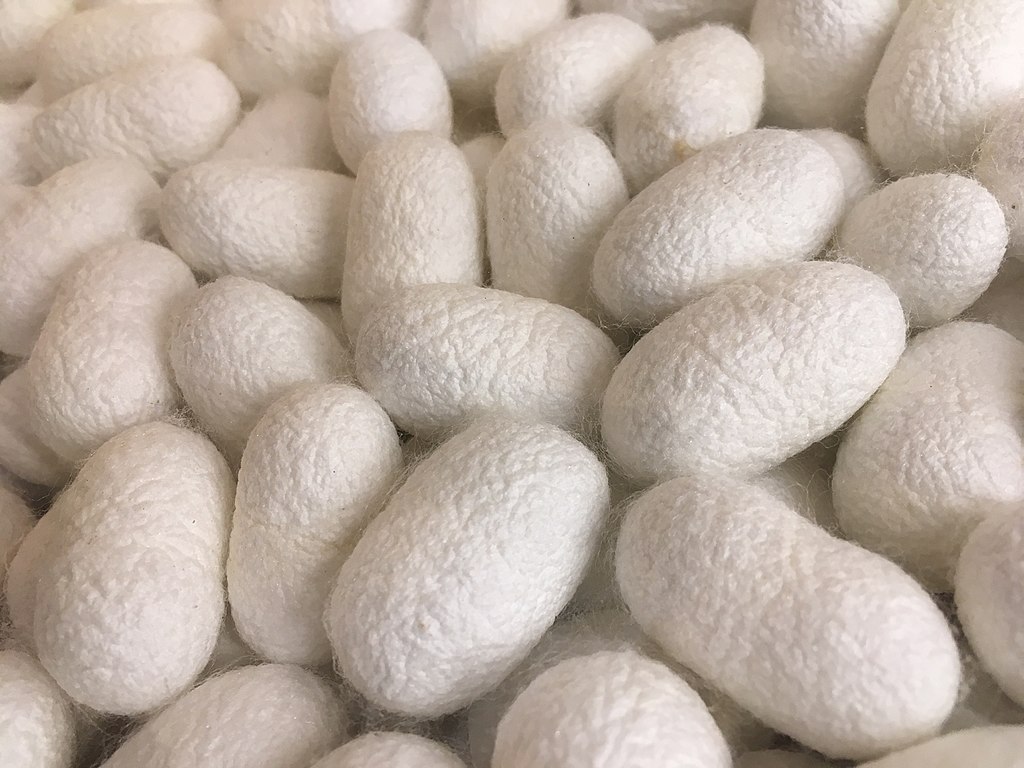
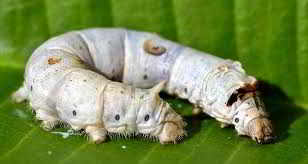
“Mulberry silk comes from the silkworm, Bombyx mori L. which solely feeds on the leaves of mulberry plant. These silkworms are completely domesticated and reared indoors” (Central Silk Board). “Silkworm has four stages in its life cycle viz., egg, caterpillar, pupa and moth. Man interferes this life cycle at the cocoon stage to obtain the silk, a continuous filament” (Central Silk Board). The Board’s life-cycle chart gives about 10 days for the young larvae, 14 for the late-age worms, 6 for spinning the cocoon on the mountage, and 10 to 12 more before a moth would emerge.
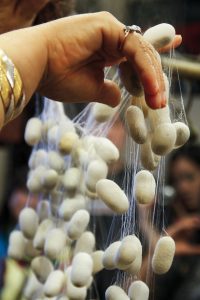
That moth is the problem: “A newly emergent moth will pierce the shell rendering the cocoon useless for conversion to raw silk”, so for reeled silk the cocoons are dried or steamed, which “kills the pupa”, and “pupae are killed within 30 minutes” in steam (FAO, Silk reeling and testing manual). A hybrid cocoon weighs 1.8 to 2.5 g, and its silk shell is 19 to 25% of that weight in newer hybrids.

How silk is reeled
One cocoon filament is too fine to use alone. “Silk reeling is the process by which a number of cocoon baves are reeled together to produce a single thread. This is achieved by unwinding filaments collectively from a group of cooked cocoons” in warm water and winding them on a reel (FAO). Cooking softens the sericin so the filament unwinds; “Range of total length is from 600 to 1 500 m of which 80 percent is reelable while the remainder is removed as waste” (FAO). The Central Silk Board puts the longest at 1,600 m.
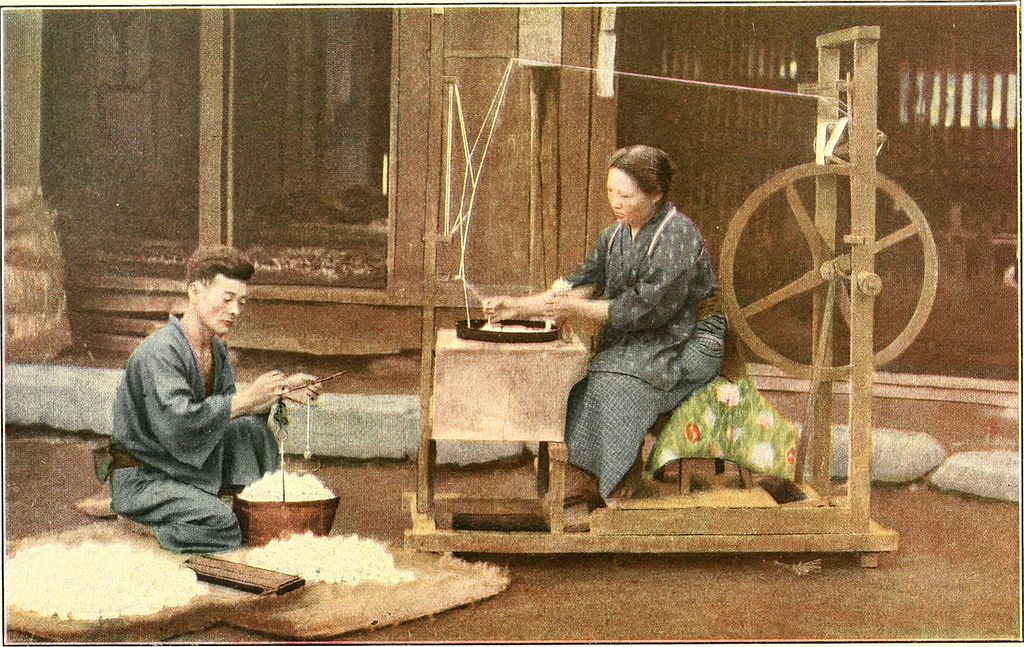

How many cocoons make a kilogram? The trade measures this by weight, as renditta: the kilograms of fresh cocoons needed for one kilogram of raw silk. FAO’s worked example uses a renditta of 9 for multivoltine cocoons and a silk percentage of 17 for bivoltine cocoons, about 5.9 kg of cocoons per kilogram of silk (FAO). At about 2 g a cocoon, that is roughly 3,000 bivoltine cocoons for a kilogram of raw silk (this page’s arithmetic).
Waste silk, broken filament and pierced cocoons are not reeled but spun, like wool or cotton, into spun silk. The site’s guide to Bhagalpuri silk weaving follows one Indian cluster from yarn to cloth.
What silk is made of
“The silk filament forming the cocoon shell is composed of two brins (proteins) named fibroin and covered by silk gum or sericin. The amount of sericin ranges from 19 to 28 percent according to the type of cocoon” (FAO); measured on the whole cocoon, sericins are “25-30% of the total silkworm cocoon by weight” (Rockwood and colleagues, Nature Protocols, 2011). Fibroin is rich in the small amino acids glycine and alanine, and “The dominance of the β-sheet-forming regimes within the fibroin structure impart the protein-based materials with high mechanical strength and toughness” (Rockwood and colleagues).
Degumming removes the sericin: “The sericin, or gum, is removed by boiling the fibers in soapy water or a dilute alkali” (CAMEO, silk), and with it the colour of yellow or golden cocoons, which “washes away with the sericin” (FAO). In section each mulberry brin looks like an equilateral triangle “with rounded corners”, the two facing each other at their bases (FAO).

Properties of silk
| Property | Value |
|---|---|
| Filament length per cocoon | 600–1,500 m, 80% reelable |
| Tenacity | 3.6–4.8 g/den for a single bave; raw silk 2.6–4.8 g/den; degummed silk stronger than raw |
| Wet strength | “decreases about 20 percent when wet and regains its original strength after drying” |
| Elongation at break | 18–23% (raw silk) |
| Density | Raw silk 1.32–1.40 g/cm³; degummed 1.30–1.38 |
| Moisture regain | 11%, “the accepted moisture regain coefficient for silk”; EU allowance 11.00% |
| Heat | White silk starts to yellow after 15 minutes at 110 °C; disintegrates at about 170 °C |
| Light | “Continuous exposure to light weakens silk faster than cotton or wool” |
| Chemicals | Hydrolysed by acid more than by alkali, least between pH 4 and 8; chlorine “attacks fibroin more vigorously than does sodium hypochlorite”; damaged even by weak alkali such as soap |
| Electricity | “a poor conductor of electricity”, so it builds static |
Silk’s strength is often overstated. It is strong for its fineness, but the old claim that it is “as strong as the wire of equal thickness” is not supported, and linen, at 40 to 80 cN/tex, is stronger. The site’s fibre list compares the figures.
Worked example: grams per denier into megapascals. FAO’s middle figure, 4.0 g/den, is about 35 cN/tex. At a density of 1.35 g/cm³, the textile unit converter shows that as 472.50 MPa and a breaking length of 35.69 km. Wet, about 20% weaker, 28 cN/tex is 378.00 MPa. Raw silk is sold by denier, and a 20-denier thread is, in the count converter, 2.22 tex, or Nm 450: 450 kilometres of thread to the kilogram.
Wild silks: tasar, eri and muga
Besides mulberry silk, India produces the “vanya” or wild silks, which come from silkworms that are not, or only partly, domesticated (Central Silk Board, vanya silk):
- Tasar “is generated by the silkworm, Antheraea mylitta which mainly thrive on the food plants Asan and Arjun”; China’s oak tasar “comes from another silkworm which is known as Antheraea pernyi” (CSB, tasar).
- Eri “is a multivoltine silk spun from open-ended cocoons, unlike other varieties of silk”, from Philosamia ricini, which “feeds mainly on castor leaves” (CSB, eri). Because the moth leaves the cocoon, eri is the silk most often sold as “ahimsa” or “peace” silk; no certification scheme defines that term.
- Muga, “This golden yellow colour silk”, comes from Antheraea assamensis; “Assam accounts for more than 95% of the muga silk production”, the rest from neighbouring north-eastern states and Cooch Behar (CSB, muga). “Muga Silk of Assam” is a registered geographical indication (IP India).
Wild silks look different under the microscope: they “have a flat and ribbon-like structure with an oval to rectangular cross-section, while the cross section of BM filaments has a triangular shape” (Scientific Reports, 2023), and they resist chemicals that dissolve mulberry silk: “Wild silks, such as tussah silk, are not completely soluble in 75 % m/m sulphuric acid” (Regulation 1007/2011, Annex VIII).
How to wash and iron silk
- By hand: “Soak your silk garment in lukewarm water (for 10 minutes maximum). Preferably use a special detergent for silk or a mild soap. Gently rub the stains. Then rinse it with clear water” (clevercare, GINETEX).
- By machine, only if the label allows: “Choose a ‘wash by hand’ programme, without a spin cycle, and use a detergent recommended for silk” (clevercare).
- Drying: “Silk should not be twisted to dry”; hang it or lay it flat, “away from direct sunlight and heat” (clevercare).
- Ironing: inside out, “using a low iron, as high temperature might result in scorching or burning (the shiny effect)” (clevercare). On the care label, two dots, 160 °C, is the “wool/silk/polyester/viscose” setting (GINETEX symbol index).
- No chlorine bleach, which attacks fibroin (FAO).
How to tell real silk
- Burn test: “Silk burns readily with an unsteady flame. It smells like burnt hair. The ash is readily crumbled” (CAMEO). Polyester imitations melt instead, at 250 to 260 °C. See fibre identification tests.
- Microscope: “raw silk appears as two strands that are held together with sericin protein” (CAMEO); degummed mulberry silk is a smooth filament of triangular section. See the microscopic appearance of fibres.
- The label. In India, “Silk Mark is a Quality Assurance Label, which signifies that the product to which it is affixed is made of pure silk”, for yarn, saris, dress materials and furnishings “made up of 100% Natural silk” (Ministry of Textiles, via PIB, 2022). In the EU, “100%” and “pure” may only be used for products of a single fibre, and “silk” may not be used to describe the look of a continuous filament yarn of another fibre (Regulation 1007/2011, Articles 5 and 7).
Where silk is produced
The International Sericultural Commission puts world raw silk production at 97,351 tonnes in 2024 (provisional): China 50,500 and India 41,121, together about 94% (ISC; this page’s arithmetic). “India is the second largest producer of silk and also the largest consumer of silk in the world” (Central Silk Board).
| India, raw silk, tonnes | 2023-24 | 2024-25 | 2025-26 |
|---|---|---|---|
| Mulberry, bivoltine | 9,675 | 10,160 | 11,229 |
| Mulberry, multivoltine | 20,217 | 20,959 | 21,021 |
| Tasar | 1,586 | 1,884 | 1,768 |
| Eri | 7,183 | 7,886 | 7,766 |
| Muga | 252 | 232 | 249 |
| Total | 38,913 | 41,121 | 42,033 |
| Raw silk imported | 2,650 | 2,036 | 2,627 |
Mulberry silk was three-quarters of India’s output in 2024-25, and eri almost a fifth. “Karnataka, Andhra Pradesh, West Bengal, Tamil Nadu and Jammu & Kashmir … together accounts for 92 % of country’s total mulberry raw silk production” (CSB). India imported raw silk worth ₹1,002.03 crore in 2024-25.
A short history of silk
- About 8,500 years ago, chemical traces of silk protein were found in soil from tombs at Jiahu, China: “The direct biomolecular evidence reported here showed the existence of prehistoric silk fibroin, which was found in 8,500-year-old tombs” (Gong and colleagues, PLoS ONE, 2016). This is residue, not surviving cloth.
- Byzantium. The historian Procopius tells how monks “coming from India” brought silkworm eggs from “Serinda” to the emperor Justinian, and “caused them to be transformed into worms, which they fed on the leaves of the mulberry” (Procopius, History of the Wars VIII.17). He gives no year; later scholars date it to about 552.
- Japan and Europe. “The worms were first cultivated in Japan about 195 CE and in Europe about 555 CE” (CAMEO).
Uses of silk
Saris, scarves, ties, shirting, linings and fine furnishings; the cloths are listed by name on the types of fabric page, from chiffon and organza to taffeta and charmeuse. Beyond clothing, silk is used for surgical sutures, and its proteins are a research material in medicine and engineering, as the site’s page on spider silk proteins describes. Old silk needs care: the site’s comparison of conservation cleaning treatments covers it.

Related on this site
- Natural protein fibres and a comparison of protein fibres.
- Wool, the other great animal fibre, and rayon, first sold as “artificial silk”.
- Bhagalpuri silk weaving, and the list of textile fibres.
Sources and corrections
- Definitions and labelling: Regulation (EU) No 1007/2011, Articles 5 and 7, Annexes I, VIII and IX; Press Information Bureau, Silk Mark, 22 August 2022.
- Sericulture, reeling and properties: FAO, Silk reeling and testing manual, Agricultural Services Bulletin 136 (Y.-W. Lee, 1999), chapters 2, 4, 6 and 10; D. N. Rockwood and colleagues, Materials fabrication from Bombyx mori silk fibroin, Nature Protocols 6, 2011; CAMEO, Museum of Fine Arts, Boston, silk; Degumming and characterization of Bombyx mori and non-mulberry silks, Scientific Reports, 2023.
- India and the world: Central Silk Board, silk, mulberry, vanya, tasar, eri and muga silk, production and trade; International Sericultural Commission, statistics; IP India, registered geographical indications.
- Care: GINETEX clevercare, silk hand washing, machine washing, drying, ironing and the care symbols index.
- History: Y. Gong and colleagues, PLoS ONE 11, e0168042, 2016; Procopius, History of the Wars VIII, translated by H. B. Dewing.
Change log. 6 October 2026: rewritten in full, with the site’s two other overviews of silk folded in. Corrected: silk is not “as strong as wire of equal thickness”, nor stronger than linen; muga comes mostly, not only, from Assam; the cocoon filament is 600 to 1,500 m long, of which 80% can be reeled. Added: India’s production by type, wild silks, sourced properties, care and identification.
Found an error? Please tell us through the contact page, naming the section and the source that disagrees.