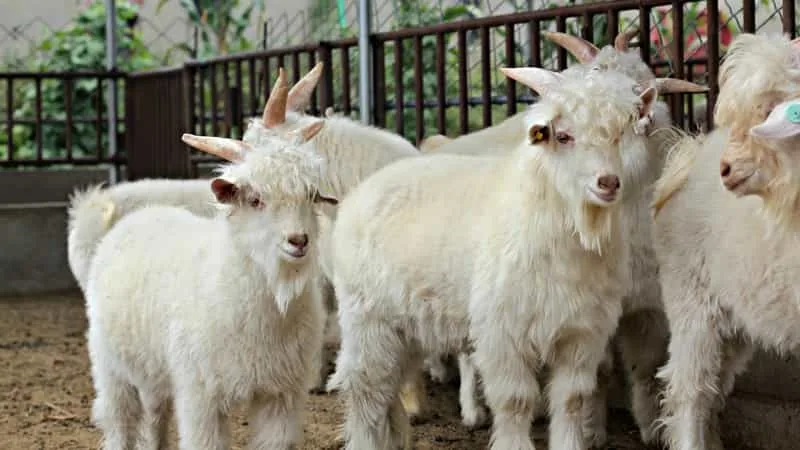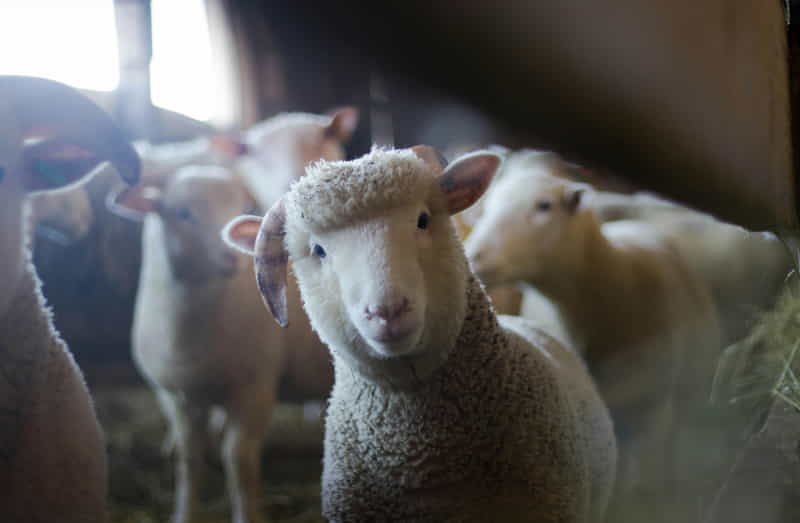
Protein fibres (protein fibers in American spelling) are textile fibres made of protein rather than cellulose or a synthetic polymer. The natural ones come from animals. The hair fibres are made of keratin: wool from sheep, and the speciality hairs such as cashmere and mohair from goats, alpaca, llama and camel hair from camelids, angora from the Angora rabbit, and yak. Silk is a filament of a different protein, fibroin, which the silkworm spins into its cocoon. A third group, the regenerated protein fibres, was spun in factories from milk casein and from groundnut, maize and soybean protein, mostly between the 1930s and the 1950s. Side by side, silk is much the stronger (27–40 cN/tex against 8–18 for wool) and, unlike the hair fibres, a continuous filament; only wool and the hair fibres felt, because only they have overlapping surface scales. Protein fibres are damaged by alkali and dissolved by chlorine bleach, and clothes-moth larvae eat wool and hair; silk is on their list too, though one museum database rates it moth-resistant. Wool’s agreed commercial moisture regain is 13.6%, silk’s 11%.
Last verified: 12 October 2026. Every figure is linked to the statute, standard, handbook, museum record or review it comes from, as that source gives it, with its basis. Where sources disagree, both are shown.
Protein fibres at a glance
| Fibre | Comes from | Mean fibre diameter, µm | Typical raw length | What marks it out |
|---|---|---|---|---|
| Wool | Fleece of the sheep, Ovis aries | Merino 15–27 | 7–12 cm (Merino) | Distinct surface scales; felts |
| Cashmere | Fine undercoat of the cashmere goat, separated from the coarse hair (dehaired) | 13–19 | 3–12 cm | US law caps the average at 19 µm |
| Mohair | Angora goat | 22–45 | 8–16 cm | Lustre; flat scales with little overlap; felts far less than wool |
| Alpaca | Alpaca (Huacaya and Suri types) | 17–45 | 4–15 cm | Hollow core (medulla) from low to very high |
| Llama | Llama | 20–45 | 6–12 cm | Medulla from low to very high |
| Camel hair | Bactrian camel | 18–26 | – | Mostly China and Mongolia |
| Angora | Angora rabbit (not the Angora goat) | 11–15 | 8–16 cm | Highly medullated, so lighter than other animal fibres |
| Yak | Yak | 18–21 | 5–10 cm | Tibet, China and Mongolia |
| Vicuña | Vicuña, a wild camelid | 12–14 | – | Among the finest animal fibres; Peru and Chile |
| Silk (mulberry) | Cocoon of the silkworm Bombyx mori | 15–20 (cocoon filament) | 600–1,500 m per cocoon (FAO); 250–750 m (CAMEO) | Two fibroin strands glued by sericin; reeled as a filament |
| Casein fibre | Milk protein, regenerated in a factory | 20–30 | – | Weak when wet; replaced by synthetic fibres |
Hair fibres: B. A. McGregor, Properties, Processing and Performance of Rare Natural Animal Fibres (Rural Industries Research and Development Corporation, 2012), tables 1.1 and 2.1; cashmere limit, 16 CFR 300.19. Silk: FAO, Silk reeling and testing manual. Casein: CAMEO, the materials database of the Museum of Fine Arts, Boston. British wools run much coarser than Merino; the wool fibre page gives them breed by breed.
What is a protein fibre?
A protein fibre is one whose fibre-forming substance is protein: long chains of amino acids joined by peptide bonds. EU fibre-naming law lists the natural protein fibres as wool, “fibre from sheep’s or lambs’ fleeces”; the hair of named animals (alpaca, llama, camel, cashmere goat, Angora goat, Angora rabbit, vicuña, yak, guanaco, cashgora goat, beaver and otter); the hair of other animals, such as cattle hair, common goat hair and horsehair; and silk, “fibre obtained exclusively from silk-secreting insects”. The manufactured ones have a name of their own, protein: “fibre obtained from natural protein substances regenerated and stabilised through the action of chemical agents” (Regulation (EU) No 1007/2011, Annex I). United States rules call them azlon, “a manufactured fiber in which the fiber-forming substance is composed of any regenerated naturally occurring proteins” (16 CFR 303.7).
Protein carries nitrogen; pure cellulose does not. Animal fibres typically carry 16–17% nitrogen and 3.2–3.7% sulphur (McGregor, citing Ward and colleagues, 1955, and Carr and colleagues, 1986). Laboratories use the difference to measure a blend of jute with wool or hair: the EU method takes 16.2% nitrogen for the animal fibre and 0.22% for jute (Regulation 1007/2011, Annex VIII, method 12; ISO 1833-15).
Keratin and fibroin: the two proteins
Wool and every hair fibre are keratin. Keratins are, in the definition N. H. Leon quotes from Lundgren and Ward, “natural, cellular systems of fibrous proteins cross-linked by cystine sulphur”, and the ordered part of wool keratin is the α-helix (Leon, Journal of the Society of Cosmetic Chemists, 1972). The cross-links are disulphide bonds between cystine residues. Silk is fibroin, a protein of a quite different make-up: mostly glycine and alanine, with almost no cystine (FAO).
| Amino acid | Merino wool (keratin) | Mohair (keratin) | Silk fibroin |
|---|---|---|---|
| Glycine | 5.25 | 4.84 | 42.8 |
| Alanine | 4.10 | 4.03 | 32.4 |
| Serine | 9.66 | 7.83 | 14.7 |
| Tyrosine | 5.25 | 3.51 | 11.8 |
| Glutamic acid | 14.41 | 15.52 | 1.7 |
| Cystine | 12.02 | 9.70 | 0.1 |
The chemistry explains the behaviour. “Oxidizing agents attack the disulfide groups of the cystine in wool and increase the solubility of the wool in alkaline solutions” (Harris and Smith, US National Bureau of Standards, 1936). Fibroin’s chains are “densely packed without bulky side chains”, which FAO gives as the likely reason protein-digesting enzymes do not readily attack silk in fibre form. The silk filament is two fibroin strands glued by a second protein, sericin, 19–28% of the cocoon shell depending on the cocoon (FAO), which is boiled off in degumming (CAMEO). Nor are the hair fibres identical: sulphur measured 3.4% in cashmere, 4.2% in alpaca and 3.0–3.4% in Turkish mohair (McGregor, citing Harris and Smith, 1937, and Onions, 1962).
Examples of protein fibres
- Wool, from sheep: “by far the most commonly-used animal fibre” (McGregor). See the wool fibre page and the page on wool crimp.
- Speciality hair fibres: cashmere (with pashmina), mohair, alpaca, llama, camel hair, angora, yak, vicuña and guanaco. The site’s hair fibres and alpaca pages cover them one by one.
- Silk: mulberry silk from the domesticated Bombyx mori, and wild silks such as tussah. See the silk fibre page.
- Regenerated protein fibres: casein (Lanital, Aralac), groundnut (Ardil), maize zein (Vicara) and soybean fibre, described below.
Protein fibres compared: density, moisture regain, strength and stretch
Natural fibres vary with breed, fineness and test, so each figure is its source’s. Two kinds of moisture figure appear. A commercial regain is an agreed value, set in a standard, that trade uses to weigh fibre. A measured regain is what a sample actually holds, which depends on humidity and on whether the fibre is drying or taking up moisture: FAO gives silk 10% on adsorption (taking up moisture) and 11.1% on desorption (drying) at 65% relative humidity. Tenacity is breaking force divided by linear density.
| Fibre | Density, g/cm³ | Moisture regain | Tenacity, dry and wet | Elongation at break | Source |
|---|---|---|---|---|---|
| Wool | 1.30–1.31 (DNFI); 1.30–1.40 (FAO); 1.32–1.34 (CAMEO) | 13.6% commercial; EU allowance 17.00% carded, 18.25% combed | 8–18 cN/tex; lower when wet | 30–48% (FAO table); 25–40% in a 2021 review | DNFI sheet; IS 13157; EU Annex IX; FAO; Beckman et al.; McGregor |
| Silk (mulberry) | Raw 1.32–1.40; degummed 1.30–1.38 | 11% commercial; EU allowance 11.00% | 27–40 cN/tex; about 20% lower wet, recovered on drying | 18–23% (raw silk) | FAO; DNFI sheet; IS 13157; EU Annex IX |
| Cashmere | 1.31 (animal fibres generally) | Animal fibres generally 15–18% measured at 20 °C and 65% RH; EU allowance as wool | 8.3–11.2 cN/tex (tops of several origins) | – | McGregor |
| Mohair | 1.31 (animal fibres generally) | As cashmere | Higher than wool of the same diameter | Higher than wool of the same diameter | McGregor, citing Smuts and colleagues (1981) |
| Alpaca | 1.31 (animal fibres generally) | As cashmere | Huacaya stronger than Merino wool, Suri about equal; both weaker wet | Dry: Huacaya 37.4%, Suri 33.8%; wet: 51.2% and 43.5% | McGregor, citing Villarroel (1959) |
| Angora | About 1.20 | As cashmere | – | – | McGregor |
Three cautions. The regains measure different things: 13.6% for wool is a trade convention from ASTM D1909‘s 1985 table; McGregor’s 15–18% is what animal fibres generally hold in a standard laboratory atmosphere; the EU’s 17–18.25% is the allowance added to dry mass when a fibre-content label is calculated. The hair fibres’ strength figures come from different studies on different material, so they rank fibres rather than compare cleanly with wool’s range. And FAO’s own table puts the two main fibres on one basis: raw silk 2.6–4.8 g/den against wool 1.2–1.5, with wool stretching 30–48% and raw silk 18–23%. On the middle of each range, silk is about 2.7 times as strong for its weight, and wool stretches about twice as far.
Burning, alkali, acid, chlorine, felting and moths
| Wool and the hair fibres | Silk | Casein fibre | |
|---|---|---|---|
| In a flame | “difficult to ignite”, spreads slowly, goes out easily, fragile ash and “a characteristic warning smell” (McGregor); wool “chars producing the smell of burning hair” (CAMEO) | “burns readily with an unsteady flame. It smells like burnt hair. The ash is readily crumbled” (CAMEO); Leeder’s table, in McGregor, groups silk with wool as slow to burn | “Burns slowly and brightly in air, but extinguishes with removal of flame source”; odour of burning hair (CAMEO) |
| Alkali | “Damaged by alkalis” (CAMEO); an alkali-solubility test measures wool damage (Harris and Smith) | Soluble in hot, strong alkali; damaged even by soap (CAMEO) | Affected by alkalis (CAMEO) |
| Acid | Survives the 75% sulphuric acid that dissolves silk, which is how the two are separated in analysis (EU method 11) | Dissolved by 75% sulphuric acid; acid hydrolyses fibroin more than alkali does (FAO) | Insoluble in dilute acids (CAMEO) |
| Chlorine bleach | Dissolved by hypochlorite (EU method 2) | Dissolved by hypochlorite; “Chlorine attacks fibroin more vigorously than does sodium hypochlorite” (FAO) | Dissolved: EU method 2 covers regenerated protein too |
| Felting | Wool felts. Woven mohair shrank 1.9% against 33.0% for wool in Onions’s data; “cashmere does not felt like wool” (McGregor) | Does not felt: only scaled animal hairs do (van der Vegt) | Smooth filaments (CAMEO) |
| Clothes moths | Eaten (Potter); wool mothproofing treatments suit the speciality fibres too (McGregor) | Listed among clothes-moth foods (Potter); CAMEO rates silk “Resistant to moths” but “Susceptible to carpet beetles” | “not susceptible to moths but can be degraded by some bacteria” (CAMEO) |
Felting separates the fibres most in use. Van der Vegt put the cause in one line: “The special feature of animal hair fibres by which they and only they show felting power, is their scaliness”, which lets a fibre slide more easily towards its root than its tip, so rubbing in water walks the fibres into a tangle. Silk, a secreted filament and not a hair, falls outside that rule. The hairs’ scales differ too: Wortmann and colleagues (1988) measured scale edges 0.7–0.9 µm high on wool and around 0.3 µm on mohair, cashmere, camel, alpaca and yak (McGregor). Flatter scales are why mohair is lustrous and felts slowly, though “prolonged machine washing is equally harmful to wool and mohair fabrics”.
Wool vs silk
| Wool | Silk | |
|---|---|---|
| Protein | Keratin, cross-linked by cystine (12% of Merino wool) | Fibroin, mostly glycine and alanine, almost no cystine; coated with sericin |
| How it is collected | Shorn from the sheep as a fleece of staple fibres, 7–12 cm long in Merino | Reeled from the cocoon as one filament of 600–1,500 m, about 80% of it reelable, after the pupa inside is killed |
| Fineness | Merino 15–27 µm | Cocoon filament 15–20 µm on average |
| Strength for its weight | 1.2–1.5 g/den | Raw silk 2.6–4.8 g/den |
| Stretch before breaking | 30–48% | 18–23% (raw silk) |
| Commercial regain | 13.6% | 11% |
| Felting | Felts when rubbed warm and wet | Does not felt |
| Light | – | “Continuous exposure to light weakens silk faster than cotton or wool” |
The two are collected so differently that one is a staple fibre and the other a filament. A fleece is shorn, scoured, then carded or combed and spun. A cocoon is the silkworm’s own continuous filament, so the cocoons are dried or steamed, which kills the pupa, before the moth can emerge: “A newly emergent moth will pierce the shell rendering the cocoon useless for conversion to raw silk” (FAO). About a fifth of each filament cannot be reeled and is removed as waste (FAO). The silk fibre page covers sericulture and reeling, the wool fibre page shearing and scouring.

The speciality hair fibres: how they differ from wool
Cashmere, mohair, alpaca and the rest are the same kind of fibre as wool: McGregor’s review concludes that “while there are differences in the morphological and chemical composition of wool, mohair, cashmere and alpaca the basic structural components are similar”. What separates them is fineness, the shape and height of the surface scales, and how much hollow core, or medulla, they carry.
- Cashmere is defined in US law by fineness: a wool product may be labelled cashmere only if the fibre is “the fine (dehaired) undercoat fibers produced by a cashmere goat”, averages no more than 19 microns, has no more than 3% by weight of fibres averaging over 30 microns, and a coefficient of variation of diameter no more than 24% (16 CFR 300.19).
- Mohair, from the Angora goat, is coarser (22–45 µm), lustrous, and stronger and more extensible than wool of the same diameter (Smuts and colleagues, 1981, in McGregor); its flat scales are why it felts so little.
- Alpaca comes as Huacaya and Suri. In Villarroel’s 1959 tests, Huacaya fibre was stronger than his Merino wool and more extensible than Suri, and Suri had the smoother surface. Heavily medullated fibres are weak (McGregor).
- Angora, from the rabbit, is highly medullated, often with several medulla channels, which brings its density down to about 1.20 g/cm³, against 1.31 for other animal fibres, which can affect blend ratios (McGregor, citing Blankenburg and Philippen, 1988).
- Camel hair, yak, vicuña and guanaco run 12–26 µm in McGregor’s table; the site’s hair and fur fibres page covers them.
Regenerated protein fibres: casein, groundnut, maize and soybean
Regenerated protein fibres are made by dissolving a protein and forcing it through a spinneret into a bath that sets it into fibre. Casein “is processed with formaldehyde or benzaldehyde and metal salts then pressed through spinnerets” (CAMEO). The first commercial one was Lanital, Snia Viscosa’s casein fibre from the work of the Italian chemist Antonio Ferretti, “patented in 1935 and sold in 1936” (CAMEO, Lanital). Aralac, an American casein fibre, followed in the 1940s; ICI made Ardil from groundnut protein from 1951 to 1957; and Vicara, from maize zein, was sold from 1948 to 1957 (CAMEO, Aralac, Ardil and zein fiber).
| Fibre | Made as | Tenacity, cN/tex | Wet strength | Elongation | Density, g/cm³ | Regain |
|---|---|---|---|---|---|---|
| Casein (milk) | Lanital, Italy, from 1936; Aralac, US, 1940s | 8.0–9.7 | 0.3–0.6 g/den against 0.9–1.1 dry | 60–70% | 1.3 | 14.0% |
| Groundnut | Ardil, ICI, UK, 1951–1957 | 6.2–8.0 | – | 40–60% | 1.31 | 15.0% |
| Zein (maize) | Vicara, US, 1948–1957 | 10.6 | 0.65 g/den against 1.2 dry | 25–35% | 1.25 | 10.0% |
| Soybean | Trials in Japan (1940) and the US (1945); never commercially produced | 7.0 | 0.25 g/den against 0.8 dry | 50% | – | 11% |
Which are still made? The fibres in the table are historical. CAMEO records that Lanital, “along with other regenerated protein fibers”, was replaced by synthetic fibres “because casein fibers are weak when wet and susceptible to microbiological growths”, and Vynias that after the Second World War cheap petroleum fibres ended up “marginalising the commercial outlook of man-made protein fibres”. The revival he describes is a different product: modern soybean fibre “is a man-made regenerated protein fibre from soybean protein blended with PVA” (polyvinyl alcohol, a synthetic polymer), for which “a production line has already been established in China”, citing the producer, Huakang, in 2005. Whether it, or the yarns sold today as milk fibre, are made in volume now, the sources read here do not say. More on their manufacture: regenerated protein fibres. For trade, India’s IS 13157 gives “azlon (modified natural proteins)” a commercial regain of 10.0%, and the EU gives “protein” an agreed allowance of 17.00%.
Worked example: the weight of a wool and silk yarn
Because wool and silk hold different amounts of water, a wool and silk yarn is not invoiced at the weight on the scale but at a commercial weight: the oven-dry mass plus an agreed regain for each fibre, in proportion to its share. ASTM D1909’s tables are “intended primarily for determining the commercial weight of a specific fiber when the fiber is bought or sold on this basis”.
Take 1,000 kg of a 60/40 wool and silk yarn that a laboratory finds holding 12.0% moisture on its dry weight (an assumed figure, found by oven-drying a sample, to ASTM D1576 for wool). Its oven-dry mass is 1,000 ÷ 1.12 = 892.86 kg.
- With the commercial regains of IS 13157 (wool 13.6%, silk 11.0%), the blend’s regain is 0.6 × 13.6 + 0.4 × 11.0 = 12.56%, and the blend invoice weight calculator gives a commercial weight of 1,005.00 kg: the lot is drier than the agreed condition, so the invoice is 5 kg more than the scale.
- On the EU’s labelling allowances (combed wool 18.25%, silk 11.00%), the blend’s allowance is 15.35% and the same calculator counts the same dry fibre as 1,029.91 kg. That basis is not an invoice table: EU law applies these allowances to each fibre’s dry mass to work out the fibre composition declared on a label (Regulation 1007/2011, Article 19(3) and Annex IX).
The two bases differ by 24.91 kg on the same yarn, and the fibre matters as much: the same 892.86 kg of dry fibre is 1,014.29 kg at wool’s 13.6% but 991.07 kg at silk’s 11%. A contract for a protein-fibre blend should name both its regain table and the blend ratio. The moisture regain calculator turns a laboratory’s wet and dry weights into the measured regain.
What the chemistry means for washing, processing and storage
- Keep alkali away. Scouring animal fibres too hot or with alkaline chemicals yellows them, and non-ionic detergents rather than alkaline soaps reduce the yellowing (McGregor). Silk is damaged even by soap (CAMEO).
- Never use chlorine bleach. Hypochlorite dissolves every protein fibre; that is how laboratories remove them from a blend (ISO 1833-4).
- Wash wool and hair gently. Warmth, water and rubbing felt them; mohair and cashmere felt less than wool, but prolonged machine washing harms mohair as much (McGregor). The wool fibre page gives the care routine.
- Keep silk out of the sun. Light weakens silk faster than cotton or wool, and white silk starts to yellow after 15 minutes at 110 °C (FAO).
- Clean before storing. “Woolens and other susceptible items should be dry-cleaned or laundered before being stored for long periods” (Potter).
How to identify protein fibres
Identification answers three narrowing questions: is it a protein fibre; is it silk or hair, and how much of each is in a blend; and which animal did the hair come from.
The burn test: protein, cellulose or synthetic?
| Fibres | Burning behaviour |
|---|---|
| Cotton, linen, viscose | Burns very easily |
| Acrylic | Burns readily, melts and then drips |
| Polyester, nylon | Shrinks and melts away from the flame, drips |
| Wool, mohair, cashmere, silk, other animal fibres | Slow to start, slow to burn |
Hold a few fibres in tweezers at the edge of a small flame, away from anything flammable. A protein fibre smells of burning hair and leaves a soft ash that crumbles, as the CAMEO and McGregor descriptions above record; a thermoplastic melts and drips; cellulose burns fast. That is all a burn test tells you: it cannot separate wool from cashmere, and a blend burns as a mixture of its parts. The site’s fibre identification tests page compares the common fibres.
Chemical tests: protein from the rest, and silk from wool
- Hypochlorite dissolves wool, animal hair, silk and regenerated protein and leaves cotton, viscose, acrylic, polyamide, polyester and the other fibres listed; “If different protein fibres are present, the method gives the total of their amounts but not their individual quantities” (Regulation 1007/2011, Annex VIII, method 2; ISO 1833-4).
- 75% sulphuric acid dissolves silk and leaves wool and animal hair (EU method 11; ISO 1833-18). The EU text warns that “Wild silks, such as tussah silk, are not completely soluble in 75 % m/m sulphuric acid”.
- Nitrogen content gives the proportions in a blend of jute with wool or hair, because the animal fibre carries about 16.2% nitrogen and jute only about 0.22% (EU method 12; ISO 1833-15).
- Alkali solubility measures damage, not identity: Harris and Smith’s test treats wool with “a 0.1 N solution of sodium hydroxide at 65° C for 1 hour”, and the more dissolves, the more the wool has been oxidised. India’s current method is IS 3429.
Chemistry stops at the species. Satlow (1965) compared cystine and cysteic acid, alkali and urea-bisulphite solubility and the action of acids, alkalis and enzymes on sheep’s wool, alpaca, camel hair, cashmere and mohair, and concluded that the differences were insignificant (McGregor).
Microscopy: wool, cashmere, mohair or yak?
To name the animal, a laboratory looks at the fibres. ASTM’s identification standard said microscopy is “indispensable for positive identification of the several types of cellulosic and animal fibers, because the infrared spectra and solubilities will not distinguish between species” (ASTM D276, withdrawn in 2021). The analyst measures diameter and reads the scale pattern, scale height and medulla under a light microscope (ISO 17751-1) or a scanning electron microscope (ISO 17751-2). It takes skill: an International Wool Secretariat round robin in 1972 found that sheep’s wool and mohair could not be told apart by optical microscopy alone, and mislabelling has a long record. Von Bergen reported that two-thirds of products declared as 100% cashmere in 1955–1958 were wrongly labelled, and of the samples analysed for fibre content at the DWI in Aachen in 1990–2003, 70% carried incorrect labels (all in McGregor, section 5.8).
The standard methods for fibre identification and analysis
- AATCC TM20-2021, Test Method for Fiber Analysis: Qualitative (physical, chemical and microscopical identification), and AATCC TM20A-2025, Test Method for Fiber Analysis: Quantitative (moisture, non-fibrous content and fibre composition).
- ISO/TR 11827:2012, Textiles — Composition testing — Identification of fibres.
- ISO 1833-4:2023, Mixtures of certain protein fibres with certain other fibres (method using hypochlorite); ISO 1833-18:2020, Mixtures of silk with wool or other animal hair (method using sulfuric acid); ISO 1833-15:2019, Mixtures of jute with certain animal fibres (method by determining nitrogen content).
- ISO 17751-1:2023 and ISO 17751-2:2023, Quantitative analysis of cashmere, wool, other specialty animal fibres and their blends, by light microscopy and by scanning electron microscopy.
- ASTM D2130-22, Diameter of Wool and Other Animal Fibers by Microprojection; ASTM D1909-13(2026), commercial moisture regains. ASTM D276 (identification, withdrawn 2021) and ASTM D629 (Quantitative Analysis of Textiles, withdrawn 2024) are no longer active.
Questions
What are protein fibres?
Protein fibres are textile fibres made of protein. The natural ones are animal fibres: wool and the other hair fibres, made of keratin, and silk, made of fibroin. Regenerated protein fibres, such as casein fibre, were made in factories from milk, groundnut, maize and soybean protein.
Which protein is wool made of?
Wool is made of keratin, the protein family of hair, horn, hooves and feathers. Wool keratin is rich in the sulphur-containing amino acid cystine, about 12 g per 100 g in Merino wool; its disulphide cross-links hold the keratin chains together, and they are what oxidising bleaches attack. So yes, wool is a protein fibre.
What are examples of protein fibres?
Wool; the speciality hairs cashmere, mohair, alpaca, llama, camel hair, angora, yak and vicuña; mulberry silk and the wild silks such as tussah; and the regenerated protein fibres made from casein, groundnut, maize zein and soybean.
What is the difference between wool and silk?
Wool is a keratin hair shorn from sheep as short, scaled staple fibres, so it felts and stretches far before breaking. Silk is a fibroin filament reeled from the silkworm’s cocoon; it does not felt, is about 2.7 times as strong for its weight on FAO’s figures, and holds a little less moisture (11% against wool’s 13.6% commercial regain).
Are regenerated protein fibres still made?
The classic ones are not: Lanital, Aralac, Ardil and Vicara were replaced by synthetic fibres. CAMEO gives casein fibre’s weakness when wet and microbial attack as the reason, and Aralac’s low strength and poor abrasion resistance; Vynias points to the cheap petroleum fibres that came after the Second World War. A soybean fibre of soy protein blended with polyvinyl alcohol went into production in China in the 2000s; the sources read here do not establish how much of it, or of today’s milk fibre yarns, is made now.
Sources
- Reviews and handbooks: B. A. McGregor, Properties, Processing and Performance of Rare Natural Animal Fibres, RIRDC publication 11/150, Deakin University, 2012; FAO, Silk reeling and testing manual, section 2.3, and cocoon drying; N. H. Leon, Structural aspects of keratin fibres (1972); D. Vynias, Soybean fibre (2011); M. Zimniewska and A. Kicińska-Jakubowska, animal fibers sheet, Discover Natural Fibres Initiative; I. P. Beckman and colleagues, Polymers 13, 2231 (2021).
- Research papers: M. Harris and A. L. Smith, Oxidation of wool: alkali-solubility test (1936); A. K. van der Vegt, A study on the mechanism of wool felting (1955).
- Museum records: CAMEO, Museum of Fine Arts, Boston (archived copies): wool, silk, casein fiber, Lanital, Aralac, Ardil, zein fiber.
- Law and standards: Regulation (EU) No 1007/2011, Annexes I, VIII and IX; 16 CFR 300.19; 16 CFR 303.7; Bureau of Indian Standards, IS 13157:1991; the methods listed under standard methods, titled and dated as their publishers’ catalogues give them.
- Extension: M. F. Potter, Clothes moths, University of Kentucky ENTFACT-609.
How this page is kept
Last verified: 12 October 2026. Fibre dimensions and the speciality hairs’ properties come from McGregor’s 2012 review, which names each study it tabulates; silk’s from the FAO manual; amino acids from Leon (1972) and FAO; the regenerated fibres from Vynias (2011) and the CAMEO records. Commercial regains are IS 13157:1991’s, labelling allowances EU Regulation 1007/2011’s, and standard titles and editions were read from the publishers’ catalogues. Both prefilled calculator links were opened on this date to check the figures quoted. If you find an error, please tell us through the contact page.