Introduction
Twist insertion turns loose fibers into a cohesive yarn by rotating them around the yarn axis so they spiral and interlock, raising fiber-to-fiber friction, strength and stability. Twist is counted in twists per inch (TPI) or per meter (TPM) and related to yarn count by the twist multiplier, TM = TPI / √Ne. Ring, rotor, air-jet and friction spinning each insert twist differently, which shapes yarn strength, texture and production speed [Textile World, 2022].
Principles of Twist Insertion
Twist insertion involves rotating fibers around their longitudinal axis, causing them to spiral and interlock, thereby enhancing cohesion and strength. The degree of twist is quantified by the number of twists per unit length, typically expressed as twists per inch (TPI) or twists per meter (TPM). The twist level is influenced by the twist multiplier (TM), which relates twist to yarn count and is calculated as:
Where:
- TM: Twist multiplier, a dimensionless value.
- TPI: Twists per inch.
- Ne: English cotton count (number of 840-yard hanks per pound).
A higher TM results in a harder, stronger yarn, while a lower TM produces a softer, bulkier yarn. Twist direction, denoted as “S” (left-hand twist) or “Z” (right-hand twist), also affects yarn appearance and performance [Fibre2Fashion, 2023].
Significance of Twist Insertion
Twist insertion serves several key functions in yarn production:
- Strength Enhancement: Twist increases fiber-to-fiber friction, improving tensile strength.
- Cohesion: Interlocking fibers prevent slippage, ensuring yarn integrity.
- Elasticity and Flexibility: Moderate twist enhances yarn stretch and recovery properties.
- Aesthetic Properties: Twist affects yarn texture, influencing fabric drape and appearance.
The optimal twist level depends on the fiber type, yarn count, and intended application. For example, fine cotton yarns for shirting require high twist for strength, while coarse wool yarns for carpets use low twist for bulkiness.
Spinning Techniques and Twist Insertion Methods
Different spinning techniques employ unique methods of twist insertion, each tailored to specific production goals and yarn characteristics. Below is a detailed analysis of the major spinning techniques.
Ring Spinning
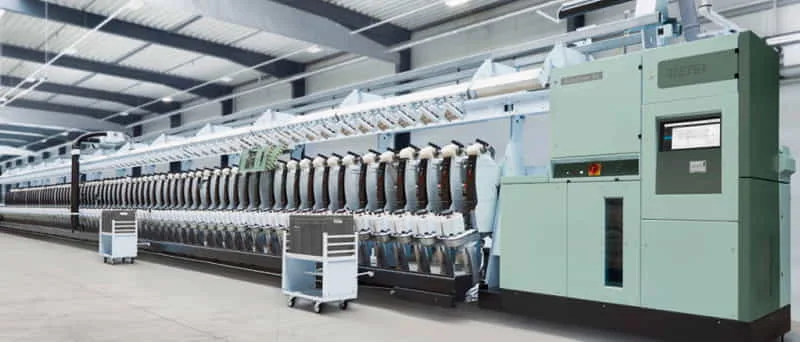
Process: Ring spinning is the most traditional and widely used spinning technique. Fibers are drafted through a series of rollers to reduce their thickness, then fed into a spinning zone where a rotating spindle inserts twist. The yarn is wound onto a bobbin via a traveler moving around a ring, creating true twist as the fibers spiral around the yarn axis.
Twist Insertion: The twist is inserted by the rotation of the spindle, with TPI controlled by the spindle speed and delivery rate of the drafted fibers. The formula for TPI is:
Advantages:
- Produces strong, uniform yarns with excellent tensile strength.
- Suitable for a wide range of fiber types and yarn counts.
- High-quality yarns ideal for fine fabrics like dress shirts.
Disadvantages:
- Slower production speed compared to modern techniques.
- Higher energy consumption due to mechanical components.
Applications: Apparel (shirts, suits), home textiles (bedding), and technical textiles [Textile Technology, 2023].
Rotor Spinning (Open-End Spinning)
Process: Rotor spinning is a high-speed, open-end technique where fibers are fed into a rotating rotor. Air currents deposit fibers onto the rotor’s inner surface, forming a fiber ring. As the yarn is withdrawn, twist is inserted, binding the fibers into a yarn.
Twist Insertion: Twist is generated by the rotor’s rotation, with the yarn forming a false twist initially, which becomes true twist as it is wound. The TPI is determined by:
Advantages:
- High production rates (up to 10 times faster than ring spinning).
- Cost-effective for medium to coarse yarns.
- Eliminates roving process, simplifying production.
Disadvantages:
- Lower yarn strength and uniformity compared to ring-spun yarns.
- Limited to coarser yarn counts.
Applications: Denim, towels, upholstery, and industrial textiles.
Air-Jet Spinning
Process: Air-jet spinning uses high-pressure air jets to entangle and twist fibers into yarn. Drafted fibers pass through a nozzle where swirling air currents create a false twist, wrapping outer fibers around a core of parallel fibers.
Twist Insertion: Unlike true twist, air-jet spinning produces a fasciated yarn structure with a core of untwisted fibers wrapped by twisted outer fibers. The effective twist level is controlled by air pressure and nozzle design.
Advantages:
- Extremely high production speeds (up to 400 m/min).
- Low hairiness, resulting in smooth yarns.
- Cost-effective for synthetic and blended yarns.
Disadvantages:
- Lower tensile strength due to false twist structure.
- Limited to finer yarn counts and specific fiber types (e.g., polyester, cotton blends).
Applications: Apparel (casual wear), home textiles (sheets), and technical fabrics [Sustainable Textile, 2024].
Friction Spinning
Process: Friction spinning involves feeding fibers onto a rotating perforated drum or disc, where friction between the drum and fibers imparts twist. The yarn is formed by layering fibers and twisting them as they are withdrawn.
Twist Insertion: Twist is generated by the frictional contact between fibers and the rotating drum, creating a layered yarn structure with variable twist levels.
Advantages:
- Versatile for producing coarse, specialty yarns.
- Can process waste fibers and unconventional materials.
- High bulkiness suitable for specific applications.
Disadvantages:
- Lower yarn strength and uniformity.
- Limited production speed and commercial adoption.
Applications: Carpets, blankets, and technical textiles (e.g., filtration fabrics).
Comparison of Spinning Techniques
The following table summarizes the key characteristics of the discussed spinning techniques:
| Technique | Twist Type | Production Speed | Yarn Strength | Applications |
|---|---|---|---|---|
| Ring Spinning | True Twist | Low | High | Apparel, Bedding |
| Rotor Spinning | True Twist | High | Moderate | Denim, Towels |
| Air-Jet Spinning | False Twist | Very High | Low | Casual Wear, Sheets |
| Friction Spinning | Variable Twist | Moderate | Low | Carpets, Filters |
Practical Considerations
Selecting a spinning technique depends on factors such as fiber type, yarn count, end-use requirements, and production costs. For instance, ring spinning is preferred for high-quality apparel due to its superior yarn strength, while rotor spinning is ideal for high-volume production of coarser yarns. Challenges in twist insertion include maintaining uniformity, minimizing energy consumption, and adapting to new fiber blends. Advances in automation and sensor technology are improving twist control and production efficiency [Textile Technology, 2024].
Sustainability in Spinning
Modern spinning techniques are increasingly focused on sustainability. Rotor and air-jet spinning consume less energy than ring spinning, reducing the carbon footprint. Additionally, friction spinning’s ability to process waste fibers supports circular economy principles. Manufacturers are also exploring bio-based fibers and low-impact processing to enhance environmental performance.
Twist Insertion
The new spinning systems clearly avoid the limitations produced by the twist insertion mechanism. It is possible to increase the twist insertion rate
and the yarn production speed quite considerable. This increase is shown in the following:
| Spinning System | Actual twist inserting rate (rpm) | The system is limited by | |
|---|---|---|---|
| Twist insertion rate | Doffing & transport | ||
| Ring | 15,000-24,000 | Yes | No |
| Wrap | 25,000-35,000 | Yes | No |
| Rotor | 80,000-1,50,000 | Yes | Partly |
| Air-Jet | 1,50,000-2,50,000 | No | Yes |
| Friction | 2,00,000-3,00,000 | No | Yes |
End Products Different Spinning Technique
| Methods/End-use | Open-end/Rotor | Wrap | Friction | Air-jet | Ring |
|---|---|---|---|---|---|
| Shirting | ✓ | ✓ | ✓ | ||
| Bedding | ✓ | ✓ | ✓ | ||
| Outer Wear | ✓ | ✓ | ✓ | ✓ | |
| Sports wear | ✓ | ✓ | ✓ | ||
| Blankets | ✓ | ✓ | ✓ | ||
| Knitted goods | ✓ | ✓ | |||
| Decorative Fabrics | ✓ | ✓ | |||
| Carpeting | ✓ | ✓ | ✓ | ||
| Woolen | ✓ | ✓ | ✓ | ||
| Worsted | ✓ | ||||
| Industrial Textiles | ✓ | ✓ | ✓ | ||
| Waste Processing | ✓ | ✓ | ✓ | ||
| Fiber | Short | Medium Long | All | Long Synthetic | All |
Conclusion
Twist insertion is a cornerstone of yarn production, with each spinning technique offering unique methods to achieve desired yarn properties. Ring spinning provides unmatched strength, rotor spinning excels in speed, air-jet spinning prioritizes smoothness, and friction spinning offers versatility for specialty yarns. By understanding the mechanics and applications of these techniques, textile professionals can optimize production, improve yarn quality, and align with sustainability goals. Continued innovation in spinning technologies will further enhance efficiency and adaptability, meeting the evolving demands of the global textile industry.