

Rayon is a fibre made from cellulose, usually wood pulp, that is dissolved and then regenerated as a fibre. It is neither natural nor synthetic: the raw material is a plant polymer, but the fibre is made in a factory. “Rayon” is the US name; in Europe the same fibre is called viscose, after the viscose process that makes most of it (16 CFR 303.7; Regulation (EU) No 1007/2011). Rayon is soft, drapes well, absorbs more moisture than cotton and dyes brightly, but ordinary viscose loses about half its strength when wet, so it shrinks and stretches if washed roughly. Modal and lyocell are newer forms that stay strong wet. Together these fibres made 8.4 million tonnes in 2024, 6% of the world’s fibre, and viscose was 80% of that (Textile Exchange).
Below: the questions readers ask first (is rayon natural, is it the same as viscose, how to wash it, is “bamboo” rayon), then the types, how viscose is made and what it costs the environment, sourced properties, uses, producers, history and identification. Two of the site’s calculators are worked through.
Last verified: 6 October 2026. Sources are linked where they are used and listed at the end.
Is rayon natural or synthetic?
Neither. Rayon is a manufactured fibre, but not a synthetic one: it is cellulose, the same polymer as cotton, taken from wood and reshaped. US law defines it as “A manufactured fiber composed of regenerated cellulose” (16 CFR 303.7(d)). That is why it behaves more like cotton than like polyester: “Rayon has many properties similar to cotton and can also be made to resemble silk” (Britannica, rayon). It burns like paper rather than melting, and it absorbs water. The difference from cotton is in the structure: regeneration leaves the cellulose in a less ordered form, with crystallinity of 30 to 40% in viscose against 50 to 65% in lyocell (Varnaitė-Žuravliova and Baltušnikaitė-Guzaitienė, Journal of Functional Biomaterials, 2024), and water gets into it easily: “Readily penetrated by water, the fibre swells and loses strength when wet” (Britannica).
Rayon, viscose, modal, lyocell, cupro: the names
| Name | What the law says (EU Regulation 1007/2011, Annex I) |
|---|---|
| Viscose | “regenerated cellulose fibre obtained by the viscose process for filament and discontinuous fibre” |
| Modal | “a regenerated cellulose fibre obtained by a modified viscose process having a high breaking force and high wet modulus”, with minimum strength values set by formula |
| Lyocell | “a regenerated cellulose fibre obtained by dissolution, and an organic solvent (mixture of organic chemicals and water) spinning process, without formation of derivatives” |
| Cupro | “regenerated cellulose fibre obtained by the cuprammonium process” |
All four carry an EU agreed moisture allowance of 13% (Annex IX). In the United States all of them are rayon, and “the term lyocell may be used as a generic description” for fibre spun from an organic solvent without chemical intermediates (16 CFR 303.7(d)). The word itself was a marketing choice: “rayon” was chosen in 1924 by the National Retail Dry Goods Association to replace “artificial silk” (Online Etymology Dictionary). The site’s page on modal and lyocell covers those two in more depth.
Is “bamboo” fabric rayon?
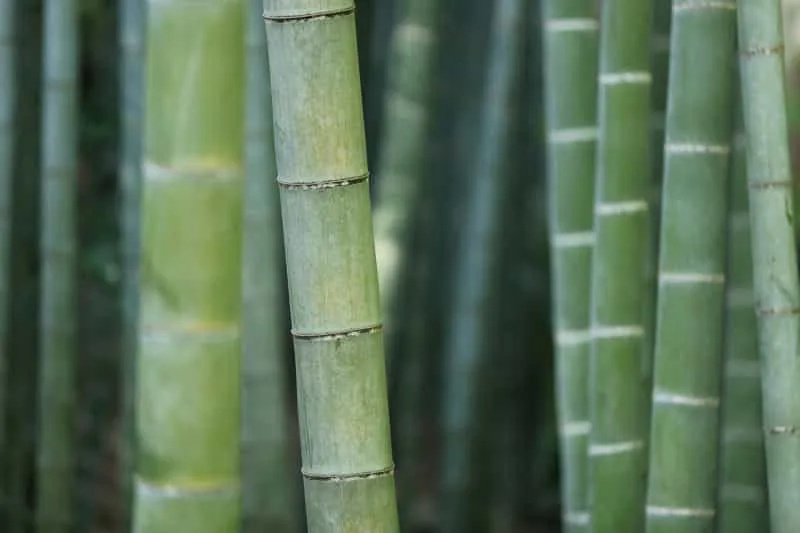
Almost always. The US Federal Trade Commission’s guidance is blunt: “most ‘bamboo’ textile products, if not all, really are rayon”, and “While different plants, including bamboo, can be used as a source material to create rayon, there’s no trace of the original plant in the finished rayon product”. Such fabric must be labelled with the fibre’s generic name, “such as rayon, or ‘rayon made from bamboo'” (FTC, How to Avoid Bamboozling Your Customers). Claims that bamboo fabric is naturally antibacterial or biodegrades like the plant describe the plant, not the rayon.
How to wash rayon
Gently, because ordinary viscose is weak when wet. Ohio State University’s extension service put it plainly: “The distinguishing property of regular rayon is its low wet strength. As a result, it becomes unstable and may stretch or shrink when wet”, and “If machine washed, untreated regular rayons can shrink as much as 10 percent” (Ohio State University Extension, HYG-5538). Modal and other high-wet-modulus rayons, and lyocell, are much more robust.
- Read the label first: two fabrics both marked rayon can need very different care.
- Wash cool and gently. “Preferably wash your viscose clothes inside out, using a 30°C delicate setting. Do not soak your viscose garments” (clevercare, GINETEX). Squeeze, do not wring.
- Air dry. “Let your viscose garments air dry to preserve their original shape. Tumble drying and direct exposure to sunlight are not recommended” (clevercare).
- Iron on the reverse, on low heat, “to avoid scorching or burning (the shiny effect)” (clevercare).

Pros and cons of rayon
| Advantages | Drawbacks |
|---|---|
| Soft, smooth and drapey; can look like silk, cotton, wool or linen | Ordinary viscose loses about half its strength when wet |
| Absorbs more moisture than cotton: 11–14% regain against 7–8% | Shrinks, by up to 10% if untreated rayon is machine washed |
| Dyes easily to bright colours | Creases, like other cellulose fibres |
| Made from a renewable raw material, and biodegradable cellulose | The viscose process uses carbon disulphide, toxic to workers, and its wood supply has been linked to deforestation |
| Lyocell and modal keep their strength wet | Burns readily, with a limiting oxygen index of about 18 |
Types of rayon
- Regular viscose, the bulk of production: about 6.7 million tonnes in 2024 (Textile Exchange). Sold as staple fibre, spun like cotton, or as continuous filament yarn.
- Modal and high-wet-modulus rayon. “Modal fibres are manufactured by a modified viscose process with a higher degree of polymerization and modified precipitating baths … This leads to fibres with improved properties such as higher wet strength and better washability” (Shen, Utrecht University, 2011). About 0.2 million tonnes in 2024.
- Lyocell dissolves pulp directly in an organic solvent, N-methylmorpholine-N-oxide (NMMO), instead of converting it with carbon disulphide. Lenzing says that for its TENCEL lyocell “more than 99.8% of the solvent is recovered and fed back into the loop” (Lenzing, claim proof, October 2024). “Lyocell is the only regenerated cellulose fiber with a wet tensile strength reaching the cotton wet strength” (Varnaitė-Žuravliova and Baltušnikaitė-Guzaitienė). About 0.4 million tonnes in 2024.
- Cupro, from cellulose dissolved in copper and ammonia. “There was only one supplier of cupro, which produced around 0.02 million tonnes in 2024” (Textile Exchange).
- Acetate is a relative but not a rayon: the cellulose stays chemically modified as an ester. About 1.1 million tonnes in 2024, “mainly used for non-textile applications” (Textile Exchange).
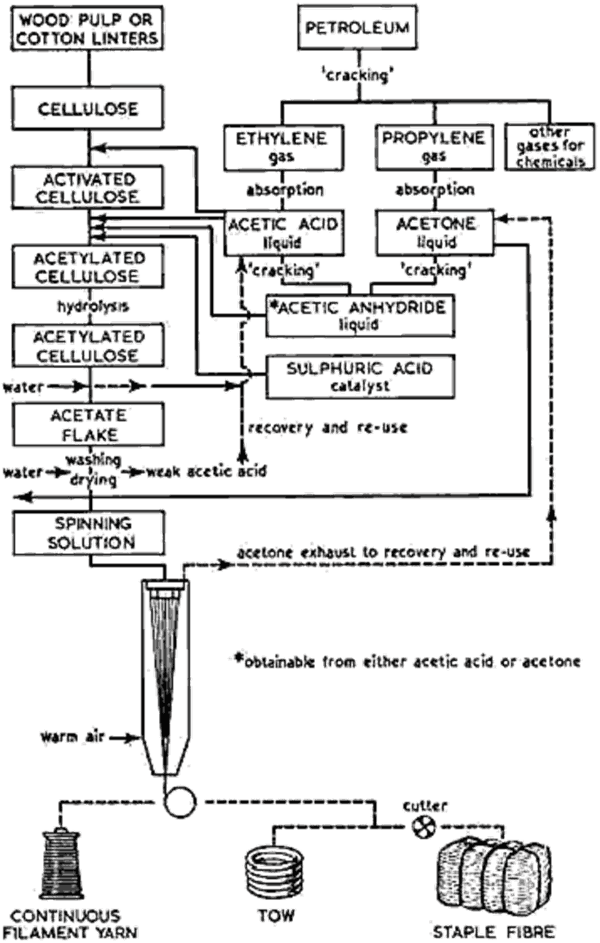
How viscose rayon is made
The EU’s reference document on the industry summarises it: “the alkaline pulp is treated with carbon disulphide (CS2) and dissolved by adding sodium hydroxide solution. A viscous orange-brown solution called ‘viscose’ is formed which is ripened, degassed and then pressed through spinnerets into a highly acidic spinning bath. Here, the cellulose precipitates when CS2 and the by-product H2S is released” (European Commission, BAT reference document for polymers, 2007, chapter 11). Step by step:
- Steeping. Dissolving pulp from wood is mixed with sodium hydroxide, forming alkali cellulose; hemicelluloses dissolve out.
- Pressing, shredding and ageing. The alkali cellulose is pressed to about 50% dry content, shredded and “pre-ripened to gain an average degree of polymerisation and an even viscosity”.
- Xanthation. Carbon disulphide converts it to sodium cellulose xanthate.
- Dissolving and ripening. The xanthate dissolves in dilute sodium hydroxide to give viscose, which is filtered, ripened, de-aerated and filtered again.
- Wet spinning. The viscose is pumped through spinnerets into a bath of sulphuric acid with sodium sulphate and zinc sulphate, which decomposes the xanthate and regenerates cellulose fibre. A typical bath holds 80 g/l of sulphuric acid, 150 to 300 g/l of sodium sulphate and 10 to 20 g/l of zinc sulphate at 45 to 55 °C (Shen).
- Stretching, washing and cutting. The tow is stretched, desulphurised, washed, bleached, finished, and for staple cut to length, typically about 4 cm. Filament yarn is spun from spinnerets of “30 to more than 2000” holes.

Rayon and the environment
Carbon disulphide. “Carbon disulfide is used primarily as a solvent in the viscose rayon (about 65%) and cellophane (about 10-12%) industries”, and in exposed workers “the nervous system appears to be the critical target for carbon disulfide-induced toxicity” (WHO, Concise International Chemical Assessment Document 46, 2002). The EU reference document records 80 to 100 kg of CS2 consumed per tonne of staple fibre, with sulphur, sulphate and zinc emissions to air and water. Britannica notes that production “has declined in industrial countries because of environmental concerns connected with the release of carbon disulfide into the air and salt by-products into streams”. In 2017 the Changing Markets Foundation alleged that viscose manufacturers in several Asian countries were “dumping untreated wastewater, which is contaminating local lakes and waterways” (Changing Markets, Dirty Fashion).
Forests. Rayon’s pulp comes from trees, and the campaign group Canopy’s annual Hot Button Report grades producers on forest sourcing; it “has been, and continues to be, the primary MMCF sourcing analysis tool for the fashion sector with a focus on forests” (Canopy). Textile Exchange reports that 65 to 70% of man-made cellulosic fibre in 2024 came from FSC or PEFC certified or controlled wood, and 1.1% from recycled feedstock.
Lyocell avoids CS2 altogether, though the EU reference document adds a caution: its products “are different to the standard viscose fibre, and therefore this process should not be regarded as an environmentally compatible alternative to the viscose process”. The site’s carbon footprint calculator adds up a garment’s stages.
Properties of rayon fibres
| Fibre | Density, g/cm³ | Tenacity dry, cN/tex | Tenacity wet, cN/tex | Moisture regain |
|---|---|---|---|---|
| Viscose | 1.52–1.54 | 24–26 | 10–13 | 11–14% |
| Modal | 1.52–1.54 | 34–36 | 19–21 | 11.8% |
| Lyocell | 1.50 | 40–42 | 34–36 | 10–13% |
| Cotton, for comparison | 1.50–1.54 | 24–36 | 26–40 | 7–8% |
Ordinary viscose keeps only about 40 to 54% of its dry strength when wet, by these figures, so “loses about half its strength when wet” is fair; cotton gains strength wet, and lyocell loses little. Viscose’s limiting oxygen index is 18, and flame-retardant viscose made with additives reaches 28 to 30 (US patent 8,070,996). The site’s fibre list compares rayon with 33 other fibres.
Worked example: what wet weakness means in megapascals. Put viscose’s dry tenacity, 25 cN/tex, and a density of 1.52 g/cm³ into the textile unit converter: it is a stress of 380.00 MPa, or 2.83 g/den. Wet, at 11.5 cN/tex, the same fibre holds 174.80 MPa, 1.30 g/den: less than half, which is why a viscose garment can stretch out of shape in the wash.
Uses of rayon
- Clothing. “In apparel, rayon is used alone or in blends with other fibres in applications where cotton is normally used” (Britannica), and as filament yarn for drapey, lustrous fabrics. Grasim, India’s largest viscose filament yarn maker, names “georgettes, crepes, chiffons, and many more” (Grasim). Rayon is often blended with polyester; the fibre list works through invoicing a polyester and viscose lot.
- Nonwovens, hygiene and medical: wipes, surgical swabs, drapes, gauze and wound pads, where viscose’s absorbency counts (Varnaitė-Žuravliova and Baltušnikaitė-Guzaitienė).
- Industrial: “High-strength rayon … is made into tire cord for use in automobile tires”, and rayon is “blended with wood pulp in papermaking” (Britannica).
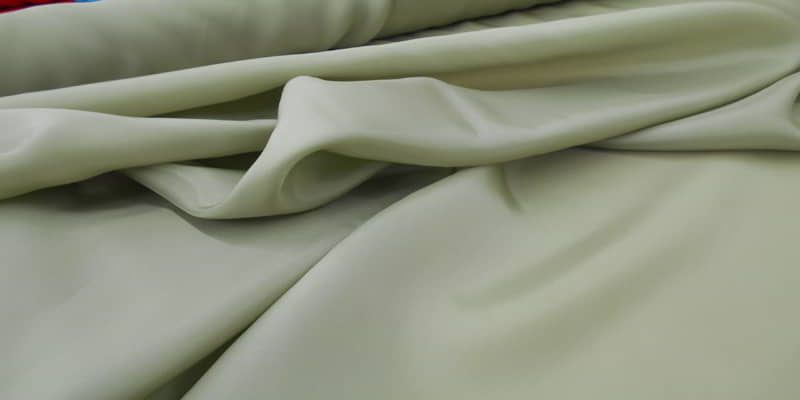
Worked example: a filament yarn count. Filament yarns are quoted in denier. A 120-denier viscose filament yarn is, in the count converter, 13.33 tex or 133.33 decitex, and would be Nm 75 or Ne 44.29 in the spun-yarn counts.
Production
Man-made cellulosic fibres grew from 7.9 million tonnes in 2023 to 8.4 million in 2024, and “Global MMCF production has more than doubled since 1990, when annual production was around 3 million tonnes” (Textile Exchange, Materials Market Report 2025). Of that, viscose was about 6.7 million tonnes, acetate 1.1 million, lyocell 0.4 million and modal 0.2 million. The largest producers describe themselves this way:
- Sateri, China: “the largest MMCF producer in the world”, with “annual capacity of 2.4 million metric tonnes (including Viscose and Lyocell)” (Sateri).
- Lenzing, Austria: nominal fibre capacity of 1,110,000 tonnes in 2025, under the brands TENCEL, LENZING ECOVERO and VEOCEL (Lenzing, March 2026).
- Grasim, India, the Aditya Birla Group’s fibre company, is “India’s largest” maker of cellulosic staple fibre, with about 890,000 tonnes a year of capacity at Vilayat, Kharach, Nagda and Harihar, and 51,000 tonnes of filament yarn at Veraval and Kalyan (Grasim, integrated annual report 2025-26). It calls itself “the largest viscose filament yarn (VFY) manufacturer in India and the third largest globally” (Grasim).
The site’s viscose staple fibre page covers staple manufacture in more detail.
A short history of rayon
- 1884–1891, “artificial silk”. Joseph Swan showed nitrocellulose fibres in London in 1884 and 1885; “In 1889 Chardonnet exhibited fibres made by squeezing a nitrocellulose solution through spinnerettes”, and “Manufacture of ‘Chardonnet silk,’ an early type of rayon and the first commercially produced man-made fibre, began in 1891 at a factory in Besançon” (Britannica).
- 1890s, cuprammonium. Louis-Henri Despeissis patented a cuprammonium process in 1890, and J.-P. Bemberg began production as “Bemberg silk” in 1908.
- 1891–1892, viscose. Charles Cross, Edward Bevan and Clayton Beadle discovered viscose, and patented it in 1892 (Science Museum Group). “By 1905 the British silk firm Samuel Courtauld & Company was producing this fibre”, and “In 1911 the American Viscose Corporation began production in the United States” (Britannica).
- 1924, the name “rayon”; 1998, industrial lyocell in Austria (EU reference document).
How to identify rayon
- Burn test: rayon “Burns with small flame, incandescent ash and odor of burnt paper” (CAMEO, viscose rayon), like cotton; see fibre identification tests.
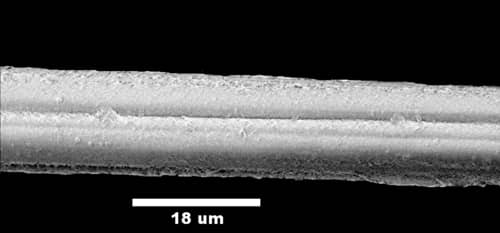
- Microscope: “Viscose fibers have continuous lengthwise striations”; their cross-sections “were originally circular with indentations; now may be dog bone or trilobal” (CAMEO), while lyocell is smooth and round in section. See the microscopic appearance of fibres.
- Blend analysis: viscose, cupro or modal are separated from cotton with sodium zincate to ISO 1833-5, and from certain other fibres with formic acid and zinc chloride to ISO 1833-6.
Related on this site
- Modal and lyocell, and viscose staple fibre manufacture.
- Cotton, the cellulose fibre rayon was made to rival, and polyester, its usual blending partner.
- Timeline of manmade fibres, and the list of textile fibres.
Sources and corrections
- Definitions and labelling: Regulation (EU) No 1007/2011, Annexes I and IX; 16 CFR 303.7; US Federal Trade Commission, How to Avoid Bamboozling Your Customers; Online Etymology Dictionary, rayon.
- Process, properties and environment: European Commission JRC, Reference Document on Best Available Techniques in the Production of Polymers, August 2007, chapter 11; L. Shen, Bio-based and recycled polymers for cleaner production, PhD thesis, Utrecht University, 2011 (with Lenzing’s fibre data); D. Varnaitė-Žuravliova and J. Baltušnikaitė-Guzaitienė, Journal of Functional Biomaterials 15, 348, 2024; Lenzing, TENCEL lyocell claim proof, 2024; US patent 8,070,996; WHO, CICAD 46, carbon disulfide, 2002; Changing Markets Foundation, Dirty Fashion, 2017; Canopy, Hot Button Report; Britannica, rayon.
- Market: Textile Exchange, Materials Market Report 2025; Grasim Industries, viscose filament yarn.
- Care and identification: Ohio State University Extension, HYG-5538, Rayon: the multi-faceted fiber; GINETEX clevercare, viscose washing, drying and ironing; CAMEO, viscose rayon; Science Museum Group, Clayton Beadle.
Change log. 6 October 2026: rewritten in full, with the site’s two other rayon pages folded in. Corrected: the first commercial man-made fibre was Chardonnet’s, made at Besançon from 1891, not artificial silk in the United States in 1911, which is when American Viscose began; the old process diagram showed cellulose acetate, not cuprammonium rayon, and is now captioned as such; world output is about 6.7 million tonnes of viscose, not “more than 4 million tons”. Removed: passages closely following an Ohio State University fact sheet, which is now cited directly where it is used.
Found an error? Please tell us through the contact page, naming the section and the source that disagrees.

Rayon is such an interesting fiber it has so much potential with its softness and versatility, but its environmental footprint and lower-quality uses have held it back. With cleaner production methods, though, it could strike a better balance between affordability and sustainability.