Virtual labs for textile education use simulations, VR, AR, and online platforms to teach fiber analysis, fabric construction, dyeing, and sustainable practices. Platforms like Gaston College’s Virtual Textile Academy and the Stereoscopic Chemical Laboratory offer accessible, eco-friendly learning, reducing resource use by up to 90%. These labs enhance engagement, safety, and scalability, preparing students for careers in sustainable textiles. This article explores their types, benefits, applications, and future trends, emphasizing their role in modern education.
Introduction to Virtual Labs in Textile Education
The textile industry, a cornerstone of global manufacturing, demands a workforce skilled in complex processes like fiber analysis, weaving, dyeing, and sustainable textile production. Traditionally, textile education relied on hands-on laboratory experiences, but the rise of virtual labs has transformed how students and professionals acquire these skills. Virtual labs for textile education leverage digital simulations, virtual reality (VR), augmented reality (AR), and interactive platforms to replicate physical lab environments, offering accessible, scalable, and eco-friendly learning opportunities. These platforms enable students to explore textile properties, experiment with manufacturing processes, and understand sustainability without the constraints of physical resources. This comprehensive article delves into the types, benefits, applications, and future trends of virtual labs in textile education, emphasizing their role in fostering sustainable practices and preparing learners for a dynamic industry.
Understanding Virtual Labs in Textile Education
Virtual labs are digital environments that simulate real-world laboratory settings, allowing students to conduct experiments, analyze materials, and explore textile processes through software, simulations, or immersive technologies like VR and AR. Unlike traditional labs, which require physical equipment, chemicals, and space, virtual labs provide a cost-effective, flexible alternative that can be accessed remotely. They incorporate interactive modules, 3D visualizations, and data-driven simulations to teach concepts such as fiber identification, yarn spinning, fabric construction, and eco-friendly dyeing techniques.
The adoption of virtual labs has been accelerated by advancements in digital technology and the need for accessible education, particularly during disruptions like the COVID-19 pandemic. These platforms not only replicate hands-on experiments but also integrate sustainability principles, teaching students about eco-friendly materials and processes like low-impact dyeing and recycled fiber use. By combining theoretical knowledge with practical application, virtual labs bridge the gap between classroom learning and industry demands, preparing students for careers in sustainable textiles.
Types of Virtual Labs for Textile Education
Virtual labs for textile education vary in design and functionality, catering to different learning objectives and technological capabilities. Below are the primary types, their features, and their educational applications.
Simulation-Based Virtual Labs
Simulation-based labs use software to replicate textile processes, allowing students to manipulate variables and observe outcomes in a controlled digital environment.
Features:
- Interactive modules for processes like weaving, knitting, dyeing, and finishing.
- Real-time data analysis to study fabric properties such as tensile strength, drape, and texture.
- Scenarios that mimic industry challenges, such as optimizing dye formulations or reducing water usage.
Examples:
- FASHSim Lab: Developed to focus on cotton fiber and fabric, this lab allows students to simulate textile production from field to finished product, analyzing properties like absorbency and durability.
- Textile Kit Online: Includes virtual lab assistants with study questions and table-top labs, enabling students to explore physical swatches alongside digital simulations.
Applications:
- Teaching fundamental textile processes like yarn spinning and fabric construction.
- Conducting experiments that would be resource-intensive in physical labs, such as testing dye fastness.
- Supporting group collaboration and data analysis skills for industry-relevant projects.
Sustainability Note: Simulations reduce the need for physical materials, cutting water and chemical waste by up to 90% compared to traditional labs.
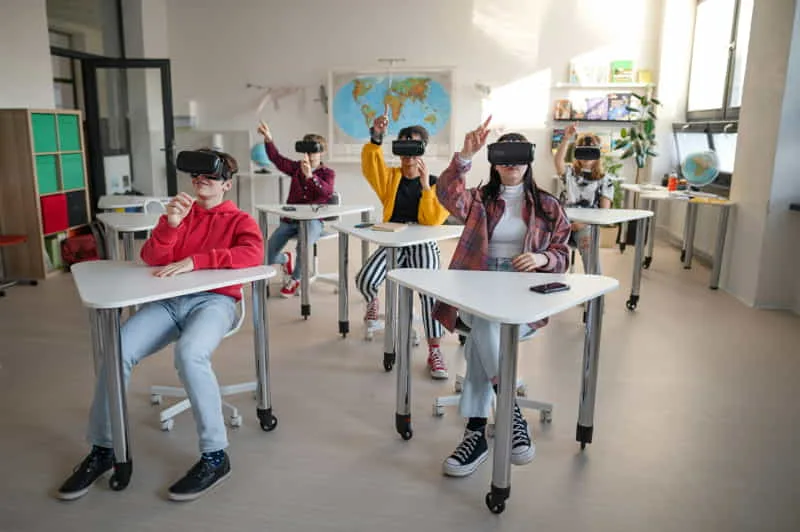
Virtual Reality (VR) Labs
VR labs immerse students in 3D environments, replicating textile labs or production facilities using headsets like the Pico Neo3 or Ultraleap technology.
Features:
- Stereoscopic 3D visualizations of textile structures, fibers, and machinery.
- Interactive experiments, such as dyeing or weaving, in a multisensory environment.
- Integration with AI to provide real-time feedback and guided learning.
Examples:
- Stereoscopic Chemical Laboratory (SCL): Developed for textile coloration and finishing, SCL allows students to conduct experiments in a 3D virtual lab, learning tools, processes, and safety protocols.
- Wilson College of Textiles VR Lab: Uses VR headsets to explore fabric structures, offering magnified views of fibers and weaves beyond traditional microscopy.
Applications:
- Visualizing complex textile structures, such as yarn twist or fabric weave patterns.
- Conducting hazardous experiments, like chemical dyeing, without safety risks.
- Enhancing engagement through immersive, game-based learning.
Sustainability Note: VR labs eliminate the need for physical chemicals and water, supporting eco-friendly education and reducing environmental impact.
Augmented Reality (AR) Labs
AR labs overlay digital information onto the physical world, enhancing hands-on learning with interactive elements accessed via smartphones or AR glasses.
Features:
- Real-time annotations of textile samples, highlighting properties like fiber composition or weave structure.
- Integration with physical swatches for hybrid learning experiences.
- Customizable simulations for designing textiles or analyzing performance.
Examples:
- CIRTex Virtual Textiles: Explores AR for simulating fabric attributes, such as drape and texture, to aid e-commerce and design education.
- Textile Academy AR Modules: Used for technical embroidery and smart textile systems, allowing students to visualize conductive threads and sensor integration.
Applications:
- Enhancing understanding of textile applications in fashion, interiors, and technical textiles.
- Supporting virtual garment fitting and design analysis for sustainable fashion.
- Facilitating remote collaboration for design projects.
Sustainability Note: AR reduces material waste by enabling digital prototyping, minimizing the need for physical samples.
Online Learning Platforms with Virtual Components
Online platforms combine video tutorials, interactive quizzes, and virtual labs to deliver comprehensive textile education.
Features:
- Self-paced courses covering fibers, yarns, fabrics, and sustainability.
- Interactive tools like clickable indexes for sample analysis and virtual lab assistants.
- Customizable learning pathways for individual or corporate training.
Examples:
- Gaston College Virtual Textile Academy: Offers stackable credentials with courses on weaving, knitting, dyeing, and sustainability, accessible online.
- NC State Textile Online Programs: Provide engaging, interactive courses with virtual components, led by distance education specialists.
Applications:
- Upskilling professionals in textile manufacturing and sustainability.
- Providing accessible education for students in remote or underserved areas.
- Supporting corporate training with tailored virtual labs.
Sustainability Note: Online platforms reduce travel-related carbon emissions and promote eco-friendly practices through modules on sustainable textiles.
E-Textile Virtual Labs
E-textile labs focus on smart textiles, integrating electronics and sensors for applications like wearable technology and medical textiles.
Features:
- Simulations of conductive threads and sensor integration.
- Virtual testing of e-textile performance, such as conductivity or thermal regulation.
- Collaborative platforms for interdisciplinary learning.
Examples:
- Textile Academy E-Textiles: Teaches technical embroidery and smart textile systems, with virtual labs for sensor design.
- SparkFun Education E-Textile Projects: Offers virtual labs for students to explore wearable electronics, enhancing STEM education.
Applications:
- Training students in wearable technology and smart textile design.
- Developing prototypes for medical or performance textiles.
- Encouraging innovation in sustainable e-textile solutions.
Sustainability Note: Virtual e-textile labs reduce the need for physical prototypes, minimizing electronic waste and resource consumption.
Benefits of Virtual Labs in Textile Education
Virtual labs offer numerous advantages for students, educators, and the textile industry:
- Accessibility: Online and VR labs allow students in remote areas to access high-quality education, with Gaston College’s Virtual Textile Academy serving as a prime example.
- Cost-Effectiveness: Eliminates the need for expensive lab equipment, chemicals, and maintenance, reducing costs by up to 70% compared to physical labs.
- Safety: Virtual environments allow students to experiment with hazardous processes like chemical dyeing without risks.
- Sustainability: Digital simulations reduce water, chemical, and material use, supporting eco-friendly education practices.
- Flexibility: Self-paced platforms accommodate diverse schedules, ideal for working professionals or students balancing multiple commitments.
- Engagement: Immersive VR and AR experiences enhance student engagement, with studies showing a 30% improvement in retention compared to traditional methods.
- Scalability: Virtual labs can train large groups simultaneously, supporting corporate upskilling and global education outreach.
Challenges and Solutions
Despite their benefits, virtual labs face challenges in textile education:
- Limited Hands-On Experience: Virtual labs may not fully replicate tactile learning. Solution: Combine virtual simulations with physical swatches, as seen in The Textile Kit’s hybrid approach.
- Technical Barriers: High costs for VR headsets or software compatibility issues. Solution: Use affordable platforms like mobile-based AR or browser-based simulations.
- Student Engagement: Online learning can feel isolating. Solution: Incorporate gamified elements and collaborative projects, as in SCL’s game-based VR labs.
- Sustainability Awareness: Limited focus on eco-friendly practices in some curricula. Solution: Integrate modules on sustainable textiles, as Gaston College does.
Applications in Textile Education
Virtual labs are transforming textile education across various domains:
- Fiber and Yarn Analysis: Students explore fiber properties and yarn spinning techniques through simulations, such as FASHSim Lab’s cotton-focused modules.
- Fabric Construction: Virtual weaving and knitting labs teach students about weave patterns and fabric structures, with Wilson College’s VR lab offering 3D visualizations.
- Dyeing and Finishing: SCL enables safe experimentation with coloration and finishing processes, emphasizing eco-friendly dyes.
- Sustainable Textiles: Courses on recycled fibers and low-impact dyeing promote circular economy principles, as seen in Gaston College’s curriculum.
- Smart Textiles: E-textile labs teach students to design wearable technologies, supporting innovation in medical and performance textiles.
- Fashion Design: AR labs enable virtual garment fitting and design analysis, reducing material waste in prototyping.
Case Studies
Case Study 1: Gaston College Virtual Textile Academy
Gaston College’s Virtual Textile Academy offers a stackable credentials program covering fibers, weaving, dyeing, and sustainability. Its self-paced, online format has trained over 500 students globally, with 90% reporting improved industry readiness. The program’s focus on eco-friendly practices, such as low-impact dyeing, aligns with sustainable textile goals.
Case Study 2: Stereoscopic Chemical Laboratory (SCL)
Developed by researchers at Hong Kong Polytechnic University, SCL uses VR to simulate textile dyeing and finishing experiments. Students reported a 25% increase in understanding of chemical processes and safety protocols, with the platform reducing physical lab waste by 85%.
Case Study 3: FASHSim Lab
The FASHSim Lab, focused on cotton textiles, combines virtual simulations with data analysis, enabling students to study fiber properties remotely. Initial testing showed a 20% improvement in student competency compared to traditional labs, with reduced resource consumption.
Future Trends in Virtual Labs for Textile Education
The future of virtual labs in textile education is shaped by technological and sustainability advancements:
- AI Integration: AI-driven virtual labs will provide personalized feedback and optimize learning paths, as seen in emerging fashion design platforms.
- Advanced VR/AR: Next-generation VR headsets and AR glasses will offer hyper-realistic simulations, enhancing textile structure analysis.
- Sustainable Focus: Increased emphasis on eco-friendly materials and processes, such as bio-based fibers and waterless dyeing simulations.
- E-Textile Innovation: Virtual labs will expand training in smart textiles, supporting applications in healthcare and wearable technology.
- Global Collaboration: Cloud-based platforms will enable international student collaboration, fostering innovation in sustainable textile design.
Choosing the Right Virtual Lab
When selecting a virtual lab for textile education, consider:
- Learning Objectives: Choose labs aligned with specific skills, such as dyeing (SCL) or smart textiles (Textile Academy).
- Technology Access: Ensure compatibility with available devices, favoring browser-based or mobile AR for affordability.
- Sustainability Integration: Prioritize platforms teaching eco-friendly practices, like Gaston College’s curriculum.
- Interactivity: Select labs with gamified or collaborative features to enhance engagement.
- Certification: Opt for programs offering recognized credentials, such as Gaston College’s stackable certificates.
Conclusion
Virtual labs for textile education are revolutionizing how students learn about fibers, fabrics, and sustainable practices. By leveraging simulations, VR, AR, and online platforms, these labs offer accessible, safe, and eco-friendly alternatives to traditional training. From Gaston College’s Virtual Textile Academy to the Stereoscopic Chemical Laboratory, these tools prepare students for the textile industry’s evolving demands while promoting sustainability. As AI, VR, and sustainable textiles advance, virtual labs will continue to shape the future of textile education, fostering innovation and environmental responsibility. For more insights into textile education and sustainable practices, visit TextileSchool.com, a leading resource for industry professionals and learners.
Citations
- “Virtual Textile Academy – Textile Technology Center.” Gaston.edu, www.gaston.edu/textile-technology-center/customized-training/virtual-textile-academy/. Accessed 9 Aug. 2025.
- “Professor Help – The Textile Kit.” TheTextileKit.com, www.thetextilekit.com/professor-help/. Accessed 9 Aug. 2025.
- “Home | Textile.org.” Textile.org, textile.org/. Accessed 9 Aug. 2025.
- “Virtual Textiles – Cirtex.” Cirtex.org, www.cirtex.org/virtual-textiles/. Accessed 9 Aug. 2025.
- “FASHSim Lab: Learning About Cotton From Field to Virtual Fashion.” RIT.edu, www.rit.edu/fashsim-lab/. Accessed 9 Aug. 2025.
- Lau, Kung Wong, et al. “Doing Textiles Experiments in Game-Based Virtual Reality: A Design of the Stereoscopic Chemical Laboratory (SCL) for Textiles Education.” International Journal of Information and Learning Technology, vol. 34, no. 3, 2017, pp. 242–258, www.emerald.com/insight/content/doi/10.1108/IJILT-01-2017-0002/full/html. Accessed 9 Aug. 2025.
- “Digitizing Textiles: Smooth as Silk?” Textiles.NCSU.edu, textiles.ncsu.edu/news/2023/digitizing-textiles-smooth-as-silk/. Accessed 9 Aug. 2025.
- “Fashion Simulation Lab: Development and Initial Testing of a Virtual Fashion Simulation Lab.” UDSpace.UDEL.edu, udspace.udel.edu/handle/19716/29745. Accessed 9 Aug. 2025.
- “Textile Online Programs: Providing a Rich, Engaging Learning Experience.” Online-Distance.NCSU.edu, online-distance.ncsu.edu/textile-online-programs/. Accessed 9 Aug. 2025.
- “Field to Virtual Fashion: Development and Initial Testing of a Virtual Textile Simulation Lab.” IASTateDigitalPress.com, www.iastatedigitalpress.com/jctl/article/12546/galley/11788/view/. Accessed 9 Aug. 2025.