1. Introduction
Modern infrastructure demands solutions that are strong, lightweight, cost-effective, and environmentally sustainable. Traditional materials like stone, concrete, and steel still dominate construction, but technical textiles—especially Geotech—are now integral to projects ranging from roads and bridges to landfills and coastal protection.
Geotech products provide reinforcement, separation, filtration, drainage, and containment, making them indispensable in transportation infrastructure, environmental protection, hydraulic engineering, and urban development.
2. What is Geotech?
Geotech is one of the 12 recognized categories of technical textiles, encompassing textiles used in geotechnical and civil engineering projects. These are engineered fabrics—often made from polymers or natural fibers—designed to interact with soil, rock, water, or other building materials to enhance structural performance.
Key characteristics:
- High tensile and tear strength
- Resistance to biological degradation and chemicals
- Long-term durability under load
- Controlled permeability for water flow
- Resistance to UV and weathering
3. Functions of Geotech Textiles
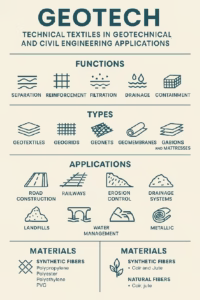
Geotech materials generally perform five core functions:
- Separation – Preventing the mixing of different soil layers (e.g., subgrade and aggregate in roads).
- Reinforcement – Strengthening soil and improving load distribution.
- Filtration – Allowing water to pass while preventing soil particle migration.
- Drainage – Conducting water away from structures.
- Containment – Encapsulating soil, sand, or other materials for stability.
4. Types of Geotech Products
Geotech includes several product families:
4.1 Geotextiles
- Woven Geotextiles – Made by weaving high-strength polypropylene or polyester yarns; excellent for reinforcement and separation.
- Nonwoven Geotextiles – Produced by needle-punching or heat-bonding fibers; ideal for filtration and drainage.
- Knitted Geotextiles – Less common, used in specialized reinforcement applications.
4.2 Geogrids
Polymer grid-like structures used for soil reinforcement in retaining walls, embankments, and road bases.
4.3 Geonets
Net-shaped polymer structures designed for drainage and gas venting.
4.4 Geomembranes
Impermeable polymer sheets used as liners in landfills, canals, and ponds to prevent leakage.
4.5 Geocomposites
Combination of geotextiles, geogrids, geonets, or geomembranes to achieve multiple functions in one product.
4.6 Gabions and Mattresses
Wire mesh containers filled with rock for erosion control and retaining walls.
5. Applications of Geotech Textiles
Geotech products are widely used in:
| Sector | Applications |
|---|---|
| Road Construction | Separation, subgrade stabilization, asphalt reinforcement |
| Railways | Trackbed stabilization, drainage layers |
| Erosion Control | Slope stabilization, shoreline protection |
| Landfills | Liner systems, leachate collection |
| Drainage Systems | Subsurface drainage, sports fields |
| Water Management | Canal lining, flood control, embankment protection |
| Foundations | Load distribution, soil reinforcement |
6. Materials Used in Geotech
- Synthetic Fibers: Polypropylene (PP), Polyester (PET), Polyethylene (PE), Polyvinyl Chloride (PVC).
- Natural Fibers: Coir, jute (for temporary erosion control).
- Metallic Components: Galvanized or PVC-coated steel wire (for gabions).
7. Manufacturing Techniques
- Weaving – Produces durable, high-strength fabrics.
- Needle-punching – Creates nonwoven structures with good permeability.
- Extrusion – For geogrids, geomembranes, and geonets.
- Coating/Laminating – Adds impermeability or UV protection.
8. Advantages of Geotech
- Increases structural stability
- Reduces maintenance costs
- Lightweight, easy to transport and install
- Environmentally friendly options available
- Extends lifespan of infrastructure
- Improves water management and erosion control
9. Global Market Overview
- Market size (2024): USD 18–20 billion
- CAGR: 6–7% expected through 2035
- Key growth drivers: Rapid infrastructure development, climate resilience projects, environmental regulations
- Leading regions: Asia-Pacific (China, India), Europe, North America
10. Sustainability in Geotech
- Use of biodegradable erosion control mats made from jute/coir.
- Recyclable polymer geotextiles.
- Reduced aggregate usage through soil stabilization.
- Improved drainage to prevent flooding and soil degradation.
11. Case Study: Geotextiles in Highway Construction
In a highway expansion project in the USA:
- Woven geotextiles were placed between the subgrade and aggregate layers.
- Result: Reduced aggregate requirement by 25%, improved pavement lifespan, and lowered maintenance costs over 10 years.
12. Challenges in Geotech
- High initial cost in some applications
- Counterfeit products with poor durability
- Need for skilled installation
- Disposal of synthetic materials after service life
13. Future Trends
- Smart Geotextiles – Sensors embedded to monitor strain, moisture, or temperature.
- Self-healing membranes – For long-term waterproofing.
- Nano-treated surfaces – For enhanced resistance to fouling or bio-growth.
- Fully biodegradable reinforcement mats – For eco-sensitive projects.
14. Conclusion
Geotech technical textiles are the unsung heroes of modern civil engineering. They may be hidden beneath roads, behind retaining walls, or under embankments, but their contribution to safety, durability, and sustainability is monumental. With advancing materials science and growing infrastructure needs, Geotech will continue to shape the landscapes—both natural and built—of the future.
FAQ
Geotech refers to technical textiles used in geotechnical, civil engineering, and environmental applications. These materials interact with soil, rock, and water to provide reinforcement, separation, filtration, drainage, and containment.
Examples include:
Woven and nonwoven geotextiles
Geogrids for soil reinforcement
Geonets for drainage
Geomembranes for waterproof lining
Gabions for erosion control
Geocomposites combining multiple functions
Common materials include:
Synthetic fibers: Polypropylene (PP), Polyester (PET), Polyethylene (PE), PVC
Natural fibers: Coir and jute for biodegradable erosion mats
Metallic: Galvanized or PVC-coated steel wire for gabions
They improve stability, extend structure lifespan, reduce maintenance costs, enhance drainage, prevent erosion, and allow lightweight yet strong engineering solutions.
Yes, many Geotech solutions use recyclable polymers or biodegradable natural fibers. They also reduce the need for raw aggregates, lowering the environmental footprint.
Applications include roads, railways, landfills, canals, flood protection systems, coastal defense, sports fields, and slope stabilization.
Woven geotextiles: 20–50 years
Nonwoven geotextiles: 15–30 years
Geomembranes: 20–40 years
Natural fiber mats: 2–5 years (biodegradable)
Future innovations will include smart geotextiles with embedded sensors, self-healing membranes, fully biodegradable reinforcement mats, and nano-enhanced materials for improved performance.