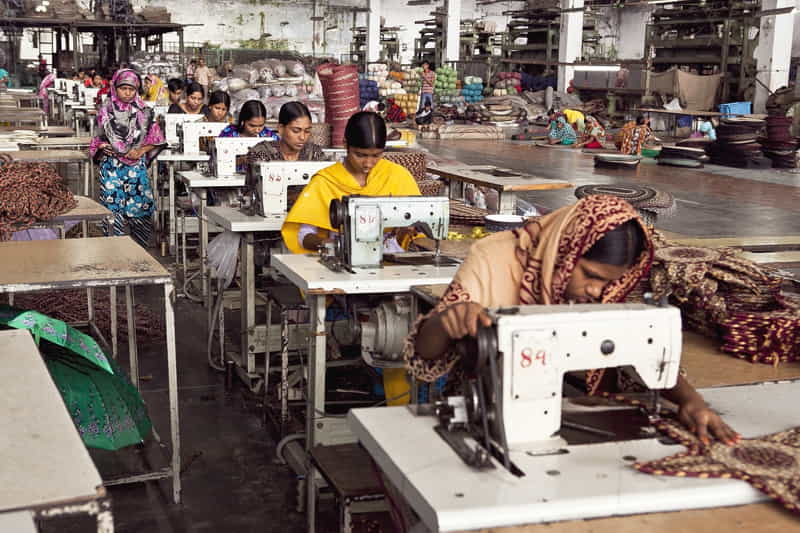
Textile manufacturing in Bangladesh vs Vietnam comes down to this: after China and the European Union, the two countries are the world’s largest clothing exporters, almost level, and they compete in different ways. In 2025 Bangladesh exported $38.8 billion of clothing and Vietnam $37.5 billion, by the World Trade Organization’s count, but Vietnam grew 10.5% that year and Bangladesh 0.9%, so the gap narrowed from $4.5 billion to $1.3 billion. Bangladesh competes on a wage floor about half of Vietnam’s and on duty-free entry to the European Union as a least developed country, and it depends on garments for about four-fifths of all its exports. Vietnam competes with a broader industry that also exports $13.6 billion a year of textiles (yarn, fabric and made-up articles), and with free trade agreements whose rules of origin reward fabric made in Vietnam, the EU or Korea. Both import almost all of their cotton and large amounts of yarn and fabric.
Last verified: 17 October 2026. Export figures are the WTO’s for calendar 2025 unless a fiscal year is named; wages, duties and trade rules are as they stood on that date. Sources are linked where each figure is used and listed at the end.
Textile manufacturing in Bangladesh vs Vietnam at a glance
| Measure | Bangladesh | Vietnam | Source and year |
|---|---|---|---|
| Clothing exports | $38.82 billion, 3rd after the EU and China | $37.51 billion, 4th | WTO, 2025 |
| Growth of clothing exports | +0.9% | +10.5% | WTO, 2025 over 2024 |
| Share of world clothing exports | 2.6% in 2000, 6.8% in 2025 | 0.9% in 2000, 6.5% in 2025 | WTO |
| Textile exports (yarn, fabric, made-ups) | Not in the world’s top ten | $13.60 billion, 4th after China, the EU and India | WTO, 2025 |
| Textile imports (yarn, fabric, made-ups) | $13.53 billion (WTO estimate), 4th largest importer | $20.21 billion, 3rd largest importer, after the EU and the US | WTO, 2025 |
| Raw cotton imports | 8.05 million bales | 7.98 million bales | USDA, 2024/25 season (480 lb bales) |
| Cotton grown at home | 153,000 bales | 3,000 bales | USDA, 2024/25 season |
| Garments in total exports | 80.6% (FY 2025-26) | Not compared here | EPB data via BGMEA |
| Statutory monthly minimum for garment workers | Tk 12,500 at entry grade, set from 1 December 2023, plus annual increments | VND 5,310,000 in Region I, VND 3,700,000 in Region IV, from 1 January 2026 | See wages |
| Entry to the EU | Duty-free under Everything but Arms while a least developed country | EU-Vietnam FTA since 1 August 2020; garments need EU, Vietnamese or Korean fabric | European Commission |
| US base duty on a cotton knit T-shirt | 16.5% | 16.5% | US HTS 6109.10.00, plus any additional duties in force |
The WTO’s clothing figures come from its World Trade Statistics 2025 tables (Table 22 for clothing, Table 21 for textiles), which put world clothing exports at about $574 billion in 2025. National figures differ from them because they use other product groups and other years: Bangladesh reports by fiscal year (July to June), and Vietnam’s industry association reports the whole textile and garment sector. The WTO also lists the EU as one exporter, first in clothing and ahead of China; reports that call Bangladesh the second largest clothing exporter set the EU aside. Compare like with like.
Which is bigger, and is Vietnam overtaking Bangladesh?
On clothing alone, Bangladesh is still bigger, but only just. The WTO’s 2025 table has Bangladesh at $38.82 billion and Vietnam at $37.51 billion, a gap of $1.31 billion. In 2024 the same series had Bangladesh at about $38.5 billion and Vietnam at about $33.9 billion. If Vietnam keeps growing faster, it passes Bangladesh; if Bangladesh recovers, it does not. No one can say which from one year of data.
On the whole textile and clothing industry, Vietnam is already bigger, because it also exports yarn and fabric: $13.6 billion of textiles in 2025 against clothing of $37.5 billion. Bangladesh does not appear among the top ten textile exporters at all, so its textile exports are under $5.5 billion, the figure for the tenth, Japan: a fraction of its $38.8 billion of clothing. So a claim that Vietnam has “overtaken” Bangladesh is true only when textiles are counted with clothing, and a claim that Bangladesh “keeps second place” counts clothing alone and sets the EU aside. Both can be true in the same year.
The long view explains the competition. In 2000 Bangladesh had 2.6% of world clothing exports and Vietnam 0.9%. By 2010 they had 4.2% and 3.0%. By 2025 they had 6.8% and 6.5%, while China’s share fell from 36.9% in 2010 to 27.3%. Vietnam gained faster.
The Vietnam textile industry
Vietnam’s textile and garment industry is a full chain with a gap in the middle. At the top it spins: Vietnam exported $13.6 billion of textiles in 2025, fourth in the world after China, the EU and India, and up 18.6% on the year in the WTO’s figures. At the bottom it sews, for the clothing exports above. The trade figures show the gap: Vietnam is also the world’s third largest importer of textiles, at $20.2 billion in 2025, so it buys about $6.6 billion more yarn, fabric and made-ups than it sells.

That fabric gap matters because of trade rules. The European Commission’s summary of the EU-Vietnam agreement says Vietnamese clothing gets its EU duty cut only if the fabric is produced in the EU, Vietnam or Korea, with the cuts on apparel phased in over up to seven years. The agreement entered into force on 1 August 2020. Fabric from Korea counts as Vietnamese under conditions set out in Annex V of the origin protocol, applied since 23 December 2020. A Vietnamese factory sewing Chinese fabric does not get the agreement’s rate.
The industry association VITAS estimated in November 2025 that the sector would export about $46 billion that year, with a trade surplus of about $21 billion, and put the share of materials sourced at home at about 52%. Those are the association’s own estimates for the whole textile and garment sector, so they are not comparable with the WTO’s clothing figure.
Finding a textile manufacturer in Vietnam
For a buyer looking for a cut-and-sew knitwear factory or a fabric mill in Vietnam, the member list of the industry association, VITAS, and the trade fairs are practical starting points, narrowed by product. Three questions sort suppliers faster than a factory tour. Where does the fabric come from? It decides whether the order qualifies for the EU preference. Which audits and certifications does the factory hold, and can you see the reports? And does the factory make the product category you need, at your order size, in its own lines rather than through subcontractors? The site’s guide to fabric sourcing in garment manufacturing covers the fabric side of that check.
The Bangladesh textile industry
Bangladesh’s textile industry is, for export purposes, its ready-made garment (RMG) industry. In fiscal year 2025-26 (July 2025 to June 2026) garments earned $38.70 billion, 80.6% of the country’s $48.00 billion of exports, according to Export Promotion Bureau data published by the garment manufacturers’ association BGMEA. Knitwear ($20.62 billion) has been larger than woven garments ($18.08 billion) since 2020-21. The EU took 49.3% of those garments and the United States 20.0%.
The export industry’s journey began around 1980. BGMEA’s own history says Desh Garments, one of the first export factories, was set up after 130 trainees were sent to South Korea in 1978 to learn garment production. From there it grew on low wages, on quota access to Western markets until the WTO’s Agreement on Textiles and Clothing and its quotas ended on 1 January 2005, and since then on duty-free access to the EU and other markets as a least developed country. Bangladesh grows very little cotton (153,000 bales in the 2024/25 season, USDA figures) and imported 8.05 million bales, so its spinning mills run on imported fibre. Its garment factories also buy yarn and fabric abroad: Bangladesh imported an estimated $13.5 billion of textiles in 2025, the fourth largest amount in the world.
The industry now also sells on certification. BGMEA reports 291 garment factories certified under the US Green Building Council’s LEED scheme, which it calls the world’s largest number. That is the association’s own count, not an audited national figure. The safety record after 2013 is the other half of that story.
Wages: what the minimum is in each country
Bangladesh sets a separate minimum wage for garment workers. The current scale was set at Tk 12,500 a month for the entry grade (grade five of five) from 1 December 2023, according to the government gazette as reported by The Daily Star, up from Tk 8,000 in 2018, as the Cornell Global Labor Institute’s February 2025 brief records. Annual increments are added from that base. Vietnam sets one regional minimum for all employees under labour contracts: Decree 293/2025/ND-CP, issued on 10 November 2025, raised it from 1 January 2026 to VND 5,310,000 a month (VND 25,500 an hour) in Region I, as the government news portal reports, the highest of four regions, down to VND 3,700,000 in Region IV.
At the US Treasury’s reporting rates of exchange for 30 September 2026 (Tk 124 and VND 25,959 to the dollar), Bangladesh’s entry-grade floor is about $101 a month, Vietnam’s Region I floor about $205 and its Region IV floor about $143. These are legal floors, not what factories pay: overtime, attendance bonuses, allowances and employer social insurance contributions where the law requires them all sit on top. They are still the fairest like-for-like starting point, because both are legal minimums that a garment factory must pay.
Worked example: what the wage gap does to the price of a T-shirt
A wage floor twice as high sounds decisive. Run it through a garment costing and it is not, because the fabric costs more than the sewing. The example below takes the knitted garment that the site’s knitted garment FOB costing calculator uses by default (0.36 kg of fabric at $6.50 a kg with 5% wastage, $0.85 of trims, 18.5 standard minutes to make, 10% overhead, 12% margin and 3% buying commission) and changes only the cost of a standard minute.
The minute rate here is the wage floor alone. Divide the monthly minimum by 12,480 minutes (26 working days of 8 hours, or 208 hours, which matches the ratio of Vietnam’s monthly and hourly minimums: 5,310,000 ÷ 25,500 = 208), convert at the Treasury rates above, and divide by an assumed 60% line efficiency, because a line paid for 60 minutes earns about 36 standard minutes in that time.
| Step | Bangladesh (entry grade) | Vietnam (Region I) |
|---|---|---|
| Monthly minimum | Tk 12,500 | VND 5,310,000 |
| Per minute worked (÷ 12,480) | Tk 1.00 | VND 425 |
| In US dollars | $0.0081 | $0.0164 |
| Per standard minute at 60% efficiency | $0.013 | $0.027 |
| Cut and make, 18.5 minutes | $0.24 | $0.50 |
| Fabric with wastage | $2.46 | $2.46 |
| Total direct cost | $3.55 | $3.81 |
| FOB price per piece | $4.50 | $4.83 |
The wage floor doubles the labour in the garment, from 24 cents to 50 cents, but moves its FOB price by 33 cents, about 7%. Fabric is $2.46 of the $3.55 of direct cost in both columns. Three things follow. A buyer choosing between the two countries on wages alone is arguing about a few cents a piece. A fabric price 10% lower, 25 cents here, is worth about as much as the whole wage gap, and so can a duty saving at the border. And productivity counts: the Vietnamese line at 75% efficiency would bring its minute rate to $0.022 and close about two-fifths of the gap.
The example is deliberately narrow. Real cut-and-make rates include supervisors, mechanics, power and the factory’s own costs, which is why the calculator’s default minute rate is $0.09, not $0.013. And it assumes the same fabric at the same price in both countries, when the fabric’s origin is exactly what decides the duty in the EU (next section). The site’s guide to garment costing builds a full costing line by line.
Trade rules: why the fabric’s origin decides the duty
European Union. As a least developed country, Bangladesh exports to the EU under Everything but Arms, which removes tariffs and quotas on all goods except arms and ammunition. Vietnam exports under the EU-Vietnam agreement, which needs EU, Vietnamese or (under conditions) Korean fabric, as above. For a buyer, a Bangladeshi garment enters the EU duty-free today under the scheme’s origin rules for least developed countries, while a Vietnamese garment gets the agreement’s rate only with qualifying fabric and a certificate of origin.
Bangladesh’s graduation. The UN General Assembly decided in November 2021 that Bangladesh, Laos and Nepal would leave the least developed country category after a five-year preparatory period, which ends on 24 November 2026. Bangladesh asked the UN Committee for Development Policy on 18 February 2026 for three more years, to 24 November 2029, and the committee supported an extension in June 2026; and in July 2026 the Economic and Social Council asked the General Assembly to decide before 24 November 2026, as reported in Dhaka. On 17 October 2026 that decision was still to come. Graduation does not end EU access at once: the EU’s GSP regulation gives a graduated country a three-year transitional period in Everything but Arms, as it did for Bhutan, which graduated on 13 December 2023 and leaves the scheme from 1 January 2028 under Delegated Regulation (EU) 2024/1363. The EU’s new GSP regulation, Regulation (EU) 2026/1395, which applies from 1 January 2027, keeps the three-year transition (Article 17) and eases the GSP+ entry criteria for countries leaving the least developed category.
United States. Neither country has a free trade agreement with the United States, so both pay the same base duty: 16.5% on a cotton knit T-shirt under HTS heading 6109.10.00, for example. Additional US duties on both countries have changed several times since 2025; the Supreme Court struck down the emergency-powers tariffs on 20 February 2026, and other duties have been imposed since. Read the current Chapter 99 lines of the tariff on the day of import rather than a figure from a news report. The site’s page on import-export regulations for textiles explains HS codes, duty and proof of origin in general.
Safety, labour and environment
The Rana Plaza building in Bangladesh collapsed on 24 April 2013, killing 1,138 workers and injuring more than 2,500, according to the ILO. What followed changed how Bangladesh’s garment industry is inspected: a national tripartite action plan on fire safety and structural integrity in 2013, inspections of thousands of factories for electrical, fire and structural safety, closure of the most dangerous, and amendments to the Bangladesh Labour Act within months. The ILO’s own assessment is that the industry has come a long way and that not all factories are yet up to the agreed standards. The private inspection programmes that brands signed are described in the site’s page on occupational safety standards in textile mills.
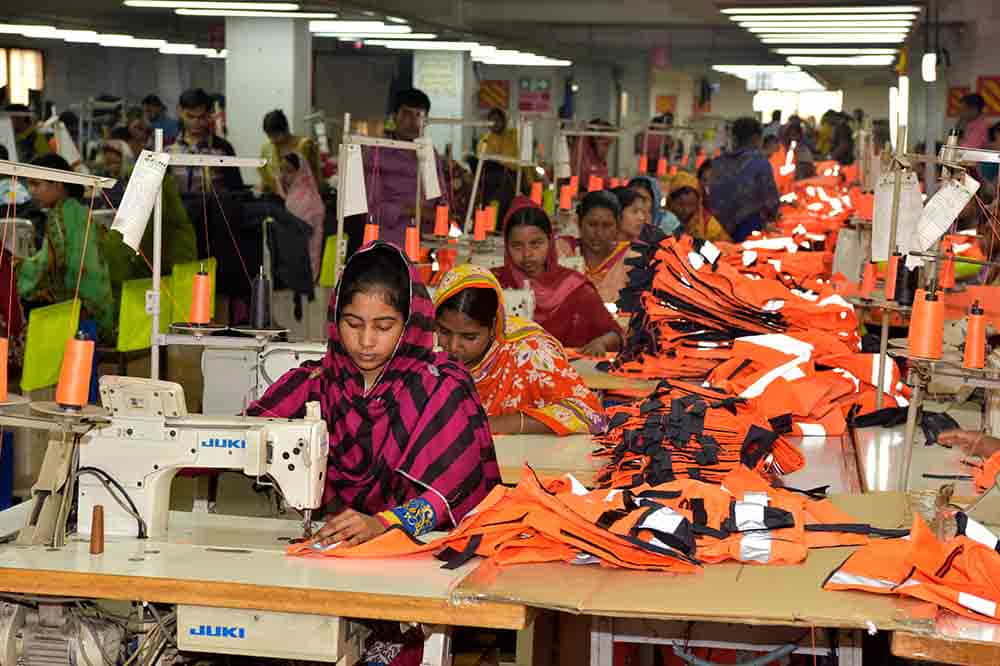
For buyers the practical point is that compliance is a property of each factory, so the country is not the audit. Ask for the factory’s own inspection and remediation reports, its social audit, and its environmental permits, and check that the factory named on the order is the one that sews it.
Bangladesh or Vietnam: how buyers decide
| If the order is… | It points to… | Because |
|---|---|---|
| Large volumes of basic cotton knitwear for the EU | Bangladesh | Duty-free EU entry while Everything but Arms lasts, the lower wage floor, and knitwear as the largest part of its garment exports |
| Garments in Vietnamese, EU or Korean fabric for the EU | Vietnam | The EU-Vietnam agreement’s preferential duty applies only with that fabric |
| Garments that need yarn or fabric made in the same country | Vietnam | Its textile industry exports $13.6 billion a year; Bangladesh is not among the top ten textile exporters |
| Labour-heavy styles where minutes per piece are high | Bangladesh, on cost | The wage gap grows with every standard minute; on an 18.5-minute garment it is about 26 cents at the floor |
| Long-term EU programmes from 2027 onwards | Either, with a plan | Bangladesh’s EU terms change after graduation and its transition; Vietnam’s EU duty cuts are being phased in |
Buying from both spreads risk across two governments, two currencies and two shipping routes. The trade-off between a second supplier’s cost and the protection it buys is a subject of its own; for a worked case of sourcing and merchandising from Bangladesh, see the site’s men’s shirt merchandising case study.
Questions people ask
Has Vietnam overtaken Bangladesh in garment exports?
Not in clothing, as of the WTO’s 2025 figures: Bangladesh $38.82 billion, Vietnam $37.51 billion. Vietnam is ahead if yarn and fabric are counted too, because it exported $13.6 billion of textiles in 2025 and Bangladesh is not among the top ten textile exporters.
How big is the textile industry in Vietnam?
In the WTO’s 2025 figures Vietnam exported $37.5 billion of clothing and $13.6 billion of textiles, making it the fourth largest clothing exporter (after the EU, China and Bangladesh) and the fourth largest textile exporter. It also imported $20.2 billion of yarn, fabric and made-up textiles.
How important is textile production to Bangladesh?
Garments earned 80.6% of Bangladesh’s exports in fiscal year 2025-26: $38.70 billion of $48.00 billion, in Export Promotion Bureau data. Half of those garments went to the EU and a fifth to the United States.
Are wages lower in Bangladesh or Vietnam?
Lower in Bangladesh. The garment entry-grade minimum set from December 2023 is Tk 12,500 a month, about $101; Vietnam’s Region I minimum from January 2026 is VND 5,310,000, about $205, at 30 September 2026 exchange rates. Actual pay is higher than either floor in both countries.
What happens to Bangladesh’s garment exports after LDC graduation?
Graduation is scheduled for 24 November 2026 unless the UN General Assembly grants the extension Bangladesh asked for. In the EU, Everything but Arms continues for a three-year transition after graduation; after that Bangladesh would need to qualify for another EU arrangement, such as GSP+, to keep lower duties. Regulation (EU) 2026/1395, which applies from 1 January 2027, keeps that three-year transition and eases the GSP+ criteria for countries leaving the least developed category.
Sources
- Exports and imports of clothing and textiles, 2000 to 2025: WTO, World Trade Statistics 2025, Tables 21 and 22 (downloaded 17 October 2026).
- Bangladesh’s garment exports by fiscal year, product and market: Export Promotion Bureau data as published by BGMEA; the industry’s history and LEED count: BGMEA’s own pages.
- Cotton imports and production, 2024/25 season: USDA Foreign Agricultural Service, Production, Supply and Distribution database (data as downloaded 17 October 2026).
- Minimum wages: the Bangladesh gazette as reported by The Daily Star via Asia News Network (13 November 2023); Cornell Global Labor Institute, Bangladesh brief, February 2025; EY Vietnam, tax alert on Decree 293/2025/ND-CP; Government of Vietnam news portal on Decree 293/2025/ND-CP. Exchange rates: US Treasury, Treasury Reporting Rates of Exchange, 30 September 2026.
- Trade rules: European Commission, EU-Vietnam agreement memo, Access2Markets guide to the agreement and Everything but Arms; Delegated Regulation (EU) 2024/1363; US International Trade Commission, Harmonized Tariff Schedule.
- LDC graduation: UN DESA, graduation of Bangladesh, Lao PDR and Nepal; the 2026 extension request as reported by Prothom Alo (2 June 2026) and The Daily Star (22 July 2026); EU GSP: Regulation (EU) 2026/1395.
- Rana Plaza and what followed: ILO, Rana Plaza: more needs to be done to ensure workplace safety (25 April 2021).
How this page is kept
Last verified: 17 October 2026. Export figures are taken from the WTO’s statistical tables and from Export Promotion Bureau data as BGMEA publishes it, each with its year; wages from the official rate and the source named beside it; trade rules from the European Commission, EUR-Lex and the US tariff schedule, all read on 17 October 2026. The worked example uses the site’s knitted garment FOB costing calculator as it stood that day, and each prefilled link was opened to check it shows the figures quoted. The WTO revises its tables each year, Bangladesh’s graduation decision is pending, and US duties change often, so check those three first.
Change log. 17 October 2026: rewritten in full, with sourced export, cotton, wage and trade-rule figures for both countries and a worked costing example. The earlier version gave no figure for either country. It is corrected on these points: its three “case studies” (an 18% cut in downtime in Bangladesh, a 20% cut in waste in Vietnam, and a joint Bangladesh-Vietnam sustainability project) named no company or source and are withdrawn; its claims about AI, blockchain and digital twins in both industries cited nothing and are removed; and it carried two stock images, a hand pointing at a network graphic and a molecular model, that showed nothing about either industry; those are removed.
Found an error? Please tell us through the contact page, naming the section and the source that disagrees.