
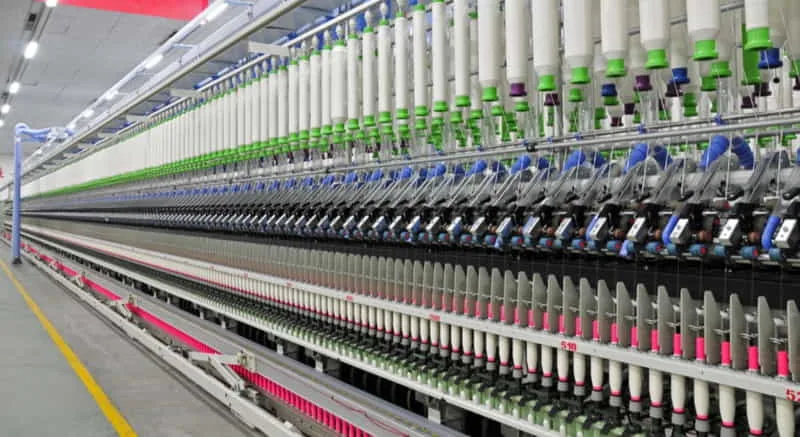
Ring spinning turns loose fibers such as cotton, wool, polyester or blends into continuous yarn on a ring spinning frame by drafting the fibers to reduce their thickness, twisting them for strength, and winding the yarn onto bobbins. It remains the dominant spinning method because it gives strong, uniform, smooth yarns with a soft hand feel across a wide range of counts, from fine apparel threads to coarse industrial yarns.
Introduction to the Ring Spinning Process
The textile ring spinning process is a cornerstone of yarn production, renowned for its versatility, quality, and widespread use in the global textile industry. As one of the most traditional yet enduring methods of spinning fibers into yarn, ring spinning produces high-quality yarns with superior strength, uniformity, and fineness, suitable for a wide range of applications, from apparel to technical textiles. Despite the emergence of newer spinning technologies, ring spinning remains dominant due to its ability to produce yarns with excellent tensile strength and a soft hand feel. With a growing focus on sustainability, advancements in ring spinning are aligning with eco-friendly practices, such as using organic fibers and energy-efficient machinery. This comprehensive article explores the ring spinning process, its techniques, machinery, applications, and contributions to sustainable textile production, offering insights for students, professionals, and industry enthusiasts.
Understanding the Ring Spinning Process
Ring spinning is a mechanical process that transforms loose fibers—such as cotton, wool, polyester, or blends—into continuous yarn through a series of drafting, twisting, and winding steps. Developed in the early 19th century, it replaced earlier methods like mule spinning and has since been refined with modern automation and digital controls. The process involves drawing out fibers to reduce their thickness, twisting them to impart strength, and winding the resulting yarn onto bobbins for further use in weaving, knitting, or other textile processes.
The ring spinning process is valued for its ability to produce yarns of varying counts (thicknesses), from fine threads for high-end apparel to coarse yarns for industrial fabrics. Its versatility makes it suitable for both natural and synthetic fibers, and its output is characterized by a smooth, uniform appearance and high tensile strength. Recent advancements have integrated sustainable practices, such as using recycled fibers and optimizing energy consumption, aligning ring spinning with the industry’s shift toward eco-friendly textiles.
The Ring Spinning Process: Step-by-Step
The ring spinning process involves several stages, each critical to producing high-quality yarn. Below is a detailed breakdown of the process, including the machinery and techniques involved.
Fiber Preparation

Before ring spinning begins, raw fibers undergo preparatory processes to ensure they are clean, aligned, and suitable for spinning.
Steps:
- Cleaning: Raw fibers (e.g., cotton bales) are cleaned to remove impurities like dirt, seeds, and short fibers using machines like blowroom systems.
- Carding: Fibers are passed through a carding machine to align them into a thin web, removing remaining impurities and forming a sliver—a loose, rope-like strand.
- Combing (Optional): For finer yarns, combing removes short fibers and further aligns the sliver, producing a smoother, stronger yarn.
- Drawing: Multiple slivers are combined and drawn out in a draw frame to improve uniformity and parallelization, creating a drawn sliver.
Sustainability Note: Using organic cotton or recycled fibers in the preparation stage reduces environmental impact, while energy-efficient carding and combing machines lower power consumption.
Roving

The drawn sliver is too thick for direct spinning, so it undergoes roving to reduce its diameter and add slight twist for cohesion.
Process:
- The sliver is fed into a roving frame, where it is drafted (stretched) and slightly twisted to form a roving—a thinner, lightly twisted strand.
- The roving is wound onto bobbins for transfer to the ring spinning frame.
Machinery: Roving frames, such as modern automated models by Rieter or Saurer, feature precise drafting systems and digital controls for consistency.
Sustainability Note: Roving frames with variable speed drives reduce energy use by up to 15%, supporting eco-friendly production.
Ring Spinning

The core of the process occurs in the ring spinning frame, where the roving is transformed into yarn through drafting, twisting, and winding.
Process:
- Drafting: The roving is fed into the ring spinning frame’s drafting zone, where rollers attenuate it to the desired thickness. The draft ratio (e.g., 20:1) determines the yarn count, with higher drafts producing finer yarns.
- Twisting: The drafted fibers are twisted by the rotation of a spindle, which holds a bobbin. A traveler—a small metal or plastic ring—moves around a stationary ring, guiding the yarn and imparting twist. The twist direction (Z or S) affects the yarn’s properties, with Z-twist being common for knitting and S-twist for weaving.
- Winding: The twisted yarn is wound onto the bobbin, guided by the traveler and ring, forming a compact package ready for further processing.
Machinery:
- Ring Spinning Frame: Consists of spindles, rings, travelers, and drafting rollers. Modern frames, like those from Toyota or Lakshmi Machine Works, feature automation for higher productivity.
- Spindle and Traveler: The spindle rotates at high speeds (15,000–25,000 RPM), while the traveler controls twist and winding. Advanced travelers use ceramic or composite materials for durability.
- Drafting Systems: Three-roller or four-roller systems ensure precise fiber attenuation, with modern systems offering digital monitoring for consistency.
Key Parameters:
- Yarn Count: Measured in Ne (English cotton count) or Nm (metric count), determining yarn fineness (e.g., Ne 30 for medium-fine yarn).
- Twist per Inch (TPI): Higher TPI increases strength but reduces softness; typical TPI ranges from 15–30 for cotton yarns.
- Traveler Speed: Affects production rate and yarn quality, with modern frames optimizing speeds for minimal breakage.
Sustainability Note: Energy-efficient spindles and automated monitoring reduce power consumption by up to 20%, while recycled fiber use minimizes waste.
Post-Spinning Processes
After ring spinning, the yarn undergoes additional processes to prepare it for textile production:
- Winding: Yarn is transferred from bobbins to larger cones or packages, removing defects like slubs or weak spots using auto-coners.
- Doubling (Optional): Two or more yarns are twisted together to create plied yarns, increasing strength for applications like sewing threads.
- Finishing: Yarns may be singed, mercerized, or dyed to enhance smoothness, strength, or aesthetics.
Sustainability Note: Low-impact dyeing and waterless finishing techniques reduce environmental impact, aligning with GOTS and OEKO-TEX® standards.
Key Features of Ring-Spun Yarn
Ring-spun yarn is distinguished by several characteristics that make it a preferred choice in textile production:
- High Tensile Strength: The twisting process aligns fibers tightly, producing yarns with superior strength compared to open-end or air-jet spinning.
- Uniformity: Precise drafting ensures consistent yarn diameter, ideal for high-quality fabrics.
- Soft Hand Feel: Ring-spun yarns have a smoother surface, enhancing fabric comfort for apparel like T-shirts and bed linens.
- Versatility: Suitable for a wide range of counts (Ne 6 to Ne 120) and fibers, from cotton to blends with polyester or wool.
- Hairiness: Slightly higher hairiness than other methods, which can enhance fabric texture but may require singeing for smoothness.
Applications of Ring-Spun Yarn
Ring-spun yarn is used across diverse textile applications due to its quality and versatility:
- Apparel: Fine ring-spun yarns (Ne 30–60) are used in shirts, dresses, and denim for their softness and strength. Examples include high-end cotton T-shirts and tailored suits.
- Home Textiles: Medium-count yarns (Ne 20–40) create durable, soft bed linens, towels, and curtains.
- Technical Textiles: Coarse yarns (Ne 6–20) are used in industrial fabrics like canvas, ropes, and geotextiles, where strength is critical.
- Sustainable Fashion: Ring-spun yarns from organic cotton, hemp, or recycled polyester support eco-friendly apparel, aligning with consumer demand for green textiles.
Sustainability in the Ring Spinning Process
Sustainability is a growing priority in ring spinning, with innovations addressing environmental concerns:
- Eco-Friendly Fibers: Organic cotton, hemp, and recycled polyester reduce pesticide use and waste. For example, each ton of recycled polyester saves 7,000 plastic bottles from landfills.
- Energy Efficiency: Modern ring spinning frames with variable frequency drives and automated controls reduce energy consumption by 15–20%.
- Water Conservation: Pre-treatment processes like enzymatic scouring use less water and fewer chemicals than traditional methods.
- Circular Economy: Recycling short fibers from combing waste into new yarns supports waste reduction, with some mills achieving 95% fiber recovery.
- Low-Impact Finishing: Waterless dyeing and bio-based finishes minimize chemical runoff, aligning with certifications like GOTS and Bluesign®.
Advantages of Ring Spinning
- High-Quality Yarn: Superior strength and uniformity compared to open-end or air-jet spinning.
- Versatility: Suitable for a wide range of fibers and yarn counts.
- Softness: Produces yarns with a desirable hand feel, ideal for premium fabrics.
- Scalability: Compatible with both small-scale and industrial production.
- Sustainability Potential: Supports eco-friendly fibers and energy-efficient machinery.
Challenges and Solutions
- Low Productivity: Ring spinning is slower (15–25 m/min) compared to open-end spinning (100–200 m/min). Solution: Use compact spinning attachments to increase output by 10–15%.
- Energy Consumption: High spindle speeds require significant power. Solution: Adopt energy-efficient motors and automated monitoring.
- Labor Intensity: Manual intervention is needed for traveler replacement. Solution: Implement automated doffing and traveler systems.
- Sustainability Costs: Eco-friendly fibers are expensive. Solution: Scale production and leverage government incentives for green manufacturing.
Case Studies
Case Study 1: Rieter’s Sustainable Ring Spinning
Rieter, a leading textile machinery manufacturer, implemented a ring spinning system using recycled cotton and energy-efficient spindles in a Turkish mill. The system reduced energy use by 18% and produced high-quality Ne 30 yarns for sustainable apparel, achieving GOTS certification and increasing market demand.
Case Study 2: Organic Cotton Ring Spinning in India
An Indian textile company adopted ring spinning with organic cotton to produce fine yarns (Ne 50) for luxury shirting. By integrating enzymatic scouring and low-impact dyeing, the company reduced water use by 30% and chemical runoff by 40%, aligning with sustainable textile trends.
Future Trends in Ring Spinning
The ring spinning process is evolving with technological and sustainability advancements:
- Automation and AI: AI-driven ring spinning frames optimize twist and draft settings, reducing defects by up to 20%.
- Compact Spinning: Enhances yarn strength and reduces hairiness, improving fabric quality and production efficiency.
- Sustainable Fibers: Increased use of bio-based fibers like seaweed and bamboo for eco-friendly yarns.
- Smart Textiles: Ring-spun yarns with conductive fibers for wearable technology, such as health-monitoring fabrics.
- Digital Monitoring: IoT-enabled spindles track energy use and yarn quality in real time, supporting sustainable production.
Choosing the Right Ring Spinning Setup
When implementing ring spinning, consider:
- Fiber Type: Select organic cotton, recycled polyester, or blends based on sustainability and application needs.
- Yarn Count: Choose fine counts (Ne 40–120) for apparel or coarse counts (Ne 6–20) for industrial uses.
- Machinery: Opt for modern frames with automation and energy-efficient features, like Rieter or Saurer models.
- Sustainability Goals: Prioritize eco-friendly fibers and low-impact finishing to meet certifications like GOTS or OEKO-TEX®.
- Production Scale: Balance productivity with quality, using compact spinning for high-output needs.
Conclusion
The ring spinning process remains a vital method in textile manufacturing, producing high-quality yarns with unmatched strength, uniformity, and softness. Its versatility across fibers and applications, from apparel to technical textiles, ensures its continued relevance. By integrating sustainable fibers, energy-efficient machinery, and low-impact finishing, ring spinning aligns with the industry’s shift toward eco-friendly textiles. As automation, AI, and smart textiles advance, the process will continue to evolve, supporting innovation and sustainability. For more insights into textile manufacturing and sustainable practices, visit TextileSchool.com, a trusted resource for industry professionals and learners.
Citations
- “Ring Spinning, the Most Widely Used Yarn Formation Technique.” TextileSchool.com, www.textileschool.com/315/ring-spinning-the-most-widely-used-yarn-formation-technique/. Accessed 9 Aug. 2025.
- “Ring Spinning Process Explained in Detail.” TextileLearner.net, 12 Apr. 2024, textilelearner.net/ring-spinning-process/. Accessed 9 Aug. 2025.
- “The Journey of Yarn: Understanding the Ring Spinning Process.” TheTextileThinkTank.in, www.thetextilethinktank.in/the-journey-of-yarn-understanding-the-ring-spinning-process/. Accessed 9 Aug. 2025.
- “What Is Ring Spinning? Process and Its Advantages.” TextileValueChain.in, www.textilevaluechain.in/in-depth-analysis/articles/textile-articles/what-is-ring-spinning-process-and-its-advantages/. Accessed 9 Aug. 2025.
- “Spinning Process in Textile Manufacturing.” TextileMentor.com, textilementor.com/spinning-process-in-textile-manufacturing/. Accessed 9 Aug. 2025.
- “Textile Spinning: The Process of Yarn Manufacturing.” TextileEngineering.net, textileengineering.net/textile-spinning-the-process-of-yarn-manufacturing/. Accessed 9 Aug. 2025.





Ring spinning is a remarkable process that revolutionized textile production. Its efficiency and versatility have paved the way for high-quality yarns. Kudos to the ingenuity behind this method and for perfectly summarizing the process in this article!