Bamboo vs hemp, in one answer: hemp fabric is a natural bast fibre, peeled from the stalk by retting and mechanical processing, while almost every fabric sold as “bamboo” is viscose (rayon) or, less often, lyocell, made by dissolving bamboo pulp and spinning the cellulose again. On chemicals hemp wins: the viscose process runs on caustic soda and carbon disulfide, and regulators in the United States, Canada and the European Union require bamboo viscose to be labelled as viscose or rayon, not as bamboo. On the whole footprint neither wins by default. The life-cycle study of hemp yarn names energy use in fibre processing and spinning, and fertiliser run-off from the crop, as the impacts to cut first; the study of viscose finds the mill’s steam, electricity and chemicals the most sensitive factors, with the plant it was made from changing the total by about a tenth. A hemp fabric beats a bamboo viscose fabric on process chemistry; bamboo lyocell, which needs no carbon disulfide, and mechanically processed bamboo, which is not dissolved at all, close most of that gap.
Last verified: 17 October 2026. Every figure on this page is linked to its source, listed again at the end. “Bamboo fabric” here means what shops sell under that name; the labelling rules are those of the United States, Canada and the EU as they stood on that date.
Bamboo vs hemp at a glance
| Hemp fabric | Bamboo viscose (most “bamboo fabric”) | Bamboo lyocell | |
|---|---|---|---|
| What the fibre is | Natural fibre from the bast of the hemp plant, Cannabis sativa (EU 1007/2011, Annex I, No 8) | Regenerated cellulose made by the viscose process (Annex I, No 25); the bamboo is only the pulp source | Regenerated cellulose spun from an organic solvent, without forming derivatives (Annex I, No 33) |
| How the fibre is freed or made | Retting loosens the fibre bundles, then breaking and scutching separate them from the woody core | Pulp + caustic soda, then carbon disulfide, then dissolved and regenerated in a spinning bath (US EPA, 2000) | Pulp dissolved directly in the solvent and spun |
| Key process chemicals | Water and microbes in retting; chemicals where hemp is chemically retted, degummed or “cottonised” (Tahir et al., 2011; PROTA) | Sodium hydroxide, carbon disulfide; carbon disulfide and carbonyl sulfide are the main air pollutants (US EPA) | An organic solvent; no carbon disulfide and no xanthate step |
| US label name | hemp | rayon, viscose, or “rayon made from bamboo” (FTC) | lyocell (an allowed name for this kind of rayon, 16 CFR 303.7(d)) |
| Canada label name | hemp | rayon, viscose, viscose rayon, “rayon from bamboo” or “viscose from bamboo” (Competition Bureau) | lyocell or lyocell rayon |
| EU label name | true hemp | viscose (no “bamboo” fibre name exists) | lyocell |
| EU agreed moisture allowance used to calculate fibre content | 12.00% | 13.00% | 13.00% |
The allowances in the last row are the conventional figures Annex IX of Regulation (EU) No 1007/2011 adds back to oven-dry mass when a laboratory works out a blend’s composition (cotton’s is 8.50%). They are a labelling convention, not a measurement of how absorbent a fabric feels.
Bamboo viscose, bamboo lyocell and bamboo linen: what the label means
Bamboo yarn is almost always regenerated cellulose. The bamboo culm is pulped, the cellulose is dissolved, and a new fibre is spun from the solution, so what reaches the knitter is viscose or lyocell whose raw material happened to be bamboo. Fibre-naming rules name a man-made fibre by its polymer and process, not by the plant its cellulose came from: ISO 2076, the international list of generic names for man-made fibres, groups them by their main polymer, and the US rule adopts the 2013 edition of that list (16 CFR 303.7). Three kinds of “bamboo” fabric reach the market, and each has its own lawful name.
| What is sold as bamboo | What it is | United States | Canada | European Union |
|---|---|---|---|---|
| Bamboo viscose (“bamboo rayon”) | Viscose-process fibre from bamboo pulp | “rayon” or “rayon made from bamboo”; the FTC accepts “viscose” as the ISO name for the predominant form of rayon | “rayon” or the process name (“viscose”, “viscose rayon”), which may be followed by “from bamboo” | “viscose”; Annex I names may not be used for other fibres, and other information is shown separately from the composition |
| Bamboo lyocell | Solvent-spun fibre from bamboo pulp | “lyocell”, an allowed alternative name for rayon of this kind | “lyocell” or “lyocell rayon” | “lyocell” |
| Mechanically processed bamboo (“bamboo linen”) | Fibre separated from the culm without dissolving it | “bamboo” is allowed only for a product made directly from bamboo fibre | “bamboo” is allowed only if the fibre was mechanically processed | No Annex I name for bamboo; a fibre not yet listed is declared as “other fibres” until a name is added (Articles 6 and 9(5)). “Linen” is reserved for flax. |
Sources for the table: FTC, How to Avoid Bamboozling Your Customers (August 2009) and Threading Your Way Through the Labeling Requirements; Competition Bureau Canada, Guidance on Labelling Textile Articles Derived from Bamboo (11 March 2009), under paragraph 26(2)(c) of the Textile Labelling and Advertising Regulations; Regulation (EU) No 1007/2011, Articles 5, 6, 9 and 16 and Annex I. The site’s register pages summarise each rule: 16 CFR Part 303, Canada’s textile labelling regulations and EU 1007/2011.
“Bamboo linen” is the label to be most wary of. In the EU the name linen belongs to flax (Linum usitatissimum), and Annex I names may not be used for another fibre “on their own or as a root or as an adjective”. In North America the word bamboo on its own is lawful only for mechanically processed fibre. A soft, drapey “bamboo” T-shirt or sheet is viscose or lyocell.
How the rules have been enforced
| Date | Regulator | What happened |
|---|---|---|
| 11 March 2009 | Competition Bureau Canada | Guidance that bamboo is not an acceptable generic name unless the fibre was mechanically processed |
| August 2009 | US FTC | Business guidance: rayon made from bamboo must be called rayon; claims that it keeps the plant’s antimicrobial properties need competent and reliable evidence |
| 3 February 2010 | US FTC | Warning letters to 78 retailers to stop labelling and advertising rayon textiles as bamboo |
| 3 January 2013 | US FTC | Four retailers agree civil penalties totalling $1.26 million (Sears and Kmart $475,000, Amazon $455,000, Macy’s $250,000, Leon Max $80,000) for selling rayon as bamboo after the 2010 letters |
| 27 February 2019 | Competition Bureau Canada | Consumer alert: the finished fabric “contains no trace of the bamboo plant or its antimicrobial properties” |
| 8 April 2022 | US FTC | Complaints against Kohl’s and Walmart seeking $2.5 million and $3 million, for rayon sold as bamboo and promoted as made by “ecofriendly processes” |
How each fibre is made, and where the chemicals are
Bamboo viscose
The US Environmental Protection Agency lists the same five steps for every viscose operation, whatever the pulp: alkali cellulose is made from cellulose and sodium hydroxide; it is reacted with carbon disulfide to form sodium cellulose xanthate; the xanthate is dissolved in sodium hydroxide solution to make viscose; the liquid viscose is regenerated into solid cellulose (for rayon, by extruding it through spinnerets); and the fibre is washed (65 FR 52166, 28 August 2000, at 52171). Hydrogen sulfide forms from by-products of the carbon disulfide reactions, and the agency found that the best-performing US rayon plant at the time captured 55 to 60% of its sulfide emissions. Carbon disulfide, carbonyl sulfide and toluene are the hazardous air pollutants emitted in the largest quantities by viscose operations, which the EPA regulates under its cellulose products manufacturing standard. Nothing in those steps depends on whether the pulp came from bamboo, beech, eucalyptus or cotton linters, which is why the regulators treat bamboo viscose as viscose. The site’s rayon and viscose page covers the fibre’s properties.
Bamboo lyocell and mechanically processed bamboo
Lyocell skips the xanthate route. The EU definition is a regenerated cellulose fibre “obtained by dissolution, and an organic solvent (mixture of organic chemicals and water) spinning process, without formation of derivatives”, and the US definition is cellulose “precipitated from an organic solution” with no substitution of the hydroxyl groups and no chemical intermediates (16 CFR 303.7(d)). No carbon disulfide is involved. Mechanically processed bamboo is separated from the culm without dissolving the cellulose, much as flax is turned into linen (the comparison is the Competition Bureau’s). It is the only form that may be sold simply as “bamboo” in the US and Canada; the FTC notes it is often called “mechanically processed bamboo”. The regenerated cellulose fibres page compares lyocell, modal and viscose.
Hemp
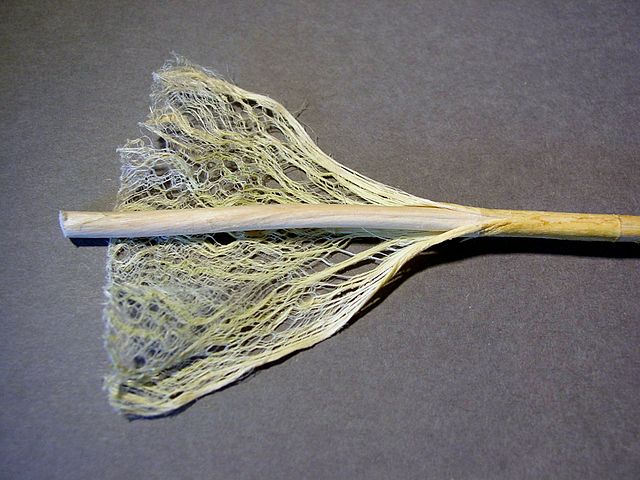
Hemp fibre is already a fibre in the plant: bundles in the bast, outside the woody core of the stem. Retting by microbes in water or on the field loosens them, and breaking and scutching or combing remove the woody core. The PROTA handbook entry gives an average fibre yield of 15% in European mechanised harvesting, and describes “cottonisation” as “the chemical or mechanical rearrangement of bast fibres” so that hemp can run on cotton machinery (Jansen, 2006). So hemp is not always chemical-free: cottonised or degummed hemp may meet alkali, and warm-water retting needs energy and produces waste water. Retting, decortication and degumming are covered step by step on the bast fibres page, and wet spinning, cottonised hemp and hemp counts on the hemp yarn page.
Which is more sustainable? What the life-cycle studies say
No peer-reviewed study we could find compares hemp fabric with bamboo viscose fabric directly. Three studies, read together, answer most of the question.
| Study | What it compared | Finding that matters here |
|---|---|---|
| He, Hou and Li, Industrial Crops and Products 237 (2025) 122267 | Viscose fibre from cotton, wood and bamboo pulp, cradle to gate, ReCiPe 2016 | Per tonne of fibre: cotton 506.92 Pt, wood 470.74 Pt, bamboo 453.43 Pt. Bamboo pulp scored lowest, but only 10.6% below cotton and 3.7% below wood. Steam consumption was the most sensitive factor; electricity and chemical reagents were also sensitive. |
| Shen, Worrell and Patel, Resources, Conservation and Recycling 55 (2010) 260–274 | Viscose, modal and lyocell made by one European producer, against Asian viscose, cotton, polyester and polypropylene, per tonne of staple fibre | The modern European cellulose fibres had the lowest overall impact; Asian viscose had a higher impact, comparable to polyester. Where and how a viscose is made outweighs what it is called. |
| van der Werf and Turunen, Industrial Crops and Products 27 (2008) 1–10 (record) | Hemp yarn with warm-water retting, against bio-retting, stand-retted “babyhemp” and dew-retted flax | No alternative was clearly better. Bio-retting raised climate and energy impacts through extra energy in fibre processing. Hemp yarn’s impacts should be cut first in energy use in fibre processing and yarn production, and in eutrophication in the crop. |
Put together: the plant is the smaller part of the story for both fibres. Bamboo pulp helps its viscose a little against wood or cotton pulp, but steam, electricity and chemical reagents at the fibre mill were the most sensitive factors in the result, and the study’s Asian viscose sat near polyester. Hemp avoids the dissolving step altogether, which removes the carbon disulfide question, but its yarn is not low-impact by default: retting and the long spinning chain use energy, and the crop needs fertiliser. For a buyer the useful signals are therefore about the factory, not the plant. The EU Ecolabel criteria for textiles (Decision 2014/350/EU, criterion 9, in force as consolidated on 6 January 2026) are one published yardstick for man-made cellulose: sulphur emissions to air of no more than 30 g per kg of viscose staple fibre, pulp bleached without elemental chlorine, at least 25% of pulp from sustainably managed forests, and at least half the pulp from mills that recover energy or co-products from their spent liquors. The site’s LCA for textiles page explains how such studies are built.
Growing the plants
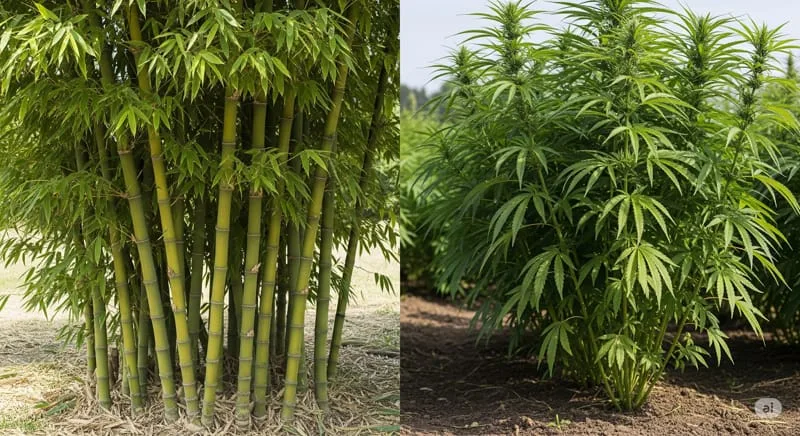
Bamboo is “a tree-like woody grass” of about 1,250 species; commercially important species usually mature in four to five years, after which “multiple harvests are subsequently possible every second year”, and it is a pulp raw material in China, India and Thailand (FAO, Unasylva 198, 1999). Hemp is an annual. In PROTA’s account it “suppresses weeds”, weeding “is rarely necessary because the dense canopy shades out most weeds”, and few of its pests cause economic damage; but it thrives on moderately to very fertile soils “provided there is enough water”, and fibre hemp takes 15–20 kg of nitrogen per 1,000 kg of stem (Jansen, 2006). Claims that either crop needs no water or no inputs at all go further than these sources.
Hemp and bamboo blend fabric: checking the label
Hemp and bamboo are often sold together, as hemp-bamboo jersey or as shirts in a hemp and bamboo viscose blend. The label must still give each fibre its generic name and its percentage, and both the US rule and the EU regulation allow a manufacturing tolerance of three percentage points of total fibre weight, not three percent of the declared figure (16 CFR 303.43; EU 1007/2011, Article 20). A label that claims a single fibre gets no tolerance in the US. The site’s fibre content tolerance calculator applies both rules.
| Worked example | Declared | Laboratory found | Result |
|---|---|---|---|
| A blend labelled 55% hemp, 45% viscose from bamboo | 55 / 45 | 51.6 / 48.4 | Each fibre is 3.4 points off, so both fibres fall outside their bands (hemp 52–58, viscose 42–48) and the margin is −0.4 points. Open it in the calculator. |
| A sheet labelled 100% viscose from bamboo | 100 / 0 | 98.5 / 1.5 (elastane) | A single-fibre claim has no tolerance, so 1.5 points is already outside the band. Open it in the calculator. |
Both labels are invented for the example. One practical catch: hemp and viscose are both cellulose, and the EU’s official chemical methods for binary blends do not separate them. Method 3 of Annex VIII dissolves viscose away from cotton, polypropylene, elastolefin or melamine but does not list hemp, and method 7 dissolves hemp and viscose together. Before trusting a test report on a hemp-viscose blend, ask the laboratory which method it used. Fibre identification is covered by ISO/TR 11827.
Hemp or bamboo: which to choose
- If chemicals in manufacture are your main concern, choose hemp, or a fibre labelled lyocell. A label reading viscose or rayon, from bamboo or not, means the carbon disulfide route.
- If you want a soft, drapey bamboo fabric, look for lyocell rather than viscose, and for evidence about the mill (an EU Ecolabel or published emissions data) rather than about the bamboo forest.
- Read the fibre name, not the marketing name. “Bamboo” alone on a soft garment, or “100% bamboo” on a sheet, are the forms the FTC has acted against (2013 release: “Pure Fiber 100% Bamboo” sheet sets).
- Treat “antibacterial”, “biodegradable” and “eco-friendly” as claims that need evidence. The FTC requires competent and reliable evidence for each, and its Green Guides treat an unqualified “degradable” claim as deceptive for an item that will not completely break down within one year of customary disposal (16 CFR 260.8).
Questions
Is bamboo fabric really eco-friendly?
Not because it is bamboo. Almost all bamboo fabric is viscose, made with sodium hydroxide and carbon disulfide like any other viscose, and the FTC has obtained civil penalties from retailers that sold it as bamboo and promoted it as made by eco-friendly processes. A 2025 life-cycle study found bamboo pulp gives a slightly lower impact than wood or cotton pulp, but steam, electricity and chemical reagents at the fibre mill were the most sensitive factors in the result; bamboo lyocell avoids carbon disulfide.
Is hemp more sustainable than bamboo?
On process chemistry, yes: hemp fibre is separated mechanically after retting, while bamboo viscose is dissolved and regenerated. On the whole footprint it depends on the mills. The life-cycle study of hemp yarn names energy in fibre processing and spinning as the first impact to cut, and no peer-reviewed study we found compares hemp fabric with bamboo fabric directly.
What is hemp fabric made of?
The bast fibre of the hemp plant, Cannabis sativa: bundles of long cells under the skin of the stem, freed by retting and scutching and then spun, often wet-spun like linen or cottonised and blended with cotton. In the EU it is labelled “true hemp”, which keeps the name apart from abaca, sold as Manila hemp.
Is bamboo fabric antibacterial?
Not by virtue of the plant. Competition Bureau Canada says the finished fabric contains no trace of the bamboo plant or its antimicrobial properties, and the FTC has challenged claims that rayon keeps them. A fabric that is antibacterial gets that from a finish, and the seller must be able to support the claim.
Is bamboo fabric biodegradable?
Viscose and hemp are both cellulose, but dyes, finishes, elastane and the place a garment ends up all change what happens to it. In the US a seller may make an unqualified “biodegradable” claim only with scientific evidence that the whole item will break down completely within a reasonably short time after customary disposal, and not if it normally goes to landfill or incineration.
Can a label say “100% bamboo”?
Only for mechanically processed bamboo fibre in the US and Canada, and in the EU not at all, because bamboo has no fibre name in Annex I. A viscose sheet must say viscose or rayon (in North America it may add “from bamboo”), and a single-fibre claim has no tolerance in the US.
Sources
- Labelling law: US 16 CFR Part 303 (sections 303.7 and 303.43); FTC, How to Avoid Bamboozling Your Customers (2009) and Threading Your Way Through the Labeling Requirements; 16 CFR 260.8 (degradable claims); Competition Bureau Canada, bamboo labelling guidance (2009) and consumer alert (2019); Regulation (EU) No 1007/2011, consolidated text of 15 February 2018 (Articles 5, 6, 9, 16 and 20; Annexes I, VIII and IX); ISO 2076:2021, Textiles — Man-made fibres — Generic names.
- Enforcement: FTC press releases of 3 February 2010, 3 January 2013 and 8 April 2022.
- Viscose process and emissions: US EPA, proposed cellulose products manufacturing standard, 65 FR 52166 (28 August 2000), and the rule’s summary page; Commission Decision 2014/350/EU (EU Ecolabel for textiles), criterion 9.
- Life-cycle studies: He, Hou and Li (2025), doi:10.1016/j.indcrop.2025.122267; Shen, Worrell and Patel (2010), doi:10.1016/j.resconrec.2010.10.001; van der Werf and Turunen (2008), doi:10.1016/j.indcrop.2007.05.003.
- The plants: FAO, Unasylva 198 (1999), “The International Network for Bamboo and Rattan”; P. C. M. Jansen (2006), Cannabis sativa L., PROTA.
How this page is kept
Last verified: 17 October 2026. The label names come from the regulations and the regulators’ own guidance, read on this date; the enforcement dates and penalty figures from the regulators’ press releases; the process description from the US EPA’s rulemaking; and the impact findings from the three peer-reviewed studies as their authors report them. The worked examples use the site’s fibre content tolerance calculator as it stood on this date, and both prefilled links were opened to check that they show the figures quoted. This page replaced an earlier version that relied on brand blogs and paid market reports; its history, market-size and brand claims were removed because no primary source supported them. Spotted an error? Tell us through the contact page and it will be corrected.