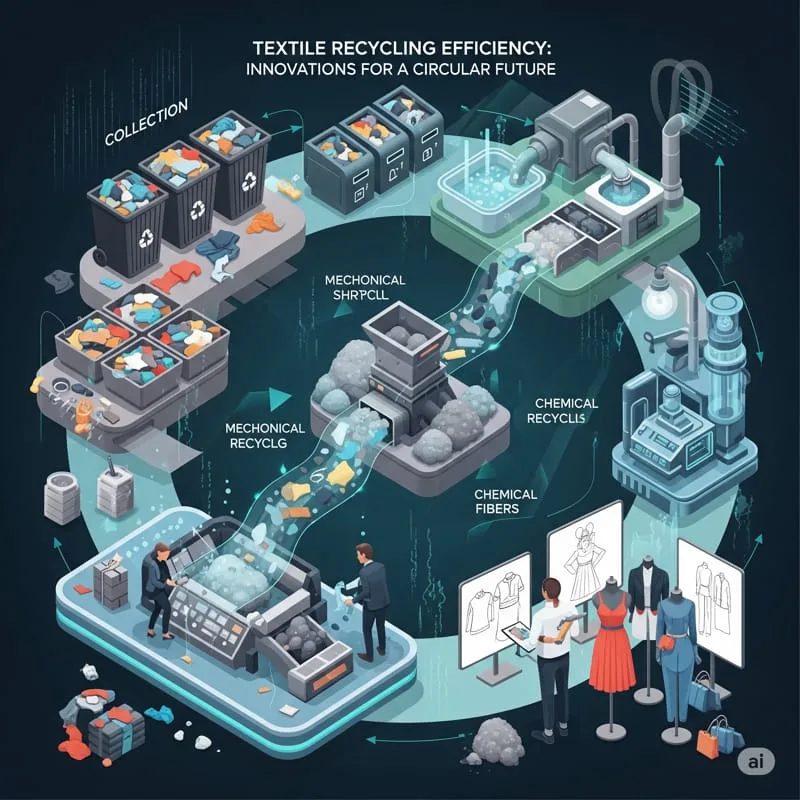
This article explores textile recycling efficiency, a critical factor in sustainable fashion, examining methods like mechanical, chemical, and thermal recycling, alongside innovations such as AI-driven sorting and enzymatic processes. It highlights global and regional efforts, including India’s waste-to-wealth initiatives, and addresses challenges like infrastructure gaps and consumer awareness, emphasizing the role of design and policy in enhancing recycling outcomes.
Textile recycling efficiency is a pivotal metric in evaluating the sustainability of textile waste management systems, measuring how effectively discarded materials are converted into usable resources with minimal environmental impact. As global textile production continues to rise, generating approximately 92 million tons of waste annually, the need for efficient recycling systems has never been more urgent. The Ellen MacArthur Foundation reports that less than 1% of textiles are recycled into new garments, with the majority ending up in landfills or incinerators (https://ellenmacarthurfoundation.org/a-new-textiles-economy). This article provides a comprehensive analysis of textile recycling efficiency, exploring methods, innovations, regional initiatives, challenges, and the path toward a circular textile industry.
Understanding Textile Recycling Efficiency
Recycling efficiency in textiles refers to the ability to transform textile waste—both pre-consumer (scraps, offcuts, and defective materials from manufacturing) and post-consumer (discarded garments and home textiles)—into usable materials with minimal resource input and environmental harm. Efficiency is influenced by the recycling method, fiber type, and infrastructure quality. Globally, only 10–13% of textile waste is recycled, according to the Textile Value Chain, with significant variations in outcomes based on technology and regional capabilities (https://textilevaluechain.in/in-depth-analysis/articles/waste-management-methods-in-the-textile-industry).
The environmental stakes are high. The textile industry accounts for 10% of global carbon emissions and substantial water pollution, much of which is linked to waste mismanagement, as noted by the United Nations Environment Programme (https://www.unep.org/news-and-stories/story/tackling-textile-industrys-environmental-footprint). Efficient recycling reduces landfill waste, conserves resources, and mitigates pollution, aligning with the circular economy principles of designing out waste, keeping materials in use, and regenerating natural systems.
Mechanical Recycling: Strengths and Limitations
Mechanical recycling is the most widely used method, accounting for 15–18% of textile waste processing. It involves shredding textiles into fibers, which are then spun into new yarns. This method is energy-efficient, using 20–30% less energy than virgin fiber production, making it a cost-effective option for natural fibers like cotton and wool. However, mechanical recycling has significant limitations. The process shortens fibers, reducing their quality and limiting their use to lower-end products like insulation, padding, or non-woven fabrics.
Blended fabrics, which combine natural and synthetic fibers, pose a major challenge. Sorting and separating these materials is labor-intensive and often impractical, reducing recycling efficiency. Innovations like AI-driven sorting systems, such as those developed by companies like Greyparrot, are improving the identification and separation of textiles, boosting recovery rates (https://greyparrot.ai/). Despite these advancements, mechanical recycling remains constrained by fiber degradation and infrastructure gaps, particularly in regions with limited waste management systems.
Chemical Recycling: High-Quality Output, High Costs
Chemical recycling offers a promising alternative by breaking down polymers at the molecular level to produce high-quality fibers suitable for new garments. This method can process both natural and synthetic fibers, including complex blends, making it more versatile than mechanical recycling. For example, companies like Worn Again Technologies are developing chemical recycling processes for polyester-cotton blends, a common challenge in textile recycling (https://wornagain.co.uk/).
However, chemical recycling is resource-intensive, requiring significant energy and, in some cases, hazardous chemicals. The process contributes to 3–10% of global greenhouse gas emissions, according to industry estimates, raising concerns about its environmental footprint. Scalability remains a barrier due to high costs and limited infrastructure. Despite these challenges, chemical recycling’s ability to produce virgin-quality fibers makes it a key component of closed-loop systems, where textiles are recycled into new garments without loss of quality.
Thermal Recycling: A Last Resort
Thermal recycling, or energy recovery, involves incinerating textile waste to generate heat or electricity. This method is effective for mixed or contaminated fibers that cannot be processed through mechanical or chemical recycling. However, it is the least sustainable option due to its high emissions and energy loss. Thermal recycling does not align with circular economy principles, as it prioritizes waste disposal over material reuse. Its use is typically reserved for textiles that are unsuitable for other recycling methods, such as heavily contaminated or non-recyclable fabrics.
Innovations Driving Recycling seguendo il testo… Recycling Efficiency
Emerging technologies are enhancing textile recycling efficiency. Enzymatic recycling, which uses biological enzymes to break down fibers, offers a sustainable alternative to chemical recycling. Companies like Carbios are developing enzymatic processes for polyester, producing high-quality recycled fibers with lower environmental impact (https://www.carbios.com/). AI-driven sorting systems improve the accuracy and speed of textile sorting, reducing contamination and increasing recovery rates. Mono-material garment design, which uses a single fiber type, simplifies recycling and enhances efficiency. Brands like H&M are adopting mono-material collections to support circularity (https://hmgroup.com/sustainability/circularity/).
Biodegradable fibers, such as lyocell and banana fiber, are also improving recycling outcomes. These materials, when free of synthetic dyes, can be composted, reducing landfill waste. In India, waste-to-wealth programs in the Garo Hills repurpose banana and pineapple fibers into compostable textiles, combining environmental and social benefits (https://www.nesfas.org/).
Regional Initiatives: India’s Waste-to-Wealth Programs
India, a major textile hub, is making strides in recycling efficiency through innovative programs. In the Garo Hills, community-based initiatives supported by the North East Slow Fashion Network transform agricultural byproducts like banana and pineapple fibers into sustainable textiles (https://www.nesfas.org/). These programs reduce waste while creating livelihoods, demonstrating the potential of localized recycling systems. Organizations like Saahas Zero Waste provide textile recycling and upcycling services in urban areas, diverting waste from landfills (https://saahaszerowaste.com/waste-types/textile-cloth-waste-management/).
Large-scale companies, such as Aditya Birla Fashion and Retail, are integrating recycling into their supply chains, supported by India’s National Technical Textiles Mission, which promotes sustainable innovation (https://texmin.nic.in/). These efforts highlight India’s growing role in advancing textile recycling efficiency.
Circular Economy and Closed-Loop Systems
The circular economy provides a framework for maximizing recycling efficiency. Closed-loop systems, where textiles are recycled into new garments, are gaining traction. Brands like Teemill operate circular supply chains, allowing customers to return used garments for recycling (https://teemill.com/circular-economy/). Take-back programs, such as those by Patagonia and Eileen Fisher, encourage reuse and recycling, extending garment lifespans (https://www.patagonia.com/stories/worn-wear/; https://www.eileenfisher.com/renew).
Zero-waste design and modular garments, like those produced by Unspun’s 3D weaving technology, enhance recycling efficiency by simplifying disassembly and material recovery (https://unspun.io/). These strategies align with the circular principle of keeping materials in use, reducing the need for virgin resources.
Policy Frameworks and EPR
Policy frameworks are critical to improving recycling efficiency. Extended Producer Responsibility (EPR) schemes hold manufacturers accountable for post-consumer waste, incentivizing sustainable design and recycling. The European Union’s Strategy for Sustainable and Circular Textiles sets ambitious waste reduction targets for 2030 (https://ec.europa.eu/environment/strategy/textiles-strategy_en). In India, the Solid Waste Management Rules 2016 promote source segregation and certified recycling partnerships, laying the foundation for EPR (https://cpcb.nic.in/solid-waste-management-rules-2016/).
Transparency and sustainability reporting, as practiced by brands like Everlane, enhance consumer trust and accountability (https://www.everlane.com/about). Blockchain technology is being explored to improve traceability, ensuring verifiable recycling claims.
Challenges to Recycling Efficiency
Textile recycling efficiency faces several challenges. Limited infrastructure, particularly for chemical and enzymatic recycling, restricts scalability. Blended fabrics and contamination from dyes and finishes complicate processing, reducing recovery rates. Consumer awareness is another barrier, as many prioritize affordability over sustainability, fueling fast fashion’s dominance.
Global regulatory disparities also hinder progress. While the EU has advanced policies, similar frameworks are less developed in other regions, including India. Investment in recycling infrastructure and consumer education is essential to overcome these obstacles.
The Role of Consumers and Brands
Consumers play a vital role in improving recycling efficiency. By supporting take-back programs, choosing second-hand platforms like ThredUp, and embracing repair services, consumers can reduce post-consumer waste (https://www.thredup.com/). Campaigns like Fashion Revolution’s “Who Made My Clothes?” raise awareness and drive demand for sustainable practices (https://www.fashionrevolution.org/).
Brands must invest in innovative recycling technologies and circular design. Collaborations with organizations like the Sustainable Apparel Coalition, which developed the Higg Index, help brands measure and improve their environmental performance (https://apparelcoalition.org/higg-index/). By prioritizing recycling efficiency, brands can lead the transition to a circular economy.
The Future of Textile Recycling
The future of textile recycling lies in technological innovation and systemic change. Enzymatic and bio-based recycling methods are reducing environmental impact, while AI-driven sorting and 3D knitting technologies improve efficiency. Lab-grown fibers, such as Bolt Threads’ bioengineered silk, offer sustainable alternatives with minimal resource use (https://boltthreads.com/).
Policy interventions, such as EPR and incentives for sustainable practices, will accelerate progress. Consumer demand for sustainability, particularly among Gen Z and Millennials, is driving the growth of rental platforms like Rent the Runway and resale markets (https://www.renttherunway.com/). Collaborative efforts among brands, policymakers, and consumers will shape a future where textile recycling is both efficient and scalable.
Conclusion
Textile recycling efficiency is a cornerstone of sustainable fashion, addressing the environmental and social challenges of textile waste. Through mechanical, chemical, and emerging enzymatic recycling methods, alongside innovations like AI sorting and mono-material design, the industry is improving its ability to transform waste into valuable resources. Regional initiatives, such as India’s waste-to-wealth programs, and global policies like EPR are driving systemic change. Despite challenges like infrastructure gaps and consumer behavior, the combination of technology, policy, and collaboration offers a promising path toward a circular textile industry that minimizes waste and maximizes sustainability.
Citations
- Ellen MacArthur Foundation. “A New Textiles Economy: Redesigning Fashion’s Future.” Ellen MacArthur Foundation, www.ellenmacarthurfoundation.org/a-new-textiles-economy. Accessed 18 July 2025.
- United Nations Environment Programme. “Tackling the Textile Industry’s Environmental Footprint.” UNEP, www.unep.org/news-and-stories/story/tackling-textile-industrys-environmental-footprint. Accessed 18 July 2025.
- Textile Value Chain. “Waste Management Methods in the Textile Industry.” Textile Value Chain, textilevaluechain.in/in-depth-analysis/articles/waste-management-methods-in-the-textile-industry. Accessed 18 July 2025.
- Greyparrot. “AI-Driven Waste Sorting Solutions.” Greyparrot, greyparrot.ai/. Accessed 18 July 2025.
- Worn Again Technologies. “Chemical Recycling for Textiles.” Worn Again, wornagain.co.uk/. Accessed 18 July 2025.
- Carbios. “Enzymatic Recycling Technology.” Carbios, www.carbios.com/. Accessed 18 July 2025.
- H&M Group. “Sustainability: Circularity.” H&M Group, hmgroup.com/sustainability/circularity/. Accessed 18 July 2025.
- North East Slow Fashion Network. “Sustainable Textiles in India.” NESFAS, www.nesfas.org/. Accessed 18 July 2025.
- Saahas Zero Waste. “Textile and Cloth Waste Management.” Saahas Zero Waste, saahaszerowaste.com/waste-types/textile-cloth-waste-management/. Accessed 18 July 2025.
- Teemill. “Circular Economy in Fashion.” Teemill, teemill.com/circular-economy/. Accessed 18 July 2025.
- Patagonia. “Worn Wear: Repair and Reuse.” Patagonia, www.patagonia.com/stories/worn-wear/. Accessed 18 July 2025.
- Eileen Fisher. “Renew: Circular Design.” Eileen Fisher, www.eileenfisher.com/renew. Accessed 18 July 2025.
- Unspun. “Sustainable Denim Innovation.” Unspun, unspun.io/. Accessed 18 July 2025.
- AirDye Solutions. “Eco-Friendly Dyeing Technology.” AirDye, www.airdyesolutions.com/. Accessed 18 July 2025.
- Science Based Targets. “Corporate Climate Action.” Science Based Targets, sciencebasedtargets.org/. Accessed 18 July 2025.
- European Commission. “EU Strategy for Sustainable and Circular Textiles.” European Commission, ec.europa.eu/environment/strategy/textiles-strategy_en. Accessed 18 July 2025.
- Central Pollution Control Board. “Solid Waste Management Rules 2016.” CPCB, cpcb.nic.in/solid-waste-management-rules-2016/. Accessed 18 July 2025.
- Everlane. “Transparency in Fashion.” Everlane, www.everlane.com/about. Accessed 18 July 2025.
- Fashion Revolution. “Who Made My Clothes?” Fashion Revolution, www.fashionrevolution.org/. Accessed 18 July 2025.
- Sustainable Apparel Coalition. “Higg Index.” Sustainable Apparel Coalition, apparelcoalition.org/higg-index/. Accessed 18 July 2025.
- Bolt Threads. “Bioengineered Fibers.” Bolt Threads, boltthreads.com/. Accessed 18 July 2025.
- Rent the Runway. “Fashion Rental for Sustainability.” Rent the Runway, www.renttherunway.com/. Accessed 18 July 2025.
- ThredUp. “Secondhand Fashion Marketplace.” ThredUp, www.thredup.com/. Accessed 18 July 2025.
- Ministry of Textiles, Government of India. “National Technical Textiles Mission.” Texmin, texmin.nic.in/. Accessed 18 July 2025.