Introduction
Wound care is a critical aspect of healthcare. It focuses on protecting and facilitating the healing of damaged skin. Wound dressings are integral to this process. They provide a barrier against infection and promote a moist environment conducive to healing. Textile materials are at the forefront of wound dressing technology. They offer versatility, biocompatibility, and the ability to be engineered for specific wound types. Therefore, understanding the properties and applications of different textile materials is essential for healthcare professionals. It also benefits researchers and anyone interested in wound care.
History of Textile Use in Wound Care
The use of textiles for wound care dates back centuries. Ancient civilizations like the Egyptians and Greeks used natural fibers. They used linen and cotton to create basic wound coverings. These materials provided absorbency and protection against external contaminants. However, they lacked advanced properties for promoting optimal healing.
Over time, advancements in textile technology led to the development of more sophisticated wound dressings. The introduction of gauze in the 19th century marked a significant improvement. Gauze offered better absorbency and breathability. The 20th century saw the emergence of synthetic fibers like rayon and nylon. These fibers provided enhanced strength and elasticity. The late 20th and early 21st centuries have witnessed a surge in innovation. Advanced materials like hydrogels, foams, and nanofibers have revolutionized wound care.
Technological Evolution of Wound Dressing Materials
The evolution of wound dressing materials has been driven by advancements in textile technology and a deeper understanding of wound healing processes.

- First-Generation Dressings: These include traditional materials like gauze and cotton. They primarily offer protection and absorbency.
- Second-Generation Dressings: These advanced materials provide enhanced functionality. Examples include:
- Hydrocolloids: These dressings contain gel-forming agents. They maintain a moist wound environment.
- Films: Transparent and flexible, these dressings allow for visual inspection of the wound.
- Foams: Highly absorbent, foam dressings are ideal for heavily exuding wounds.
- Third-Generation Dressings: These bioactive dressings actively promote healing. Examples include:
- Alginates: Derived from seaweed, alginates are highly absorbent and promote hemostasis.
- Hydrogels: These dressings provide moisture to dry wounds and facilitate autolytic debridement.
- Collagen Dressings: These dressings promote cellular growth and tissue regeneration.
- Fourth-Generation Dressings: These incorporate advanced technologies for targeted wound care. Examples include:
- ** growth factors:** Dressings that contain growth factors stimulate cell proliferation and collagen synthesis.
- Silver-impregnated dressings: These dressings provide antimicrobial protection.
- Nanofiber dressings: These dressings offer a high surface area for cell adhesion and proliferation.
Types of Textile Materials Used in Wound Dressings
A wide array of textile materials is used in wound dressings. Each offers unique properties and benefits.
Natural Fibers
- Cotton: Cotton is a widely used natural fiber due to its absorbency, softness, and cost-effectiveness. It is suitable for cleansing wounds and absorbing exudate. However, cotton fibers can shed and adhere to the wound bed. This may cause discomfort and delay healing.
- Advantages:
- High absorbency
- Soft and comfortable
- Cost-effective
- Disadvantages:
- Fiber shedding
- May adhere to the wound
- Limited barrier function
- Advantages:
- Linen: Linen is derived from the flax plant and offers strength and absorbency. It is less commonly used than cotton due to its higher cost and coarser texture.
- Advantages:
- Strong and durable
- Good absorbency
- Disadvantages:
- Higher cost
- Coarser texture
- Less readily available
- Advantages:
- Silk: Silk is a natural protein fiber known for its smoothness and biocompatibility. It is sometimes used in specialized wound dressings. Silk can promote cell growth and reduce inflammation.
- Advantages:
- Smooth and biocompatible
- Promotes cell growth
- Reduces inflammation
- Disadvantages:
- High cost
- Limited absorbency
- Potential allergen
- Advantages:
- Chitosan: Chitosan is derived from chitin, found in the exoskeletons of crustaceans. It possesses antimicrobial and hemostatic properties. Chitosan dressings can accelerate wound healing and reduce scarring.
- Advantages:
- Antimicrobial properties
- Promotes hemostasis
- Accelerates wound healing
- Disadvantages:
- Potential allergen
- Limited availability
- Advantages:
- Alginate: Alginate is derived from seaweed and is highly absorbent. It forms a gel when in contact with wound exudate. Alginate dressings are ideal for heavily exuding wounds. They maintain a moist environment conducive to healing.
- Advantages:
- High absorbency
- Maintains a moist wound environment
- Promotes hemostasis
- Disadvantages:
- May require secondary dressing
- Can dry out if not properly managed
- Advantages:
Synthetic Fibers
- Rayon: Rayon is a regenerated cellulose fiber. It offers good absorbency and softness. Rayon is often blended with other fibers to improve its properties.
- Advantages:
- Good absorbency
- Soft and comfortable
- Cost-effective
- Disadvantages:
- Lower strength compared to other synthetics
- Can lose strength when wet
- Advantages:
- Polyester: Polyester is a synthetic polymer known for its strength, durability, and low absorbency. It is used in wound dressings for its structural integrity and resistance to degradation.
- Advantages:
- High strength and durability
- Resistant to degradation
- Low absorbency
- Disadvantages:
- Poor moisture management
- Can be uncomfortable
- Advantages:
- Nylon: Nylon is a strong and elastic synthetic fiber. It provides good support and conformability. Nylon is used in specialized wound dressings requiring structural support.
- Advantages:
- Strong and elastic
- Good support and conformability
- Disadvantages:
- Low absorbency
- Can be uncomfortable
- Advantages:
- Acrylic: Acrylic fibers are soft, lightweight, and offer good insulation. They are used in wound dressings for comfort and protection.
- Advantages:
- Soft and lightweight
- Good insulation
- Disadvantages:
- Low absorbency
- Can pill
- Advantages:
- Polyurethane: Polyurethane is a versatile polymer. It can be engineered into foams, films, and hydrogels. Polyurethane dressings offer a range of properties. They include absorbency, flexibility, and moisture management.
- Advantages:
- Versatile
- Good absorbency (foams)
- Flexible (films)
- Disadvantages:
- Can be expensive
- May not be suitable for all wound types
- Advantages:
Composite Materials
Composite materials combine two or more different fibers or polymers. They enhance the properties of wound dressings.
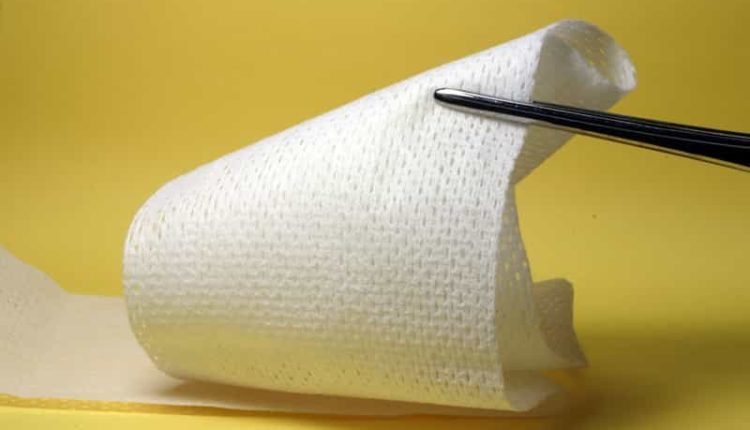
- Non-woven Fabrics: Non-woven fabrics are made by bonding fibers together. This is done through mechanical, thermal, or chemical processes. They offer good absorbency, breathability, and cost-effectiveness.
- Advantages:
- Good absorbency and breathability
- Cost-effective
- Versatile
- Disadvantages:
- Lower strength compared to woven fabrics
- Can lint
- Advantages:
- Hydrofiber: Hydrofiber is a unique material made from carboxymethylcellulose (CMC). It forms a cohesive gel when in contact with wound exudate. Hydrofiber dressings provide excellent absorbency. They maintain a moist wound environment.
- Advantages:
- Excellent absorbency
- Maintains a moist wound environment
- Conforms to the wound bed
- Disadvantages:
- May require a secondary dressing
- Can dry out if not properly managed
- Advantages:
- Silver-Impregnated Fabrics: These fabrics incorporate silver ions or nanoparticles. They provide antimicrobial protection. Silver-impregnated dressings are effective against a broad spectrum of bacteria.
- Advantages:
- Antimicrobial properties
- Effective against a broad spectrum of bacteria
- Disadvantages:
- Potential for silver toxicity
- Can be expensive
- May not be suitable for long-term use
- Advantages:
- Collagen-Based Composites: These composites combine collagen with other materials. This includes alginates or synthetic polymers. They promote cellular growth and tissue regeneration.
- Advantages:
- Promotes cellular growth and tissue regeneration
- Biocompatible
- Disadvantages:
- High cost
- Limited availability
- Advantages:
Innovations in Textile Wound Dressing Materials
Ongoing research and development efforts have led to significant innovations. These have enhanced the performance and functionality of textile wound dressings.
- Nanofiber Dressings: Nanofibers offer a high surface area-to-volume ratio. This promotes cell adhesion and proliferation. Nanofiber dressings can be engineered to deliver drugs or growth factors. This accelerates wound healing.
- Smart Textiles: Smart textiles incorporate sensors and electronics. They monitor wound parameters. These include temperature, pH, and moisture levels. This data can be transmitted wirelessly to healthcare providers. This allows for remote monitoring and timely intervention.
- Antimicrobial Textiles: In addition to silver, other antimicrobial agents are being explored. These include chitosan, copper, and antimicrobial peptides. These agents can be incorporated into textile fibers. This provides sustained antimicrobial protection.
- Growth Factor-Releasing Dressings: These dressings are designed to release growth factors. These stimulate cell proliferation and collagen synthesis. This accelerates wound healing and reduces scarring.
- 3D-Printed Dressings: Three-dimensional printing technology allows for the creation of custom-shaped wound dressings. These dressings can be tailored to fit complex wound geometries. They can also be loaded with drugs or growth factors.
Production Process of Textile Wound Dressings
The production of textile wound dressings involves several steps. These ensure the quality, sterility, and performance of the final product.
- Fiber Selection: The appropriate fiber type is selected based on the desired properties of the wound dressing.
- Yarn Formation: Fibers are spun into yarns. This is done using techniques like ring spinning or air-jet spinning.
- Fabric Formation: Yarns are woven, knitted, or non-woven into fabrics. The fabric structure influences the dressing’s absorbency, breathability, and elasticity.
- Finishing Treatments: Fabrics undergo finishing treatments. These enhance their properties. Examples include:
- Antimicrobial treatments: Application of antimicrobial agents to prevent infection.
- Hydrophilic treatments: Increase the fabric’s absorbency.
- Coating: Application of a polymer layer to control moisture vapor transmission.
- Cutting and Shaping: The fabric is cut into the desired shape and size of the wound dressing.
- Sterilization: Wound dressings are sterilized using methods like gamma irradiation or ethylene oxide gas. This eliminates microorganisms and ensures product safety.
- Packaging: Sterilized wound dressings are packaged in sterile, airtight containers. This maintains their sterility and protects them from damage.
Challenges in the Production of Textile Wound Dressings
Despite advancements in textile technology, several challenges remain in the production of wound dressings.
- Cost: The cost of advanced textile materials and manufacturing processes can be high. This limits their accessibility in resource-constrained settings.
- Scalability: Scaling up the production of novel wound dressings. This includes nanofiber and 3D-printed dressings, can be challenging.
- Biocompatibility: Ensuring the biocompatibility of textile materials is crucial. Materials must not cause adverse reactions or impede the healing process.
- Sterility: Maintaining sterility throughout the production process is essential. Contamination can lead to infection and compromise patient safety.
- Performance: Wound dressings must perform consistently. They must provide the desired level of absorbency, breathability, and antimicrobial protection.
Real-World Applications of Textile Wound Dressings

Textile wound dressings are used in a wide range of clinical settings. They address various wound types.
- Acute Wounds: These include surgical wounds, traumatic injuries, and burns. Textile dressings protect the wound, absorb exudate, and promote healing.
- Chronic Wounds: These include pressure ulcers, diabetic foot ulcers, and venous leg ulcers. Advanced textile dressings manage moisture levels. They provide antimicrobial protection and stimulate tissue regeneration.
- Surgical Wounds: Textile dressings are used post-operatively. They prevent infection, reduce scarring, and improve patient comfort.
- Burn Wounds: Specialized textile dressings provide a barrier against infection. They promote moist wound healing. They can also deliver pain relief medications.
- First Aid: Basic textile dressings like gauze and bandages are essential components of first aid kits. They provide immediate protection and support for minor wounds.
End-Users of Textile Wound Dressings
The end-users of textile wound dressings include:
- Healthcare Professionals: Doctors, nurses, and wound care specialists use textile dressings. They manage and treat wounds in clinical settings.
- Patients: Patients use textile dressings at home. This is done to manage their wounds. This is done following instructions from healthcare providers.
- Caregivers: Caregivers assist patients. They apply and change wound dressings.
- First Responders: Emergency medical technicians (EMTs) and paramedics use textile dressings. They provide immediate wound care in emergency situations.
Market for Textile Wound Dressings
The market for textile wound dressings is substantial. It is driven by the increasing prevalence of chronic wounds. It is also driven by the aging population and advancements in wound care technology.
According to market research reports, the global wound care market is projected to reach $XX billion by 202X. This is growing at a compound annual growth rate (CAGR) of X.X%. Textile wound dressings account for a significant portion of this market.
Key players in the textile wound dressing market include:
- Major Medical Device Companies: Johnson & Johnson, Smith & Nephew, 3M, and Mölnlycke Health Care.
- Specialized Wound Care Companies: Coloplast, Convatec, and Integra LifeSciences.
- Textile Manufacturers: Companies that produce textile materials for wound dressings.
Future Trends in Textile Wound Dressings

The future of textile wound dressings is promising. It is characterized by ongoing innovation and technological advancements.
- Personalized Wound Care: Tailoring wound dressings to individual patient needs. This is done based on wound characteristics, genetic factors, and other variables.
- Bioprinting: Using bioprinting technology to create living skin substitutes. These can be directly applied to wounds.
- Drug Delivery Systems: Incorporating drug delivery systems into textile dressings. This allows for controlled release of medications. These include antibiotics, analgesics, and growth factors.
- Remote Monitoring: Integrating sensors and wireless communication technologies into wound dressings. This enables remote monitoring of wound healing progress.
- Sustainable Materials: Developing wound dressings from sustainable and biodegradable materials. This reduces environmental impact.
Summary
Textile materials play a crucial role in wound care. They offer a wide range of properties and applications. From traditional cotton gauze to advanced nanofiber dressings, textile technology has revolutionized wound management. Ongoing innovations promise to further enhance the performance and functionality of textile wound dressings. These materials will improve patient outcomes and quality of life.