Sustainable textiles are fabrics whose fibre, processing and end of life do measurably less harm than the usual alternative: less irrigation water and farmland, fewer hazardous chemicals, fibre from waste rather than new crops or oil, and a garment that lasts and can be reused or recycled. No fabric is sustainable on every count. The eco-friendly fabrics that score best on published data are fibre recycled from textile waste, linen and hemp, and lyocell made in a closed solvent loop; organic cotton removes most synthetic pesticides but not cotton’s thirst; recycled polyester cuts the carbon of new polyester but still sheds microfibres. A label is the way to check a claim, and each label proves only one thing: GOTS organic fibre, GRS recycled content, OEKO-TEX STANDARD 100 tested for harmful substances. This page ranks the common fibres on water, land, chemistry, end of life and certification, with a source for every row.
Last verified: 18 October 2026. Water figures are global averages from the water footprint studies of Arjen Hoekstra and colleagues (a peer-reviewed paper and a UNESCO-IHE research report); fibre volumes are Textile Exchange’s Materials Market Report 2026; rules are quoted from EU and US legal texts. Every source is linked where it is used and listed at the end.

Sustainable textiles at a glance
| Question | Short answer | Section |
|---|---|---|
| What makes a textile sustainable? | Five things you can check: feedstock, water and land, chemistry, how long it lasts, and what happens at the end | What makes a textile sustainable |
| Which fabrics are the most sustainable? | Recycled cotton and wool, linen, hemp and closed-loop lyocell lead; virgin polyester, nylon and conventional viscose trail | The ranking |
| How much water does a cotton T-shirt take? | About 2,720 litres for a 250 g shirt as a global average, but only 1,230 litres of it is irrigation and process water | Water |
| How big is the problem? | 139 million tonnes of fibre in 2025, 59% of it polyester, and less than 1% made from recycled textiles | The industry |
| Which label proves what? | GOTS: organic fibre and processing. GRS: recycled content. OEKO-TEX STANDARD 100: tested for harmful substances, not organic | Certifications |
| Can a brand still say “eco-friendly”? | In the EU, not as a generic claim since 27 September 2026, unless it can show recognised excellent environmental performance | Claims and the law |
What makes a textile sustainable: the five things to check
Sustainability in textiles means the whole chain, not the fibre name on the label. Life-cycle studies of fibres measure the same handful of things, and they are the questions to ask of any fabric (the site’s guide to life cycle assessment for textiles explains the method):
- Feedstock. Is the fibre grown, made from wood, made from oil and gas, or recovered from waste? Fibre from waste needs no new farmland, forest or oil.
- Water and land. How much rain and irrigation water the crop needs, and where it is grown. Irrigation drawn from a dry region does more harm than rain falling on a field.
- Chemistry. Pesticides on the farm, solvents in fibre making, and the dyes and finishes in the mill, and whether they are recovered or reach the air and rivers.
- Use. How long the fabric lasts and how often it is worn. A durable garment worn for years beats a “green” one worn twice.
- End of life. Whether it sheds microfibres when washed, and whether it can be reused or recycled into new fibre. Blends and trims make recycling harder.
Workers are the sixth test, and the one no fibre comparison can settle: the same fibre can be grown and sewn well or badly. That is what the social criteria in standards such as GOTS and the GRS audit, factory by factory.
Which fabrics are the most sustainable? The eco-friendly fabric ranking
No single study ranks every fibre, so the order below is this page’s judgment, made from the sourced columns, which are weighed together rather than applied one after another: feedstock (textile waste counts most; bottle and net waste counts for less, because it does not close the loop on clothing and the fibre still sheds), irrigation water, known chemical hazards, and end of life. Two placements are judgment calls a reader may weigh differently. Viscose sits below conventional cotton for its carbon disulfide emissions, although it needs no irrigation and the one life-cycle study cited here ranks cotton last overall (Shen, Worrell and Patel 2010). Recycled polyester and nylon sit below the plant fibres because they shed microfibres. Each row names its sources. Read it as a guide to the generic fibre; a certified or badly made version of any of them can move a row up or down.
| Rank | Fibre | Water | Land and feedstock | Chemistry | End of life | Certification to ask for | Sources |
|---|---|---|---|---|---|---|---|
| 1 | Recycled cotton and recycled wool (mechanically recycled) | No new crop water: the feedstock is waste | No new land; recycled cotton is 1% of cotton, recycled wool about 8% of wool (2025) | Torn and re-spun mechanically, with no new fibre-making chemistry | Shorter fibre, so usually blended with virgin fibre | GRS or RCS | Textile Exchange MMR 2026, pp. 6, 15 |
| 2 | Linen (flax) | 3,481 m³ per tonne of fibre, of which 443 m³ irrigation | Rotation crop; in Western Europe “generally grown without irrigation” | Dew retting in the field; fibre extracted mechanically | Plant cellulose; dyes and finishes decide what is left | Masters of Flax Fibre; GOTS if organic | Mekonnen and Hoekstra 2011; Alliance for European Flax-Linen and Hemp |
| 3 | Hemp (mechanically processed) | 2,447 m³ per tonne of fibre, with no irrigation share in the global average | Dense canopy: “weeding is rarely necessary”; few pests of economic importance | Low on the farm; hemp turned into viscose carries viscose’s chemistry | Plant cellulose | GOTS or OCS if organic | Mekonnen and Hoekstra 2011; PROTA, Cannabis sativa |
| 4 | Lyocell (closed-loop, such as TENCEL) | No irrigated crop; wood pulp | Forest; 65–70% of man-made cellulosic fibre came from FSC or PEFC certified or controlled wood in 2025 | Solvent (NMMO) about 99.8% recovered and reused, the maker states | Plant cellulose | FSC or PEFC wood; EU Ecolabel | Lenzing; Shen, Worrell and Patel 2010; MMR 2026 p. 6 |
| 5 | Organic cotton | Cotton’s: the global average for lint is 9,113 m³ per tonne, 2,955 of it irrigation; organic rules do not cap water | Arable cropland | No synthetic substances except those on the permitted list | Plant cellulose; recyclable mechanically | GOTS (95% or 70% organic) or OCS | 7 CFR 205.105; GOTS; Mekonnen and Hoekstra 2011 |
| 6 | Recycled polyester (rPET) | No crop water | 97% made from plastic bottles, not old clothes; 11.8% of polyester in 2025 | 25–75% lower global warming potential and 40–85% lower non-renewable energy than virgin polyester fibre | Sheds microfibres like virgin polyester; textile-to-textile recycling is 0.3% of all polyester | GRS or RCS | MMR 2026 p. 5; Shen, Worrell and Patel 2010 |
| 7 | Recycled nylon (polyamide) | No crop water | 3% of polyamide; mostly pre-consumer waste, fishing nets and carpets | As polyamide | Sheds microfibres | GRS | MMR 2026 p. 6 |
| 8 | Conventional cotton | 9,113 m³ per tonne of lint, 2,955 of it irrigation; country averages range several-fold | Arable cropland; 63% of virgin cotton in 2024/25 was not covered by the programmes that report to Textile Exchange (“conventional/unknown”) | Synthetic pesticides and fertilisers permitted | Plant cellulose; recyclable mechanically | OEKO-TEX STANDARD 100 (harmful substances only); Better Cotton | Mekonnen and Hoekstra 2011; MMR 2026 p. 15 |
| 9 | Viscose and modal, including “bamboo” viscose | No irrigated crop for wood; bamboo varies | Forest or bamboo plantations | Viscose making emits carbon disulfide, carbonyl sulfide and toluene, the hazardous air pollutants US EPA names for the process | Plant cellulose | FSC or PEFC; EU Ecolabel; ZDHC MMCF guidelines | US EPA; US FTC |
| 10 | Virgin polyester and nylon | No crop water; process water only | Oil and gas; polyester alone was 82.5 million tonnes, 59% of all fibre, in 2025 | Fossil feedstock | Sheds microfibres; almost none is recycled back into fibre | OEKO-TEX STANDARD 100 (harmful substances only) | MMR 2026 p. 5; Napper and Thompson 2016 |
| Not ranked | Wool and silk | Not comparable on these columns | Grazing land (wool); mulberry plantations (silk) | Animal welfare is the deciding question, and the columns above cannot weigh it | Protein fibre; wool recycles well | RWS for wool | Textile Exchange RWS; MMR 2026 p. 6 |
Water figures are global averages for 1996–2005, per tonne of fibre before spinning, and include rain (green water) and the water needed to dilute farm run-off (grey water) as well as irrigation (blue water). The full fibre list, with the properties of each, is on the site’s list of textile fibres.
Recycled fibres: best when the waste was textile
Fibre recycled from textile waste takes no new land, water or oil, which is why it heads the table. The catch is the fibre itself: tearing fabric back into fibre shortens it, so recycled cotton is spun into coarser yarns and blended with virgin cotton, as the site’s page on recycling and re-spinning post-consumer fibres explains with fibre lengths and counts. All recycled cotton is textile-to-textile, but it was only about 0.4 million tonnes, 1% of cotton, in 2025 (Textile Exchange, p. 15). Recycled polyester is a different case: 97% of it is made from plastic bottles, so it diverts packaging waste rather than closing the loop on clothing, a distinction the site’s recycled polyester page covers.
Linen and hemp: the low-water crops
The global water study behind the table found the water footprint of cotton fibre “substantially larger” than that of flax and sisal, which is in turn larger than that of jute and hemp (Mekonnen and Hoekstra 2011). In Western Europe flax is “generally grown without irrigation”, and flax certified as Masters of Flax Fibre is dew-retted on the field and its fibre extracted by a mechanical process, scutching, “with zero waste” (Alliance for European Flax-Linen and Hemp). The advantage holds only while the processing stays mechanical. Hemp or bamboo pulped into viscose is viscose, whatever the plant, and the site’s comparison of bamboo and hemp fabric sets out what each label may legally say. Linen’s own page, flax and linen fibres, has the crop and fibre detail.

Lyocell, viscose and “bamboo”: same tree, different chemistry
Lyocell, viscose and modal are all regenerated from wood or plant pulp, and what separates them is the solvent. Lyocell dissolves the pulp in NMMO, which Lenzing says is “approximately 99.8%” recovered and reused in a closed loop (Lenzing). Viscose uses carbon disulfide; US EPA lists carbon disulfide, carbonyl sulfide and toluene as the hazardous air pollutants viscose plants emit in the largest quantities (EPA). A cradle-to-gate assessment of Lenzing’s own fibres found its TENCEL, modal and Austrian viscose had the lowest overall impact of the fibres studied, Asian viscose was comparable to polyester, and cotton was the least preferred (Shen, Worrell and Patel 2010); note that it studied one maker’s plants. “Bamboo” fabric is almost always viscose: the US Federal Trade Commission says most bamboo textiles “really are rayon, which typically is made using environmentally toxic chemicals” (FTC). More on the family is on the site’s rayon page.
Organic cotton versus conventional cotton
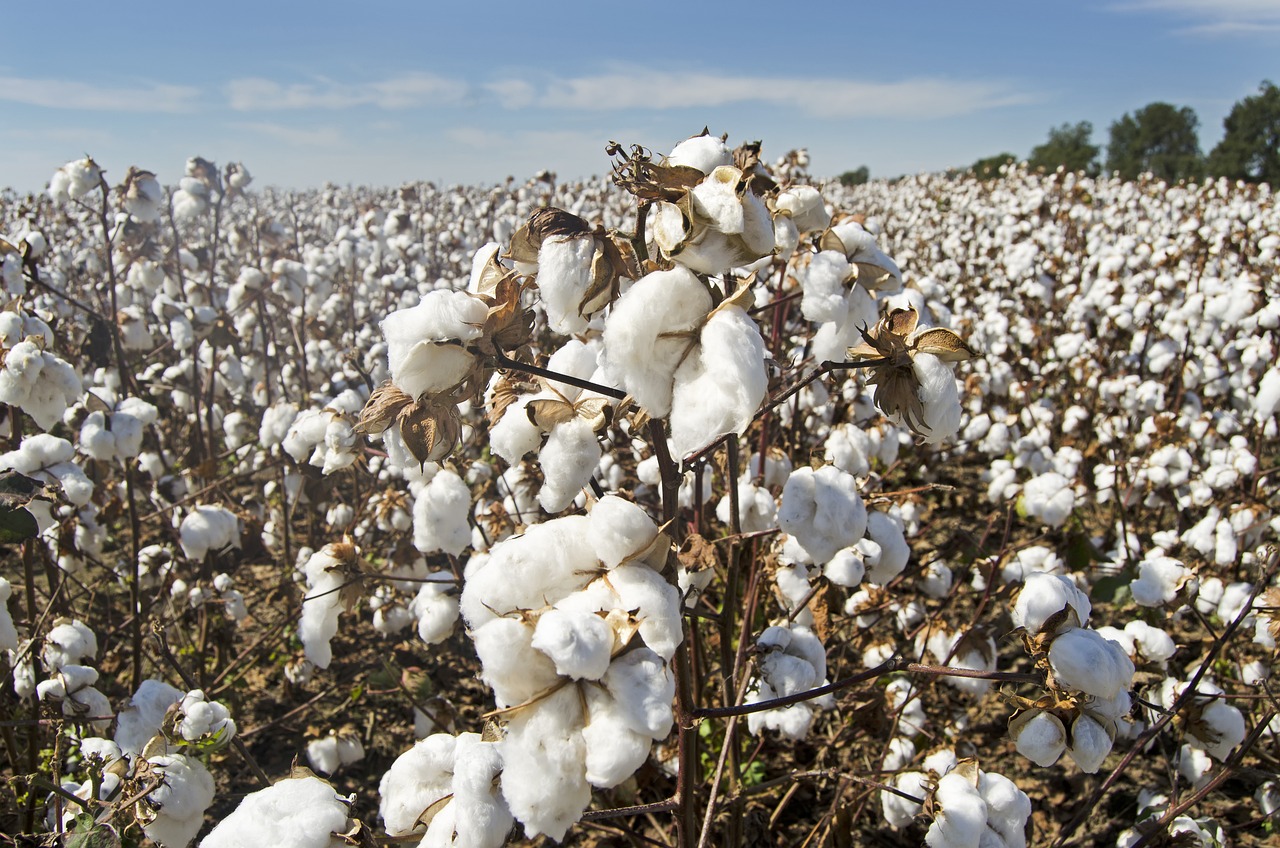
Organic cotton is grown without synthetic pesticides and fertilisers, apart from a short permitted list: the US organic rule allows a product to be sold as organic only if it is produced without synthetic substances except those on its permitted list, and without excluded methods such as genetic modification (7 CFR 205.105). That list includes a few synthetic insecticides, each with restrictions (7 CFR 205.601). That removes most of the chemistry problem, not the water one. Organic rules set no water limit, and cotton’s water footprint depends far more on where it grows: the global study put finished cotton textile at 5,404 m³ per tonne for China and 21,563 for India, counting rain and irrigation, against a world average of 9,359 (Chapagain et al. 2005, table 3.5). Organic, then, is the better cotton, but cotton grown on rain in a wet region can use less irrigation than organic cotton irrigated in a desert. The site’s cotton page covers the fibre itself.
Polyester and nylon: the fibres the world runs on
Polyester is 59% of all fibre made, 82.5 million tonnes in 2025, and it grew faster than recycled polyester, so recycled polyester’s share fell from 12.0% to 11.8% (Textile Exchange, p. 5). Recycling bottles into fibre does cut the footprint: depending on how the bottle’s burden is allocated, recycled PET fibre saves 40–85% of the non-renewable energy and 25–75% of the global warming potential of virgin PET fibre (Shen, Worrell and Patel 2010). Neither version solves shedding. Washing tests at Plymouth found polyester and acrylic fabrics shed significantly more fibres than polyester-cotton, and estimated more than 700,000 fibres from an average 6 kg load of acrylic (Napper and Thompson 2016). The site’s pages on polyester and microfiber go further.

Water: what the 2,700 litres per T-shirt figure really counts
The figure is real, but it is usually quoted without its scope. It comes from a 2005 UNESCO-IHE study of cotton consumption by Arjen Hoekstra and colleagues, which put a 250 g cotton T-shirt at 2,720 litres as a global average for 1997–2001 (Chapagain, Hoekstra, Savenije and Gautam 2005, table 4.4). Less than half of it is water taken from rivers and aquifers:
| Product (standard weight) | Blue water: irrigation and processing | Green water: rain | Dilution water for pollution | Total |
|---|---|---|---|---|
| T-shirt (250 g) | 1,230 L | 1,110 L | 380 L | 2,720 L |
| Jeans (1,000 g) | 4,900 L | 4,450 L | 1,500 L | 10,850 L |
| Single bed sheet (900 g) | 4,400 L | 4,000 L | 1,350 L | 9,750 L |
Three things follow. The rain a cotton field receives would have fallen anyway, so the blue column is the one that drains rivers. The global average hides a several-fold spread between growing countries, shown in the organic cotton section above. And the study put all cotton consumption at 2.6% of global water use. Hoekstra’s later study with Mekonnen gives per-tonne figures for 126 crops and more than 200 products made from them, which give the water column of the ranking: cotton lint 9,113 m³ per tonne and finished cotton fabric 9,982, against flax fibre 3,481, jute 2,605 and hemp 2,447 (Mekonnen and Hoekstra 2011, table 3).
In the mill, the number buyers audit is litres per kilogram of dyed fabric. The site’s water footprint per kilogram of dyed fabric calculator turns a dyehouse’s daily water and output into that figure, and the liquor ratio calculator shows where it comes from in each batch.
Is the textile industry sustainable? The figures that hold up
Not yet, on its own data. Fibre production reached a record 139 million tonnes in 2025, up from 132 million in 2024 and 58 million in 2000, driven by new fossil-based synthetics; fibre from recycled feedstock stayed at about 7.6%, most of it (6.8% of all fibre) recycled polyester from plastic bottles, and less than 1% came from recycled textiles (Textile Exchange, p. 5). In the EU, the textile waste generated, from production to households, is estimated at 12.6 million tonnes, and according to the European Environment Agency less than 1% of clothing waste is made into new clothing (Directive (EU) 2025/1892, recitals). The European Commission ranks EU textile consumption fourth for impact on the environment and climate change, after food, housing and mobility (European Commission).
On climate, the UN Environment Programme gives the fashion industry “between 2 to 8 per cent of global carbon emissions” (UNEP, 12 November 2018). The “10% of global emissions” repeated on many sites, including earlier versions of this page, is not UNEP’s figure, and no primary source for it was found. The same UNEP article gives the comparison most often quoted for waste: the equivalent of one garbage truck of textiles is landfilled or burned every second.
Sustainable textile production: what mills and designers change
Sustainable textile practices in a mill come down to the inputs it controls: the chemicals it buys, the water and energy each kilogram takes, and the waste it cuts away. These are the changes that recur across the standards and the EU rules, with where each is checked.
| Stage | What changes | How it is checked |
|---|---|---|
| Chemical inputs | Restricted substances are kept out of the dyehouse at purchase, rather than tested for in the finished cloth | ZDHC MRSL; bluesign (“managing inputs rather than relying solely on output testing”) |
| Wet processing | Lower liquor ratios, reused rinse water, treated effluent | ZDHC wastewater guidelines; litres per kg in the water footprint calculator |
| Facility management | Environmental and chemical management, and social responsibility and working conditions, certified at the production site | OEKO-TEX STeP; Higg FEM |
| Design | Single-fibre fabrics and removable trims, so the product can be recycled; the EU found 78% of textile products need disassembling before textile-to-textile recycling | ESPR design rules, to come product by product |
| Cutting and unsold stock | Less cutting waste and overproduction; unsold clothes may no longer be destroyed by large EU companies | ESPR Article 25 |
Handloom and hand-spun cloth are often offered as the low-impact answer, and for energy they are: the loom runs on the weaver. The fibre and the dye still decide most of the footprint, so a handwoven cloth of organic cotton or linen, dyed with care, is the strong case; a handwoven cloth of conventional cotton with uncontrolled dyeing is not automatically better than a mill fabric.
Certifications and labels: what each one proves
The most common mistake is to read one label as proof of everything. Each scheme certifies a defined thing, and the register entries linked below give each one’s scope and current edition.
| Label | What it proves | What it does not | Source |
|---|---|---|---|
| GOTS | “Organic” grade: at least 95% certified organic fibre; “Made with Organic Materials”: at least 70%. Covers every processing step from fibre processing and spinning to wet processing, making and trading, with environmental and social criteria. Version 8.1, implementation by 1 March 2027 | It does not certify the farm: “GOTS starts where organic farming activities ends”, and the fibre must be certified organic under a recognised farming standard | Global Standards |
| OCS | Organic content and chain of custody; only material from certified organic farms (under the IFOAM family of standards) is accepted | GOTS’s processing criteria for chemicals and working conditions are not part of it | Textile Exchange |
| GRS | Recycled content, verified to the ISO definition of recycled (pre- and post-consumer accepted), with a 50% minimum recycled content and social, environmental and chemical requirements at each site | Not that the waste was textile: bottle-based polyester qualifies | Textile Exchange |
| RCS | Recycled content and chain of custody only | No social, environmental or chemical requirements | Textile Exchange |
| OEKO-TEX STANDARD 100 | “Textiles tested for harmful substances”, in four product classes from babies (class 1, the strictest) to decoration materials (class 4) | Not organic, not recycled, and says nothing about how the fibre was grown or the mill run | OEKO-TEX |
| OEKO-TEX MADE IN GREEN | A STANDARD 100 (or ORGANIC COTTON or LEATHER) product made in STeP-certified facilities, traceable by product ID or QR code | Not an organic claim unless the ORGANIC COTTON route was used | OEKO-TEX |
| RWS | Wool from farms assessed on animal welfare (the Five Domains), land management and social requirements, with every site to the final sale certified | Not organic, not a carbon claim | Textile Exchange |
| bluesign | Brands, mills and chemical suppliers assessed on chemical safety, resource efficiency, pollution control, health and safety and compliance, with input management at the centre | Not a fibre-origin claim | bluesign |
| Cradle to Cradle Certified | Five categories: material health, product circularity, clean air and climate protection, water and soil stewardship, social fairness | Not a fibre-origin or recycled-content claim | Cradle to Cradle Products Innovation Institute |
| EU Ecolabel | The EU’s official ecolabel for textile products, from fibre criteria (for example on pulp sourcing for viscose) to chemicals in processing | Voluntary: a product carries it only if its maker applies and is licensed | Decision 2014/350/EU |
Worked example: why a 50% recycled blend can fail a 50% claim
Recycled content is certified on what comes out of the mill, not what goes in, and recycled fibre, being shorter, loses more in opening and carding. Take 1,000 kg of recycled cotton and 1,000 kg of virgin cotton, a 50% blend on paper. With an assumed 9% loss on the recycled stream and 4% on the virgin, 910 kg of recycled and 960 kg of virgin fibre come out, and the yarn is 48.66% recycled: 1.34 points short. To reach 50% on the output the spinner needs 1,054.95 kg of recycled fibre in, 54.95 kg more. The losses here are illustrations; a real mill reads them from its waste records, stream by stream. Open this blend in the recycled content calculator and change the losses to your own.
Eco-friendly claims and the law in 2026
The words on the hang tag are now regulated, and the dates below are the ones that matter for textiles sold in the EU and the US.
- Generic claims, EU, from 27 September 2026. The Empowering Consumers Directive bans “making a generic environmental claim for which the trader is not able to demonstrate recognised excellent environmental performance relevant to the claim”. Its examples include “environmentally friendly”, “eco-friendly” and “green”. Recognised excellent performance means the EU Ecolabel, an officially recognised EN ISO 14024 ecolabel, or top performance under other EU law (Directive (EU) 2024/825; register entry: Empowering Consumers Directive).
- Destroying unsold clothes, EU, from 19 July 2026. Large companies may not destroy unsold apparel, clothing accessories or footwear; medium-sized companies from 19 July 2030; micro and small companies are exempt (Regulation (EU) 2024/1781, Article 25 and Annex VII).
- Producer responsibility for textiles, EU, by 17 April 2028. Every member state must have an extended producer responsibility scheme for textiles and footwear, so producers pay for collection, sorting, reuse and recycling (Directive (EU) 2025/1892; register entry: Waste Framework Directive).
- “Biodegradable”, US. The FTC Green Guides call an unqualified degradable claim deceptive for items that end in landfill, incineration or recycling, because those places do not let an item fully decompose within a year (16 CFR 260.8).
- “Bamboo”, US. Unless the fibre is mechanically processed bamboo, the FTC expects the proper generic name for the fibre, “such as rayon, or ‘rayon made from bamboo'” (FTC).
For a maker, the practical rule is to replace adjectives with the specific, checkable claim: “55% recycled polyester, GRS certified” rather than “eco-friendly fabric”. The EU’s 2030 aim, in the Commission’s words, is that textiles on its market are “durable, repairable, recyclable, and, to a great extent, made of recycled fibres, free of hazardous substances” (European Commission, textiles strategy).
How to choose sustainable textiles: a short checklist
- Read the fibre content, not the tag line. The law requires the generic fibre names and percentages; “bamboo” on its own is not a fibre name in the EU or US.
- Prefer one fibre to a blend where you can, and removable trims: it is what makes recycling possible.
- Match the label to the claim. Organic: GOTS or OCS. Recycled: GRS or RCS. Safe on skin: OEKO-TEX STANDARD 100. A certificate number can usually be checked on the scheme’s own website.
- Judge the construction. Dense weaves and knits, firm seams and colourfast dyes outlast a light fabric of a “better” fibre. For handcrafted textiles, look at evenness of the yarn and the weave, finished edges and seams, and ask what the dye is.
- Wash when the garment needs it, not by habit. Every wash wears the fabric, and synthetic fabrics shed fibres into the waste water each time.
Frequently asked questions
What are the most sustainable clothing materials?
On published data: fibre recycled from textile waste (recycled cotton and wool), linen, hemp and closed-loop lyocell. They take little or no irrigation water and avoid the worst process chemistry. Organic cotton and recycled polyester come next, each fixing one problem of its conventional version.
What are sustainable textiles?
Textiles whose fibre, processing and end of life do measurably less harm than the usual alternative. In practice that means less irrigation and land, fewer hazardous chemicals, waste or renewable feedstock instead of new oil, a long life, and a route to reuse or recycling, checked by a certification that covers the claim.
What is the most eco-friendly fabric?
There is no single winner, because fibres trade water against chemistry against end of life. Among new fibres, hemp and jute have the smallest crop water footprints of the common textile crops, with flax (linen) next and all of them well below cotton, and mechanically recycled fibre avoids new land and water altogether. Note that in the EU, “eco-friendly” on a product label is itself restricted from 27 September 2026.
Is recycled polyester sustainable?
It is better than virgin polyester on carbon and energy, by 25–75% and 40–85% in one life-cycle study. But 97% of it comes from bottles rather than old clothes, it sheds microfibres like any polyester, and very little is recycled again. It is an improvement, not a closed loop.
Is OEKO-TEX STANDARD 100 a sustainability label?
No. It certifies that a textile has been tested for harmful substances, with the strictest limits for baby products. It says nothing about organic farming, recycled content or how the mill manages water and energy; OEKO-TEX’s MADE IN GREEN and STeP labels cover production.
Is bamboo fabric eco-friendly?
Bamboo grows fast, but almost all bamboo fabric is viscose (rayon), made with the same solvent chemistry as any viscose. Only mechanically processed bamboo fibre, which is rare, may be sold simply as bamboo in the US.
Sources
- Fibre volumes and shares: Textile Exchange, Materials Market Report 2026 (September 2026), pp. 5, 6 and 15.
- Water: M. M. Mekonnen and A. Y. Hoekstra, “The green, blue and grey water footprint of crops and derived crop products“, Hydrology and Earth System Sciences 15 (2011) 1577–1600, table 3 (data 1996–2005); A. K. Chapagain, A. Y. Hoekstra, H. H. G. Savenije and R. Gautam, The water footprint of cotton consumption, Value of Water Research Report 18, UNESCO-IHE, September 2005, tables 3.5 and 4.4 (data 1997–2001).
- Life-cycle studies: L. Shen, E. Worrell and M. K. Patel, “Open-loop recycling: a LCA case study of PET bottle-to-fibre recycling” and “Environmental impact assessment of man-made cellulose fibres“, Resources, Conservation and Recycling 55 (2010).
- Microfibres: I. E. Napper and R. C. Thompson, “Release of synthetic microplastic plastic fibres from domestic washing machines“, Marine Pollution Bulletin 112 (2016) 39–45.
- Crops and fibre making: Alliance for European Flax-Linen and Hemp; PROTA, Cannabis sativa; Lenzing, technologies; US EPA, cellulose products manufacturing NESHAP.
- Climate and waste: UNEP, “Putting the brakes on fast fashion” (12 November 2018); European Commission, EU strategy for sustainable and circular textiles.
- Standards: GOTS key features; Textile Exchange RCS and GRS and RWS; OEKO-TEX STANDARD 100; bluesign criteria; Cradle to Cradle Certified.
- Law: Directive (EU) 2024/825; Regulation (EU) 2024/1781; Directive (EU) 2025/1892; Decision 2014/350/EU; 7 CFR 205.105 and 205.601; 16 CFR 260.8; FTC, How to avoid bamboozling your customers (August 2009).
How this page is kept
Last verified: 18 October 2026. Fibre volumes are from Textile Exchange’s annual Materials Market Report and are replaced when the next edition appears. Water figures are the published global averages of Hoekstra and colleagues’ water footprint studies, quoted with their data years; they are not this site’s estimates. Certification details are read from each scheme owner’s own pages, and legal dates from the official texts on EUR-Lex and the eCFR. The ranking is this page’s judgment from those sources, made by the rule stated above it. The worked example uses the site’s recycled content calculator as it stood on this date, and the prefilled link was opened to check that it shows the figures quoted.
Change log. 18 October 2026: rewritten in full, and four overlapping articles on the same subject were merged into this page. Corrected from the earlier versions: the fashion industry’s share of global emissions is 2–8% in UNEP’s own words, not the “10%” those pages attributed to it; the “over 700,000 microplastics per wash” was measured for acrylic in a 6 kg load, not polyester; the 2,700 litres per T-shirt is a global average that counts rain and dilution water, and only 1,230 litres of it is irrigation and process water; OEKO-TEX STANDARD 100 tests for harmful substances and is not a sustainability or organic label; and the GOTS label grades are “organic” (95%) and “made with organic materials” (70%). An organic cotton growth rate of “37% a year”, water and carbon figures for organic cotton and hemp whose primary studies could not be read, unnamed mill case studies and brand endorsements were withdrawn.
Found an error, or a newer figure? Please tell us through the contact page, naming the section and the source that disagrees.