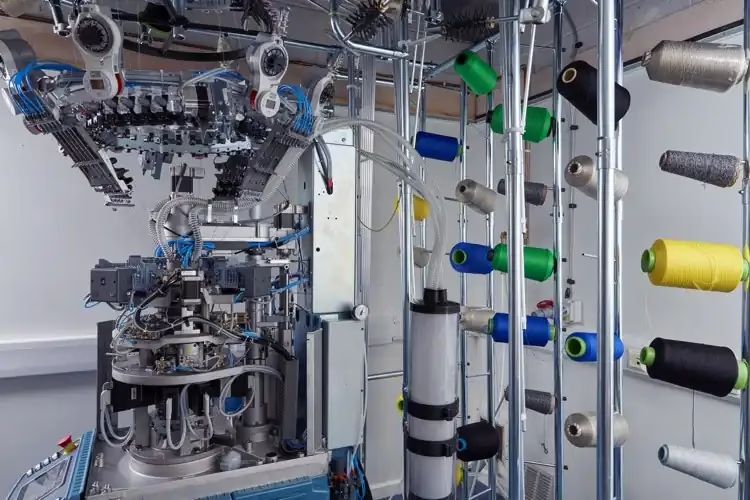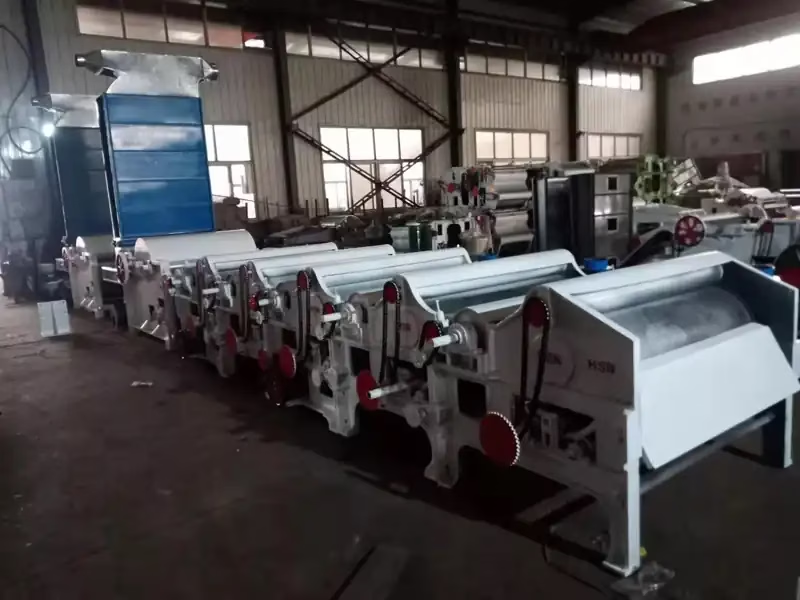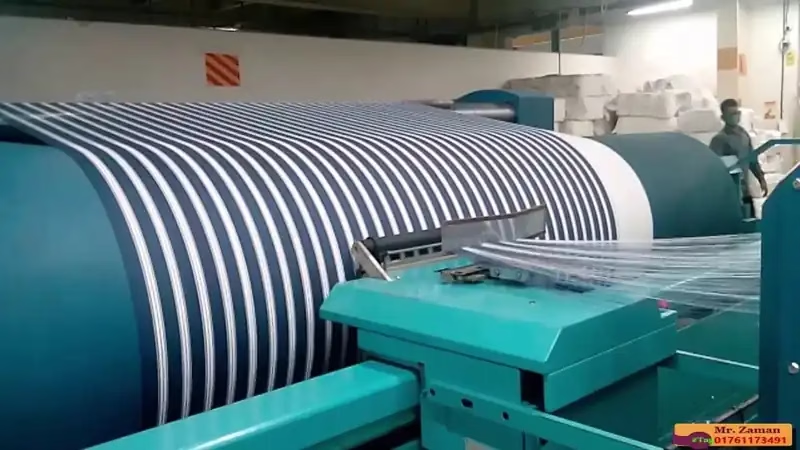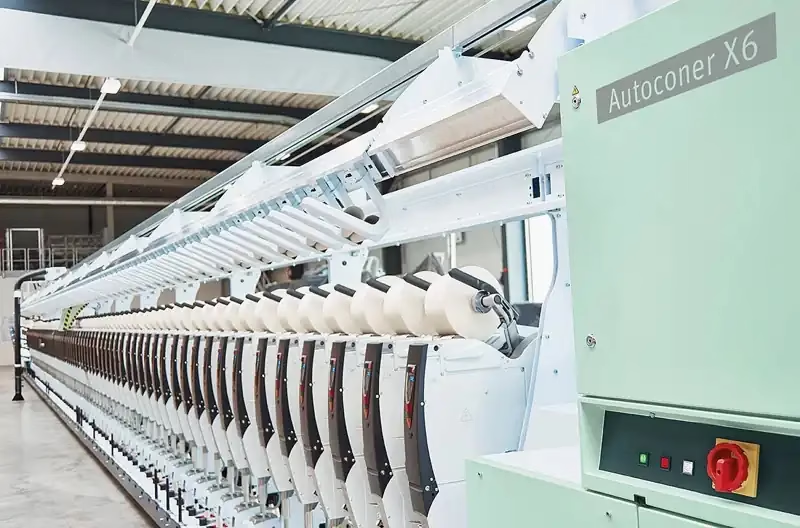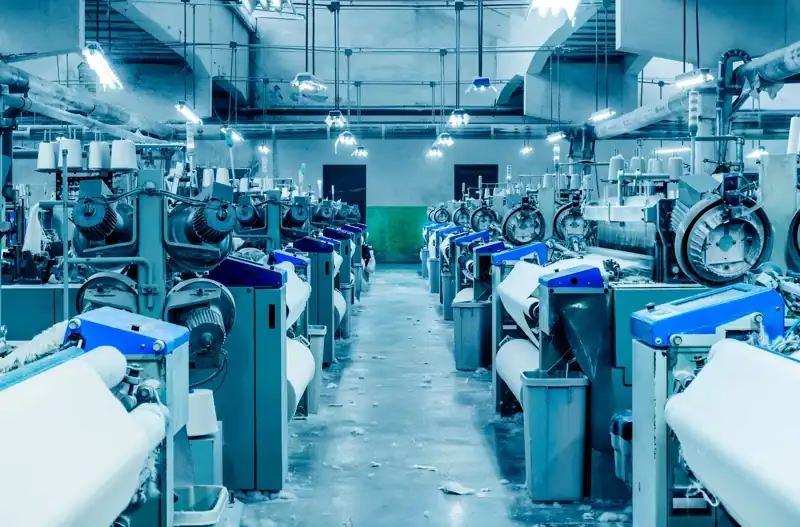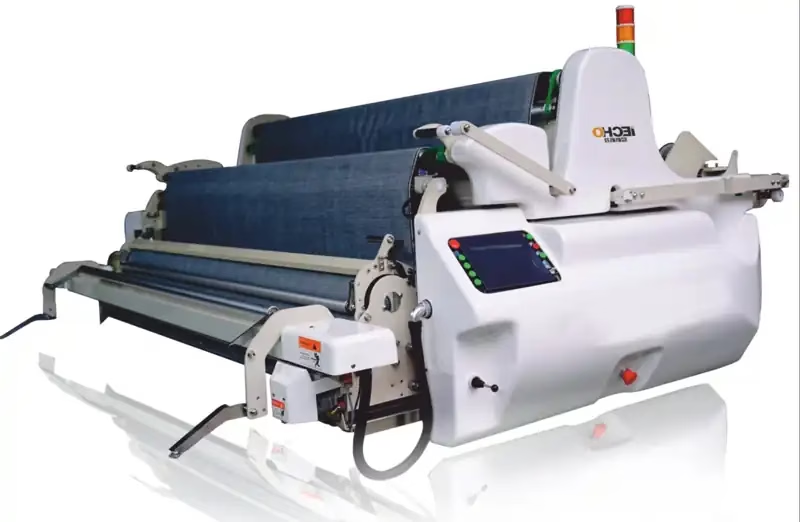
Textile machinery maintenance and downtime calculations are critical for ensuring consistent production, reducing operational costs, and maintaining high-quality output in textile manufacturing. This guide outlines key maintenance strategies—preventive, predictive, and corrective—to extend equipment lifespan and prevent failures. It includes detailed calculations for downtime percentage, cost of downtime, MTBF, and MTTR, which quantify the impact of planned and unplanned stoppages. Practical examples demonstrate applications in spinning and weaving, supported by industry-standard formulas and benchmarks. These calculations enable manufacturers to optimize maintenance schedules, reduce financial losses, and align with standards such as ASTM D7863-17, fostering efficient and sustainable operations.
1. Introduction
Textile machinery maintenance is critical for ensuring operational efficiency, consistent product quality, and minimal downtime in textile manufacturing. Effective maintenance strategies, such as preventive, predictive, and corrective maintenance, reduce unexpected breakdowns, extend equipment lifespan, and optimize production. Downtime, whether planned or unplanned, directly impacts productivity and costs. This document provides a comprehensive guide to maintenance practices and downtime calculations specific to textile machinery, including formulas, derivations, and practical examples to support textile engineers, maintenance managers, and production planners in optimizing operations.
2. Maintenance Strategies for Textile Machinery
2.1 Preventive Maintenance
Purpose: Scheduled maintenance to prevent failures by cleaning, lubricating, adjusting, or replacing components at regular intervals.
Key Activities:
- Cleaning: Remove dust, lint, and contaminants from spinning frames, looms, and dyeing machines to prevent wear.
- Lubrication: Apply appropriate lubricants to bearings, gears, and moving parts to reduce friction and corrosion.
- Inspection: Regular checks for wear, misalignment, or damage in components like belts, needles, and rollers.
- Component Replacement: Replace wearable parts (e.g., belts, seals) based on manufacturer recommendations or usage cycles.
Frequency: Typically monthly or quarterly, depending on machine type, usage intensity, and manufacturer guidelines.
Example: For a ring spinning frame, lubricate bearings every 500 hours of operation and replace belts every 6 months.
Reference: ASTM D7863-17 (Guide for Maintenance of Textile Machinery)
2.2 Predictive Maintenance
Purpose: Uses real-time data and sensors to predict failures before they occur, minimizing unplanned downtime.
Key Technologies:
- IoT Sensors: Monitor vibration, temperature, and pressure to detect anomalies (e.g., overheating in a loom motor).
- Data Analytics: Machine learning algorithms analyze sensor data to predict maintenance needs.
- Condition-Based Alerts: Automated alerts notify technicians of potential issues (e.g., excessive vibration in a carding machine).
Example: A temperature sensor on a dyeing machine detects a 10°C rise above normal, triggering maintenance before a failure occurs.
Benefits: Reduces downtime by up to 44% and maintenance costs by 20–25% compared to reactive strategies.
Reference: Textile Institute, Maintenance Management
2.3 Corrective Maintenance
Purpose: Addresses immediate repairs for unexpected failures, restoring machinery to operational status.
Key Activities:
- Diagnosis: Identify the root cause (e.g., a broken rapier in a weaving loom).
- Repair/Replacement: Fix or replace faulty components (e.g., a damaged needle bar in a knitting machine).
- Testing: Verify machine performance post-repair to ensure quality output.
Example: A sudden stoppage in a rapier loom due to a broken weft feeder requires immediate replacement and recalibration.
Drawback: High costs and downtime due to unplanned nature; should be minimized through preventive and predictive strategies.
3. Downtime Calculations for Textile Machinery
3.1 Types of Downtime
- Planned Downtime: Scheduled stoppages for maintenance, inspections, or operator training.
- Example: 2 hours monthly for lubricating a carding machine.
- Unplanned Downtime: Unexpected stoppages due to equipment failure, human error, or supply chain issues.
3.2 Downtime Percentage
Purpose: Measures the proportion of time a machine is inoperable relative to planned operating time.
Formula:
Downtime (%) = (Downtime Hours / Planned Operating Hours) × 100
Derivation: Compares total downtime (planned and unplanned) to the scheduled operational time, expressed as a percentage.
Example: A weaving loom has a planned operating time of 240 hours/month. It experiences 10 hours of planned maintenance and 5 hours of unplanned downtime.
Downtime (%) = (10 + 5) / 240 × 100 = 15 / 240 × 100 = 6.25%
Benchmark: Industry target is <10% downtime for efficient production.
3.3 Cost of Downtime
Purpose: Quantifies financial losses due to downtime, including labor, production, and overhead costs.
Formula:
Cost of Downtime ($) = (Hourly Production Value × Downtime Hours) + (Hourly Labor Cost × Number of Workers × Downtime Hours) + (Hourly Overhead Cost × Downtime Hours) + Indirect Costs
Derivation: Combines direct costs (lost production, idle labor, overhead) with indirect costs (e.g., lost revenue, customer dissatisfaction).
Example: A spinning mill produces 500 meters of yarn/hour at $10/meter, has 5 workers at $20/hour, and overhead costs of $50/hour. A 3-hour unplanned downtime occurs.
Direct Cost = (500 × 10 × 3) + (20 × 5 × 3) + (50 × 3) = $15,000 + $300 + $150 = $15,450
Indirect Cost (estimated lost future revenue) = $500
Total Cost = $15,450 + $500 = $15,950
3.4 Mean Time Between Failures (MTBF)
Purpose: Measures equipment reliability by calculating the average time between failures.
Formula:
MTBF (hours) = Total Operating Time / Number of Failures
Derivation: Divides total operational hours by the number of failure events to assess machine reliability.
Example: A knitting machine operates 1,000 hours and experiences 4 failures.
MTBF = 1,000 / 4 = 250 hours
Benchmark: Higher MTBF indicates reliable equipment; textile industry targets >500 hours for critical machines.
3.5 Mean Time to Repair (MTTR)
Purpose: Measures the average time to restore a machine to operational status after a failure.
Formula:
MTTR (hours) = Total Repair Time / Number of Repairs
Derivation: Divides total repair time by the number of repair events to assess maintenance efficiency.
Example: A dyeing machine requires 12 hours for 3 repairs.
MTTR = 12 / 3 = 4 hours
Benchmark: Textile industry targets MTTR <2 hours for efficient maintenance.
4. Practical Applications and Examples
4.1 Maintenance Schedule for a Ring Spinning Frame
Scenario: A spinning mill operates 20 ring frames, each running 24 hours/day for 25 days/month (600 hours).
Maintenance Plan:
- Preventive Maintenance: Lubricate bearings every 500 hours (1 hour/task, 2 tasks/month); replace belts every 6 months (2 hours/task).
- Predictive Maintenance: Install vibration sensors to monitor spindle health, with alerts for deviations >0.5 mm/s.
- Corrective Maintenance: Address motor failures (average 1 failure/month, 3 hours/repair).
Downtime Calculation: - Planned Downtime: 2 × 1 (lubrication) + 0.33 × 2 (belt replacement, prorated) = 2.66 hours/month.
- Unplanned Downtime: 1 × 3 = 3 hours/month.
- Total Downtime: 2.66 + 3 = 5.66 hours.
- Downtime (%): (5.66 / 600) × 100 = 0.943%.
- Cost of Downtime: Production value = 200 kg/hour × $5/kg; 5 workers at $15/hour; overhead = $40/hour.
Cost = (200 × 5 × 5.66) + (15 × 5 × 5.66) + (40 × 5.66) = $5,660 + $424.5 + $226.4 = $6,310.9
Analysis: Downtime is within the 10% benchmark, but predictive maintenance could reduce unplanned downtime further.
4.2 Downtime Reduction for a Rapier Loom
Scenario: A weaving unit operates 10 rapier looms, each producing 100 meters/hour at $8/meter, with 3 workers at $18/hour and overhead of $60/hour. Unplanned downtime averages 4 hours/month due to weft feeder failures.
Action Plan:
- Implement predictive maintenance with IoT sensors to monitor weft feeder tension.
- Train operators to reduce human errors (e.g., incorrect settings).
- Maintain spare parts inventory to reduce MTTR.
Downtime Cost (Before):
Cost = (100 × 8 × 4) + (18 × 3 × 4) + (60 × 4) = $3,200 + $216 + $240 = $3,656/month
After Predictive Maintenance: Reduces unplanned downtime to 1 hour/month.
Cost = (100 × 8 × 1) + (18 × 3 × 1) + (60 × 1) = $800 + $54 + $60 = $914/month
Savings = $3,656 - $914 = $2,742/month
5. Summary Table of Key Calculations
| Category | Formula | Example (Ring Spinning Frame) |
|---|---|---|
| Downtime (%) | (Downtime Hours / Planned Operating Hours) × 100 | (5.66 / 600) × 100 = 0.943% |
| Cost of Downtime ($) | (Hourly Production Value × Downtime Hours) + (Hourly Labor Cost × Workers × Downtime Hours) + (Hourly Overhead Cost × Downtime Hours) | (200 × 5 × 5.66) + (15 × 5 × 5.66) + (40 × 5.66) = $6,310.9 |
| MTBF (hours) | Total Operating Time / Number of Failures | 1,000 / 4 = 250 hours |
| MTTR (hours) | Total Repair Time / Number of Repairs | 12 / 3 = 4 hours |
6. Conclusion
Effective maintenance of textile machinery, through preventive, predictive, and corrective strategies, is essential for minimizing downtime and ensuring high-quality production. Downtime calculations, including downtime percentage, cost, MTBF, and MTTR, provide critical insights into operational efficiency and financial impacts. By implementing data-driven maintenance and robust downtime tracking, textile manufacturers can reduce unplanned stoppages, optimize resource allocation, and enhance profitability. These practices align with industry standards and support sustainable, competitive operations.