
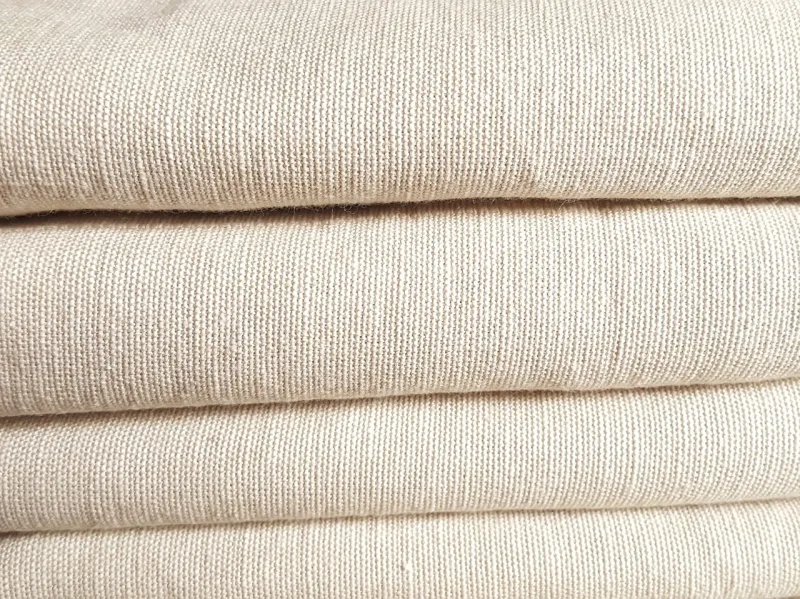
Linen is cloth woven from flax, the fibre that grows in the stem of the flax plant, Linum usitatissimum. Flax is the plant and its fibre; linen is the yarn and fabric made from it, and EU labelling law treats the two words as one fibre name, “flax (or linen)”. Linen is strong, takes up more moisture than cotton, lets air through and is prized for hot weather, but it creases easily because the fibre barely stretches. It is slow to make: flax is pulled rather than cut, left in the field for weeks to ret, then scutched and combed before it can be spun. It is also a small fibre, about 0.3% of all the fibre made in the world in 2024, according to Textile Exchange.
The questions buyers ask come first, then how flax becomes linen, with every figure sourced: the fibre’s measured properties, retting, scutching and wet spinning, what the European flax labels certify, and linen in India. Three of the site’s calculators are worked through, each with a link that opens the tool with the same figures entered.
Last verified: 5 October 2026. Sources are linked where they are used and listed at the end.
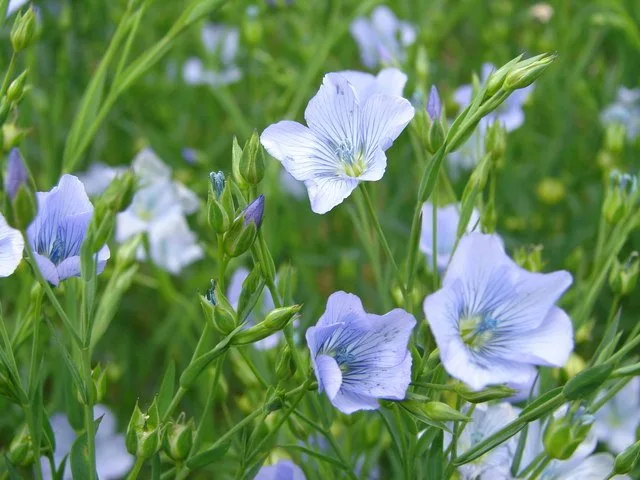
Is flax the same as linen?
Yes, in the sense that matters on a label. The EU’s textile-names regulation lists the fibre as “flax (or linen)” and defines it as “fibre obtained from the bast of the flax plant (Linum usitatissimum)”, and it reserves each listed name for the fibre it describes: the names “shall not be used for other fibres, whether on their own or as a root or as an adjective” (Regulation (EU) No 1007/2011, Article 5 and Annex I). In the United States, “linen” is one of the generic names a fibre label may use (16 CFR 303.6). A “linen-look” fabric of cotton or polyester is not linen. The one mixture the EU names is the “cotton linen union”, a fabric with a pure cotton warp and a pure flax weft that is at least 40% flax by weight (Article 9).
In everyday English the two words divide the work: flax is the plant, its seed and its raw fibre; linen is the thread and the cloth. The word linen comes from Old English līn, flax, borrowed early from Latin linum, and its use for household articles collectively, the sense in which sheets and tablecloths are still “linens” whatever they are made of, is recorded from 1748 (Online Etymology Dictionary). The species name usitatissimum means “most useful” (Old Dominion University). The site’s bed linen calculator works out the fabric a sheet or pillowcase takes, whatever its fibre.
The same species is grown for two crops. Fibre flax is grown for its long stems. Linseed, or seed flax, is grown for oil: “short branching plants are grown until seeds are fully matured”, with thicker stems than fibre flax, and the oil is “widely used in paints, varnishes, cosmetics, and linoleum” (Akin, 2013). Linseed straw also yields a fibre, but a coarse one, used mainly for paper.
Is linen breathable?
Yes, on both counts that breathability usually means: linen fabrics let air through readily, and the fibre itself takes up water vapour. The museum reference CAMEO, of the Museum of Fine Arts, Boston, gives flax a moisture regain of 12% (CAMEO, linen), the same figure the EU uses as flax’s agreed moisture allowance, against 8.50% for cotton (Regulation 1007/2011, Annex IX). Measured regain varies with the fibre and the test: one 2023 study found its flax fibres held 8.80 to 9.44% at 65% relative humidity (Różańska and colleagues).
Whether linen feels cooler than cotton is less settled than its reputation. A 2025 study knitted 100% linen and 100% cotton into the same single jersey, from the same yarn count, at about 180 g/m², and measured both. The linen fabrics “showed higher air permeability values than 100% cotton”, but the cotton fabrics had the higher thermal absorptivity, “indicating that these fabrics felt colder” at first touch (Taştan Özkan and colleagues, Tekstil ve Konfeksiyon, 2025). So linen’s comfort in heat comes mostly from how freely air and vapour move through it, and from the open, crisp fabrics it is usually woven into, rather than from a cold handle. The site’s air permeability calculator works from a tester reading made to ISO 9237, and the moisture regain calculator turns a weighing into regain.
Does linen shrink?
It can, a lot, unless the fabric has been stabilised. In a study of linen honeycomb fabrics washed five times at 30 °C, stabilisation in finishing cut the shrinkage “by a factor of between 6 and 19”: the stabilised fabrics shrank 0.50 to 2.50% in warp and weft, while the unstabilised ones shrank roughly 9 to 19% in the paper’s charts. The authors give the working limit: “No more than 2% shrinkage in the cross and lengthways directions of the fabric is allowable” (Malčiauskienė, Rukuižienė and Milašius, Fibres and Textiles in Eastern Europe, 2008). Much of linen’s shrinkage happens at the mill: a 70/30 linen and silk fabric measured to ISO 3759 lost 16% of its warp length in washing and softening at the mill, and 23% when it was dyed (Kumpikaitė and colleagues, Coatings, 2022).
For a buyer the practical rule is to choose linen sold as pre-washed or stabilised and to wash it at the temperature on the label. For a maker, shrinkage is measured, not guessed: ISO 5077 measures dimensional change in washing and drying, using the procedures of ISO 6330, and the relaxation shrinkage calculator turns before-and-after measurements into a percentage. The wash shrinkage calculator sizes a pattern for fabric that will still shrink.
Worked example: what shrinkage costs a linen sheet. Take a flat sheet finished at 260 by 180 cm, with 12 cm of hems on the length and 4 cm on the width, 3% for cutting loss, cut from 160 g/m² linen sheeting 280 cm wide (assumed figures). If the fabric is stabilised to the 2% limit, the bed linen calculator cuts each sheet 277.55 by 187.76 cm and uses 2.86 m of fabric, 1.28 kg. Allow 9% instead, the low end of the unstabilised fabrics above, and the cut grows to 298.90 by 202.20 cm and 3.08 m, 1.38 kg: almost 8% more fabric for every sheet. A sheet cut for 2% from fabric that then shrinks 9% ends up about 19 cm short.
Why does linen crease so easily?
Because the fibre hardly stretches and does not spring back. Flax breaks at an elongation of about 1.8% dry and 2.2% wet (CAMEO, flax). Like cotton it is cellulose, but in the words of the Discover Natural Fibres Initiative its “structure is more crystalline, making it stronger, crisper and stiffer to handle, and more easily wrinkled” (DNFI). A fold presses the fibres past the small strain they can recover from, and the crease stays. The stiffness that creases also gives linen its crisp fall, which the drape coefficient calculator measures.
Linen vs cotton
Cotton is the fibre linen is most often compared with and blended with. Both are cellulose; they differ in where they grow on the plant, how long and stiff they are, and how much of each the world makes.
| Linen (flax) | Cotton | |
|---|---|---|
| Where the fibre grows | In bundles in the stem, a bast fibre | As hairs on the seed |
| World production, 2024 | About 0.3 million tonnes, 0.3% of all fibre | About 24.5 million tonnes, 19% |
| Moisture regain | 12% (CAMEO) | 7.0 to 8.5% (CAMEO) |
| Agreed moisture allowance, EU | 12.00% | 8.50% |
| Creasing | Creases easily: a stiffer, more crystalline fibre that stretches about 2% before breaking | Creases less |
| Feel, same knitted construction | More air permeable | Higher thermal absorptivity: cooler at first touch |
| Washing | Boil-wash at 70 or 95 °C if white and boil-proof | The same |
| Ironing | Three dots, up to 210 °C, while damp | The same |
| Clothes moths | Larvae cannot digest it | Larvae cannot digest it |
| Water footprint of the fibre, global average | 3,481 m³ a tonne | 9,113 m³ a tonne (lint) |
| Export value | Scutched flax left the EU at an average 4.66 euros a kilogram in 2025 | World price 88.78 US cents a pound in July 2026 |
Sources for the table: production, Textile Exchange (Materials Market Report 2025); regain and elongation, CAMEO (linen, cotton); creasing, DNFI; allowances, Regulation 1007/2011, Annex IX; feel, Taştan Özkan and colleagues (2025); washing and ironing, GINETEX; moths, North Carolina State Extension; water footprint, global averages for 1996 to 2005 (Mekonnen and Hoekstra, 2011); flax value, Eurostat’s Comext data for HS 5301.21, 854.45 million euros for 183,233 tonnes. That is an average customs value, not a quoted price, and it swings: in 2024 the same flows averaged 8.08 euros a kilogram. Cotton is from this site’s monthly world cotton series (IMF); the daily Chinese cotton futures series is also carried. The site has no flax price series, because no exchange quotes flax. Even at the lower 2025 value, scutched flax cost more than twice cotton’s world price by weight.
Worked example: invoicing a linen and cotton yarn. Fibre is sold at a commercial weight: its oven-dry mass plus an agreed allowance for moisture. Take 2,000 kg of 55/45 linen and cotton yarn that a laboratory finds holding 7.5% moisture on its dry weight (an assumed figure). With the EU allowances, 12% for flax and 8.50% for cotton, the blend’s allowance is 10.43%, and the blend invoice weight calculator gives an oven-dry mass of 1,860.47 kg and a commercial weight of 2,054.42 kg. Treat the linen as if it were cotton, at 8.50%, and the commercial weight falls to 2,018.60 kg: about 36 kg, or 1.7%, of the invoice depends on using flax’s own allowance. Whether a fabric holds the blend it claims is a laboratory question; the fibre content tolerance calculator checks a test result against the label.
How to wash, dry and iron linen
Follow the care label: it states the most severe treatment the article survives. The symbols are set by ISO 3758:2023 and explained by GINETEX, the international association for care labelling (GINETEX care symbols).
- Washing. The figure in the wash tub is a maximum. GINETEX lists “cotton or linen, white, suitable for boiling” among the articles for its 70 °C and 95 °C boil washes. Most linen clothes are dyed, blended or only partly stabilised, and are labelled far lower, so read the label rather than the fibre.
- Drying. Heat and tumbling add to shrinkage. Dry linen flat or on a line unless the label shows a tumble-dry symbol, and take it down while it is still slightly damp if it is to be ironed.
- Ironing. Three dots in the iron symbol mean a sole plate of up to 210 °C, which GINETEX equates with the “cotton/linen” setting, with the instruction to “iron whilst damp”. Iron dark or shiny linen inside out or under a pressing cloth, as GINETEX advises for shiny or pressure-sensitive pieces.
- Storage. Clothes-moth larvae “cannot digest fibers made from cellulose, such as cotton, rayon, or linen” (North Carolina State Extension), though they will damage a blend with wool. Silverfish, on the other hand, “will eat starched flax” (CAMEO). CAMEO also notes that linen degrades slowly in sunlight, so store it out of the light.
Pros and cons of linen
| Advantages | Disadvantages |
|---|---|
| Strong and crisp, with bundles long enough to spin smooth, fine yarn (properties) | Creases easily and does not recover (creasing) |
| Takes up more moisture than cotton and lets air through (breathability) | Unstabilised fabric can shrink by 9% or more (shrinkage) |
| Withstands boil washes and a hot iron when the label allows (care) | Costs more than cotton: scutched flax left the EU at more than twice cotton’s world price per kilogram (linen vs cotton) |
| Not eaten by clothes moths | Little stretch, so close-fitting garments need a blend or a knit |
| Traceable to its fields under the European labels (labels) | Supply depends on the weather of one coastal strip of Europe (production) |
Properties of flax fibre
A flax “fibre” means two different things. The elementary fibre is a single plant cell, a few centimetres long. In the stem, and in the line flax that is spun, these cells are glued by pectin into technical fibres, or bundles, long enough to run most of the stem’s length. Properties of the two differ, so the table names which one each figure describes.
| Property | Value | Source |
|---|---|---|
| Elementary fibre length | 6 to 65 mm; 10 to 80 mm in a composites study | CAMEO; Martin, Davies and Baley (2014) |
| Elementary fibre diameter | 15 to 20 µm; widths of 8 to 32 µm are recorded | Akin (2013); CAMEO |
| Length of scutched fibre bundles | 74 ± 9 cm, up to 85 cm, in one industrial batch | Martin and colleagues (2014) |
| Density | 1.5 g/cm³; 1.53 to 1.54 for elementary fibres; 1.40 measured for scutched bundles, which contain voids | CAMEO; Bourmaud and colleagues (2018); Martin and colleagues |
| Tensile strength, elementary fibres | 595 to 1,510 MPa | Bourmaud and colleagues (2018) |
| Tenacity, fibre bundles (3 mm gauge) | 13.88 cN/tex dew-retted, 24.15 cN/tex water-retted, in one study | Różańska and colleagues (2023) |
| Elongation at break | 1.8% dry, 2.2% wet; 1.6 to 3.6% for elementary fibres | CAMEO; Bourmaud and colleagues |
| Moisture regain | 12%; 8.80 to 9.44% measured at 65% relative humidity | CAMEO; Różańska and colleagues |
| Agreed moisture allowance, EU | 12.00% | Regulation 1007/2011, Annex IX |
| Composition, review ranges | Cellulose 60 to 85%, hemicellulose 14.0 to 20.6%, pectin 1.8 to 15.0%, lignin 1 to 3%, wax 1 to 6% | Bourmaud and colleagues (2018) |
| Composition, one water-retted flax | Cellulose 74.83%, hemicellulose 14.43%, lignin 3.07%, pectin 1.16%, wax 1.42% | Różańska and colleagues (2023) |
| Heat and light | Degrades slowly in sunlight and at temperatures above 120 °C | CAMEO |
| Chemicals | Resists alkali, dilute acid and most organic solvents; degraded by strong acids | CAMEO |
Two things stand out. Flax is strong but barely stretches, which is what makes linen crisp and quick to crease. And its strength depends on how it was retted: in the 2023 study, dew-retted bundles were markedly weaker than water-retted ones, and over-active fungal enzymes in the field are one known cause of weak fibre (retting). Flax may also gain strength when damp: a study of flax tow found its breaking tenacity rose with moisture content up to 25% (Radkar and colleagues, Sustainability, 2019).
Worked example: reading a tenacity in other units. Fibre papers quote strength in megapascals, mills in centinewtons per tex or grams per denier. Put the water-retted bundle figure, 24.15 cN/tex, and a density of 1.5 g/cm³ into the textile unit converter: it is 2.74 g/den, a stress of 362.25 MPa and a breaking length of 24.63 km. The dew-retted bundles, at 13.88 cN/tex, come to 1.57 g/den and 208.20 MPa. Both sit well below the 595 to 1,510 MPa of single elementary fibres, because a bundle breaks at its weakest cell and at the pectin between cells.
How to identify linen: the burn test and the microscope
Burn test. Linen burns like cotton, not like a synthetic: it does not melt or form a bead. CAMEO notes that linen “burns but is difficult to ignite”, that the flame is easily blown out, and that the ash “is readily crumbled” (CAMEO). Once alight, cellulose fibres burn with a yellow flame and an afterglow, smell of burning paper and leave a soft grey ash (Ankara University course notes). The test separates linen from synthetics but not from cotton, viscose or hemp, which behave the same way.
Microscope. Seen along its length, a flax fibre shows “prominent nodes with cross-markings and dislocations”, distributed at random, some crossing to form X or V shapes, and its lumen, the central channel, is barely visible; “linen fibers have knots and joints that are not seen on cotton” (CAMEO, flax and linen). These nodes are kink bands in the cell wall, on average about 100 µm apart. Cut across, a flax fibre is roughly hexagonal, and its walls are so thick that the lumen occupies “only a few percent” of the section (Bourmaud and colleagues, 2018). CAMEO also records that a chlorine test stains linen fibres bright red. CAMEO warns that flax is “difficult to distinguish from other bast fiber” such as hemp and ramie, so a laboratory is needed to separate them reliably. The site’s fibre identification guide covers the other fibres.
How linen is made
Linen takes longer to make than any other common fibre, because the fibre must be freed from the stem before it can be spun. The steps are growing and pulling, retting, breaking and scutching, hackling, spinning, and weaving.

Growing and pulling
In Western Europe, the European trade body explains, flax is sown in March or April, and “the plants reach maturity after 100 days”. It flowers in June, each flower living only several hours, and grows to about 100 cm. “Flax is not cut, but rather pulled, to preserve the full length of the stems” (Alliance for European Flax-Linen and Hemp). The fibre lies in bundles in the outer part of the stem, between the skin and the woody core, and the length of the stem is the length of the bundles a spinner can use.
Retting: dew, water and enzymes
Retting is a controlled rot. Microbes break down the pectins that cement the fibre bundles to the skin and the core, so that machines can then separate them. It decides the fibre’s quality. Under-retting leaves “poor separation of the cuticle/epidermis layer and the woody inner tissues”, so the fibre stays dirty with shive; over-retting means “the cellulosic fibers are weakened by overly active cellulases” (Akin, 2013). There are three ways to do it.
- Dew retting (field retting) is how nearly all textile flax is retted today. The pulled stems are laid in swaths on the field, where dew, rain and sun let soil fungi colonise them. In Western Europe it runs from July to September, and the swaths are turned halfway (Alliance); a 2023 review puts it at 28 to 41 days, depending on region and weather (Różańska and colleagues). It is cheap and gives good yields, but the quality is inconsistent, the field is tied up for weeks, and it only works where the weather is right: Akin notes that England, Scandinavia and Ireland, once linen country, are “unable to ret because of the noncompliant climates”.
- Water retting sank the stems in rivers, lakes or ponds “for five to seven days”, where bacteria did the work. It gave long, strong, fine fibre, but the cost, the pollution and the stench led to its being “abandoned for the most part in the mid 1950s in western Europe” (Akin). Warm-water retting in tanks takes 70 to 100 hours (Różańska and colleagues). The Masters of FLAX FIBRE label prohibits it (labels).
- Enzyme retting replaces the microbes with their enzymes. In a pilot-plant trial, a commercial enzyme mixture at 45 °C retted flax in 24 hours, with fibre yield and quality equal to water retting. It has not replaced dew retting; “likely enzyme costs and lack of industry support prevented further development” (Akin).

Breaking, scutching and hackling: line and tow
The retted straw goes to a scutching mill and is cleaned mechanically in two stages. Scutching, a fully mechanical process that can be done at any time of year, separates the fibre from the woody core of the stem (Alliance): it “uses a specialized system to beat and stroke long fibers to remove shive”, the broken core; hackling then uses “a specialized instrument to comb, straighten, and align fibers” (Akin, 2013). Scutching yields two fibres. The long fibre, called line, keeps the stem’s length; the short, tangled fibre beaten out with the shive is tow. Hackling the line in turn combs out more short fibre, hackled tow.
Most of the straw’s weight is not fibre. In an industrial scutching line studied in France, “the scutching process yielded 25% of scutched fibers, 11% of tows, 5% of seed”, the rest being shives, and the scutched bundles measured 74 ± 9 cm (Martin, Davies and Baley, 2014). Nothing is wasted: the trade body lists the shives’ uses as “mulches, animal bedding (horses, sheep, goats, and rabbits), panels, and fuel”, and the seed is resown or pressed for linseed oil (Alliance).
Spinning: wet and dry
Hackled line is drawn out into a sliver and spun in one of two ways.
- Wet spinning soaks the flax in hot water as it is spun, which makes it supple enough to draw out into finer yarn. The trade body describes “immersing the fibres in water heated to 60°C” for clothing and household linen (Alliance); the French spinner Safilin soaks its sliver “in water of approximately 70°C in order to make it more flexible” (Safilin). Wet spinning gives the fine, smooth yarns of shirting and sheeting: Safilin offers wet-spun counts from Nm 6 to Nm 50, Nm 20 to 26 being the most used for weaving (Safilin, uses of linen yarn), and the trade body gives the whole range of linen yarn as “Nm1 to Nm60, sometimes even reaching Nm100”.
- Dry spinning spins without the bath, mainly from tow, and makes a “more rustic and thicker yarn” for furnishing fabrics and cordage (Alliance). Safilin’s dry-spun yarns run from Nm 1.8 for scutching tow to Nm 12 for long fibre.
Short flax can also be “cottonized”: cut and refined into short fibres and spun with cotton on cotton-system machinery (Akin, 2013), the route the chart below shows.
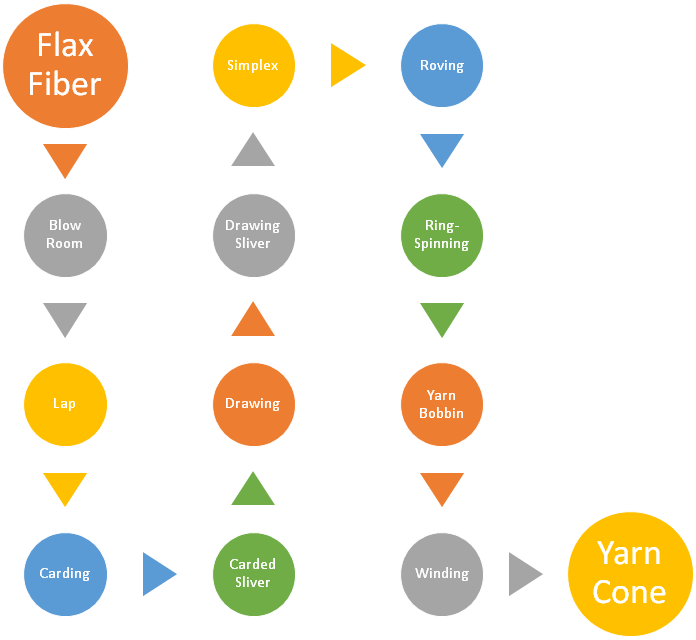
Worked example: the linen count. Linen yarn has its own count, the lea: the number of 300-yard lengths in a pound, an indirect count, so a higher number is a finer yarn (ASTM D2260). Since 300 yards is 274.32 m and a pound is 0.4536 kg, one lea is 604.8 m a kilogram, so Nm = 0.6048 × lea. A 40 lea yarn is therefore Nm 24.19, in the middle of the counts most woven, and the count converter shows it as 41.34 tex, Ne 14.28 in the cotton count, or 372.05 denier. The direct rule is tex = 1,653.5 ÷ lea. Count is tested by the skein method of ISO 2060 or ASTM D1907, after conditioning to ISO 139.
Weaving, knitting and finishing
Linen yarn is woven into everything from open plain weaves for shirts to dense damask for table linen, and it is knitted too. In finishing the fabric is washed, softened and stabilised against the shrinkage described above. Fabric weight is measured to ISO 3801, and the fabric GSM calculator works it out from ends, picks and counts.
European flax labels: Masters of FLAX FIBRE and Masters of LINEN
Two labels from the European trade body, the Alliance for European Flax-Linen and Hemp (formerly CELC), appear on linen swing tags. They certify different things, and the difference matters to a buyer.
- Masters of FLAX FIBRE™, formerly European Flax™, certifies where the fibre comes from. The flax must be grown and scutched in Western Europe: France (Normandy, Hauts-de-France and Île-de-France), Belgium and the Netherlands. Spinning, weaving and sewing can then happen anywhere; in the Alliance’s words, “those steps can be performed in or outside of Europe”, provided every company in the chain is certified. A certified product must be at least 50% linen, all of it certified flax. The label was created in 2012 and renamed in 2025. Its farming commitments are that flax is generally grown without irrigation, which is used “only in cases of specific need”; that it is retted in the field, water retting being prohibited; that seed is certified GMO-free; and that scutching is “100% mechanical”, without water or solvents. Bureau Veritas audits the processors, traders and brands, and from 2026 also the farms and scutching mills. In September 2025, 1,595 companies in 37 countries held it (Masters of FLAX FIBRE; certification FAQ).
- Masters of LINEN™ certifies that the linen was made in Europe, not only grown there. Created in 1993, it is open to spinners, weavers and knitters with their own production, and every step from certified fibre to yarn to finished fabric must be done by European companies. The fabric must be at least 50% linen, or a linen union (cotton warp, linen weft) of at least 40% linen. In December 2025, 38 companies in 8 countries held it: 8 spinning mills, 27 weavers and 3 knitters (Masters of LINEN).
So a shirt woven in India or China from Normandy flax can carry Masters of FLAX FIBRE, but not Masters of LINEN. Even under Masters of LINEN, the steps after the fabric is finished, such as making the garment, may be done anywhere by a certified company. Neither label is an organic standard. The Alliance’s own pages carry a notice that their wording is under review to align with the EU’s directive on empowering consumers for the green transition (EmpCo), so check the current text before repeating a label’s environmental claim.
Where flax is grown, and how much
Textile Exchange estimates world flax fibre production at about 0.3 million tonnes in 2024, long and short fibre together, or about 0.3% of the 132 million tonnes of all fibre made that year; cotton was 24.5 million tonnes, about eighty times as much. About 70% of the flax grown for fibre in 2024 was grown in Europe, France being the largest producer, and the other main producers were Belarus, Russia, Ukraine and China (Materials Market Report 2025, using the trade body’s data).
European fibre flax grows along “a wide coastal strip stretching from Caen to Amsterdam” (Alliance for European Flax-Linen and Hemp). The trade body reports about 200,000 hectares grown in 2025, 85 to 90% of it in France. Its scutching mills produced a record 190,000 tonnes of long fibre in 2025, against 116,000 tonnes in 2024, when they were partly working through the mediocre 2023 harvest; France, Belgium and the Netherlands produce three-quarters of the world’s long flax fibre (economic observatory). Output swings with the weather, because the crop is retted in the open field.
Most of that fibre is spun outside Europe. In 2008 the European Commission reported that more than 80% of Europe’s long flax fibre was exported, 82% of it to China (COM(2008) 307, on 2006 data). The pattern holds. EU customs data for 2025 show 183,233 tonnes of scutched flax (HS 5301.21) leaving the EU, of which 142,768 tonnes went to China and 21,981 tonnes to India, the second-largest buyer; a further 68,625 tonnes of hackled flax (HS 5301.29) left the EU, 42,066 tonnes of it to China and 13,104 tonnes to India (Eurostat Comext, dataset DS-045409). Figures from FAOSTAT need care: its item “flax, raw or retted” adds countries that report straw to countries that report fibre, so its world total, 1.29 million tonnes for 2024, is not a fibre total.
Linen in India
India spins and weaves linen but grows almost none of the flax. In the financial year 2025-26 it imported 218.43 million US dollars of flax fibre (HS 5301), down 22% from 280.05 million the year before. Belgium supplied 113.00 million and France 75.58 million, followed by Egypt and Belarus (Department of Commerce, DGCI&S data). The same year India imported 75.16 million dollars of linen yarn (HS 5306), 45.47 million of it from China, and 55.36 million dollars of woven linen fabric (HS 5309), 45.10 million of it from China. Imports of fabric with more than 50% flax from China and Hong Kong carry an anti-dumping duty of 2.36 and 1.14 US dollars a metre respectively, continued for five years in November 2025 (Notification 31/2025-Customs (ADD)).
India’s best-known linen mill is Jaya Shree Textiles at Rishra, West Bengal, which Grasim Industries set up in 1949. Grasim gives its linen capacity as 41,592 spindles of yarn and 10 million metres of fabric a year, sells the fabric under the Linen Club brand (Grasim, textiles), and describes the mill as “the country’s only fully integrated linen manufacturer” (Grasim annual report 2024-25). Its flax comes from France, Belgium and the Netherlands. The business shows how exposed Indian linen is to the European harvest: Grasim reported that in 2024-25 “linen performance was severely impacted due to demand slowdown and exceptionally high flax prices”, and that 2025-26 was “marked by stable flax prices” (annual report 2025-26). Other mills spin linen too: Sintex Industries lists 100% linen yarn from 6 to 100 lea (Sintex), and when the anti-dumping duty was first reviewed, Indian mills wove 198 lakh metres of flax fabric in 2012-13, about 37% of it at Jaya Shree (DGTR, 2015).
Growing flax at home is under trial. In February 2026 the Union Minister of Textiles, visiting the Central Research Institute for Jute and Allied Fibres at Barrackpore, noted that “a substantial quantity of linen fibre is currently imported from European countries”, and said that new flax varieties could lead to “import substitution” (ICAR, 8 February 2026). Linen is also woven on handlooms: the site’s study of the Bhagalpur handloom cluster in Bihar follows linen yarn from the market to the loom. Bhagalpur’s registered geographical indication is for its silk, “Bhagalpur Silk Fabrics & Sarees”, not its linen (GI application 180).
Is linen sustainable?
Linen has a good case, but not every claim made for it is measured. The firmest figure is water. A global study of water footprints put flax fibre and tow at 3,481 m³ a tonne, against 9,113 m³ for cotton lint, as averages for 1996 to 2005; most of flax’s footprint is rain, with 443 m³ of irrigation and other blue water against cotton’s 2,955 (Mekonnen and Hoekstra, 2011). In Western Europe flax is “generally grown without irrigation”, and the trade body’s label limits irrigation to “specific need”. The European Commission found that flax uses “considerably lower consumption of synthetic fertilisers and pesticides than do alternative crops” in the regions where it is grown (COM(2008) 307).
Two cautions. No primary source compares the pesticide use of flax directly with cotton’s, though the claim is common. And a fibre’s footprint is only its first stage: bleaching, dyeing and finishing add their own water, energy and chemicals, and flax grown in Europe, spun in Asia and sold back as a garment travels far. The site’s carbon footprint calculator adds up the stages.
Uses of linen
- Clothing: shirts, trousers, suits, dresses and summer jackets, in pure linen or blended with cotton, silk or viscose.
- Household textiles: sheets, pillowcases, tablecloths, napkins and tea towels, the articles still called “linens”.
- Artists’ canvas: “Linen cloth has long been preferred as canvases for easel painting because it is durable, lightweight, and accepts paint well” (CAMEO).
- Thread and cord: shoe thread, bookbinding thread, fishing line and twine (CAMEO).
- Banknotes: “U.S. currency paper is composed of 25% linen and 75% cotton” (Bureau of Engraving and Printing).
- Composites: “flax fiber provides a low cost alternative for glass fiber in reinforced composites” (Akin, 2013); two of the fibre studies cited on this page were written for that use.
- The rest of the plant: linseed oil for paints and linoleum, and shives for mulch, bedding, panels and fuel.

Testing linen: the standards
The methods below are the ones a linen yarn or fabric specification normally cites. Records on this site summarise each standard and link to the publisher; where the site has no current record, the link goes to the publisher.
| What is measured | Method | Tool |
|---|---|---|
| Conditioning before any test | ISO 139, standard atmospheres | Conditioning time |
| Fibre name on the label | EU Regulation 1007/2011, Annex I; US 16 CFR 303.6 | |
| Commercial weight and moisture allowance | EU Regulation 1007/2011, Annex IX; ASTM D1909 | Blend invoice weight |
| Yarn count | ISO 2060; ASTM D1907; the lea in ASTM D2260 | Count converter |
| Yarn breaking force and elongation | ISO 2062; ASTM D2256 | Tenacity units |
| Fabric mass per unit area | ISO 3801 | Fabric GSM |
| Air permeability | ISO 9237 | Air permeability |
| Shrinkage in laundering | ISO 5077 with ISO 6330 | Relaxation shrinkage |
| Care labelling | ISO 3758:2023 |
A short history of linen
People used flax long before they farmed it. Wild flax fibres, some of them spun, dyed and knotted, were found in layers of Dzudzuana Cave in Georgia that radiocarbon dates place between 32,000 and 26,000 years ago, among later ones; the excavators read them as cords for hafting tools, for baskets or for sewing garments (Kvavadze and colleagues, Science, 2009). The oldest woven garment known is linen: the Tarkhan Dress, “a V-neck linen shirt with pleated sleeves and bodice” from Tarkhan in Egypt, now in the Petrie Museum at University College London, was radiocarbon dated to 3482 to 3102 BC at 95% probability (Stevenson and Dee, Antiquity, 2016).
Linen was “one of the primary fibers for Europe throughout the Middle Ages and the Renaissance period”, until cotton, cheap and easier to process by machine, overtook it; synthetic fibres later cut its share again. Russia once grew about 80% of the world’s fibre flax crop (Akin, 2013). Because a flax plant takes up all its carbon in the one season it grows, old linen dates well by radiocarbon; the site’s radiocarbon calculator turns a measured activity on a linen or cotton sample into a conventional age.
Related on this site
- Linen weaving in the Bhagalpur handloom cluster, Bihar: the weavers, their looms and their products.
- Natural cellulosic bast fibres, and hemp, ramie and jute, flax’s nearest relatives.
- Cotton, the fibre linen is most often blended with and compared with.
- Types of fabric, and the list of textile fibres.
Sources and corrections
Every figure on this page was read at its source on 5 October 2026. Where sources disagree, both values are given. Review articles and museum references are quoted as such.
- Definitions and allowances: Regulation (EU) No 1007/2011 on textile fibre names, consolidated text of 15 February 2018, Articles 5 and 9, Annex I and Annex IX; US 16 CFR 303.6; ASTM International, ASTM D2260, tables of conversion for yarn numbers.
- Production and trade: Textile Exchange, Materials Market Report 2025; Alliance for European Flax-Linen and Hemp, economic observatory and environmental features; European Commission, COM(2008) 307; Eurostat, Comext dataset DS-045409, extra-EU exports of HS 5301.21 and 5301.29, 2024 and 2025; IMF world cotton price, via this site’s cotton series.
- Labels: Alliance for European Flax-Linen and Hemp, Masters of FLAX FIBRE, Masters of LINEN and the certification FAQ.
- Growing, retting and processing: D. E. Akin, Linen most useful: perspectives on structure, chemistry, and enzymes for retting flax, ISRN Biotechnology, 2013; Alliance, flax growing expertise; A. Różańska and colleagues, flax and hemp fibres from different retting methods, Materials 16, 2023; N. Martin, P. Davies and C. Baley, Comparison of the properties of scutched flax and flax tow for composite material reinforcement, Industrial Crops and Products 61, 2014; Safilin, from fibre to flax yarn.
- Fibre properties and identification: CAMEO, Museum of Fine Arts, Boston, flax, linen and cotton; A. Bourmaud and colleagues, Towards the design of high-performance plant fibre composites, Progress in Materials Science 97, 2018; S. Radkar and colleagues, Sustainability 11, 2019; Discover Natural Fibres Initiative, flax fibres; Ankara University, fibre identification course notes.
- Comfort, shrinkage and care: E. Taştan Özkan and colleagues, thermal comfort of cotton, cotton/linen and linen knitted fabrics, Tekstil ve Konfeksiyon 35, 2025; E. Malčiauskienė, Ž. Rukuižienė and R. Milašius, linen honeycomb weave fabric shrinkage after laundering, Fibres and Textiles in Eastern Europe 16, 2008; E. Kumpikaitė and colleagues, colour fastness and shrinkage of dyed and printed linen/silk fabrics, Coatings 12, 2022; GINETEX, care symbols; North Carolina State Extension, clothes moths and carpet beetles.
- Environment: M. M. Mekonnen and A. Y. Hoekstra, The green, blue and grey water footprint of crops and derived crop products, Hydrology and Earth System Sciences 15, 2011.
- India: Department of Commerce, Export Import Data Bank (DGCI&S), HS 5301, 5306 and 5309, 2024-25 and 2025-26; Ministry of Finance, Notification 31/2025-Customs (ADD), 7 November 2025; Grasim Industries, textiles and annual reports 2024-25 and 2025-26; Sintex Industries; Directorate General of Trade Remedies, flax fabric sunset review, 2015; ICAR, Minister’s visit to ICAR-CRIJAF, 8 February 2026; IP India, GI application 180.
- Uses, words and history: Bureau of Engraving and Printing, how money is made; Online Etymology Dictionary; Old Dominion University, flax; E. Kvavadze and colleagues, 30,000 years old wild flax fibers, Science 325, 2009; A. Stevenson and M. W. Dee, Confirmation of the world’s oldest woven garment: the Tarkhan Dress, Antiquity, 2016.
Change log. 5 October 2026: rewritten in full, with two other overviews of linen on this site folded in. Corrected from the earlier versions: flax fibres are cells of the stem, not “hairs”; elementary fibres are millimetres to centimetres long and line bundles under a metre, where the old text gave 18 to 30 inches beside 25 to 150 mm; the agreed regain is 12%, not “10 to 12%”; linen resists mildew, which the old text said attacked it; and retting is an alternative of dew, water or enzymes, not three steps in a row. Removed: a 1997 to 2001 production table, a retting colour table whose numbers could not be traced to their source, and the claim that linen conducts heat “five times” better than wool and “eighteen times” better than silk, for which no measurement was found.
Found an error? Please tell us through the contact page, naming the section and the source that disagrees.

need linen natural color with different process like linen flex,slub,checks
Need natural color in linen with different process like linen flex , slub ,linen checks just in natural color.contact _9320389908