
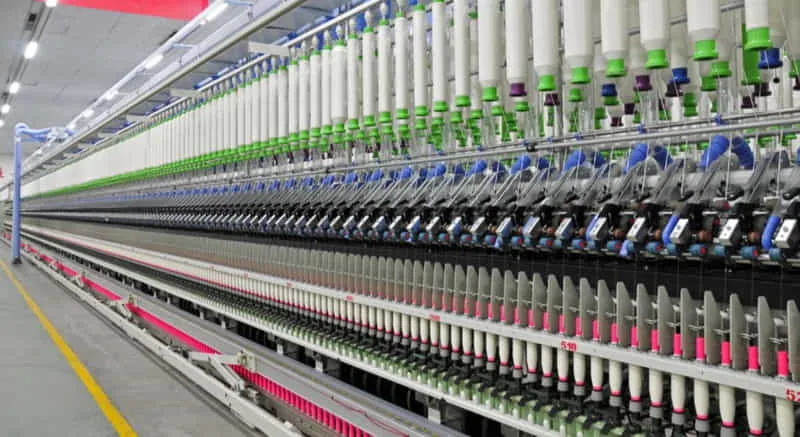
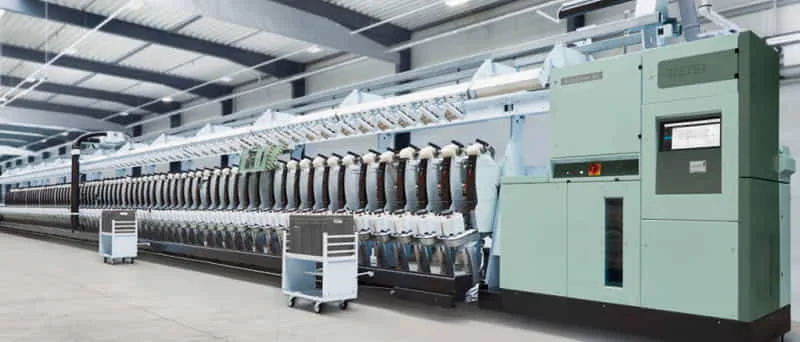
Ring spinning is the method that turns a roving (a thin, lightly twisted strand of staple fibres) into finished yarn on a ring spinning frame, usually called a ring frame. At every spindle three things happen at once: a roller drafting system draws the roving out to the final yarn count, a spindle turning at up to about 28,000 rpm puts in the twist that gives the yarn its strength, and a small C-shaped steel clip called the traveller, dragged round a fixed ring by the yarn itself, winds the yarn onto a bobbin (the cop). It is the oldest spinning system still in mill use and the most versatile: a current ring frame spins cotton, man-made fibres and blends from about Ne 4.5 to Ne 160 (132 to 3.7 tex) into strong, fine, even yarn. Its weaknesses are speed and cost: the traveller limits delivery to about 40 m/min at best, against up to 300 m/min on a rotor machine and 600 m/min on an air-jet machine, and ring yarn needs two extra stages, roving before it and winding after it.
Last verified: 18 November 2026. Machine figures are quoted from the makers’ own brochures and data sheets (Rieter for ring, rotor and air-jet machines; Bräcker for rings and travellers); the date of the invention is from the patent record. Every source is linked where it is used and listed at the end.
Ring spinning at a glance
| Question | Short answer | Section |
|---|---|---|
| What is ring spinning? | Drafting a roving to the yarn count, twisting it with a spindle and traveller, and winding it onto a cop, all at once | What it is |
| Where does it come in the process? | After blow room, carding, drawing (and combing for combed yarn) and the roving frame; before winding | Process flow |
| How does a ring frame work? | Creel, drafting, twisting, winding and building, doffing | Step by step |
| What are the parts of a ring frame? | Creel, drafting system, thread guide, balloon control ring, ring and ring rail, traveller, spindle and drive, doffer | Parts |
| What limits its speed? | The traveller: its speed round the ring and the heat it makes | Ring and traveller |
| How much does one frame produce? | About 24 g per spindle per hour at Ne 30 and 18,000 rpm, or 350 kg a shift on 1,824 spindles | Production |
| What is ring-spun yarn? | Yarn made this way: fibres in tight helices, strong and soft, the reference against which other yarns are judged | Ring-spun yarn |
| Ring, rotor or air-jet? | Ring for the widest count range and strength; rotor and air-jet for speed in a narrower range | Compared |
| Pros and cons? | Versatile and strong, but slow, extra process stages, small packages and high energy per kilogram | Advantages and disadvantages |
What is ring spinning?
Ring spinning is the last stage of making a staple yarn by the conventional route. The fibre arrives at the ring frame as roving from the roving frame. The ring frame does three jobs, continuously and at the same time:
- Drafting. A set of rollers, each pair running faster than the one before, draws the roving out until the strand has the mass per metre of the finished yarn.
- Twisting. The strand leaving the front rollers is twisted by the rotating spindle. Twist binds the fibres together: the fibres lie round one another in helical paths, so pulling on the yarn presses them together and stops them slipping past each other.
- Winding. The twisted yarn is wound onto a tube carried on the spindle, through the traveller, and the up-and-down movement of the ring rail lays it into a cop that can be stored, moved and rewound.
The machine takes its name from the ring, a polished steel ring round each spindle, and from the way the traveller runs on it. The idea is old. In 1844 John Thorp, then of North Wrentham, Massachusetts, patented an improved “whirling and rotary ring and revolving-hook spinner and twister”, and the specification refers back to the Letters Patent he had been granted on 20 November 1828 (US 3,766). The “revolving hook” hanging loosely on the ring is what is now called the traveller.
Where ring spinning sits in the spinning process

A ring spinning mill is a chain of machines, each making the strand thinner, cleaner and more parallel. In order, for cotton:
- Blow room: bales are opened, mixed and cleaned of trash. See the blow room.
- Carding: the tufts are opened to single fibres, more trash and some short fibre are removed, and the web is condensed into a sliver. See objectives of carding.
- Drawing: several slivers are doubled and drafted together on the draw frame to even them out and straighten the fibres. See the draw frame.
- Combing, for combed yarn only: a lap former and a comber remove short fibres (noil) and neps, which gives a finer, smoother, stronger yarn. See the combing machine and the lap former. Yarn that skips this step is carded yarn.
- Roving (speed frame, simplex): the drawn sliver is drafted into a roving and given a little twist so it survives being wound onto a bobbin and unwound again. See roving frames.
- Ring spinning: the roving becomes yarn on the cop. This page.
- Winding: cops hold only a small amount of yarn, so an automatic winder unwinds many of them onto one cone or cheese, cutting out faults and splicing the ends. See cone winding and the auto-coner.
- Doubling, when needed: two or more single yarns are twisted together on a ring doubler or a two-for-one twister into a plied yarn, for sewing thread or strong warp. See types of doubling.
Every machine in this line has its own page in the site’s list of ring spinning machinery. Rotor and air-jet spinning, described below, start from drawn sliver and so skip both the roving frame and, in practice, the separate winder.

How a ring frame works, step by step
1. Creel. Full roving bobbins hang in the creel above the machine, one for each spindle, and the roving runs down through a guide into the drafting system.
2. Drafting. Most ring frames use a three-roller drafting system with a pair of aprons in the front zone. The back zone gives a small break draft that straightens the roving and takes out its twist; the apron zone gives the main draft, the aprons holding the fibres until the front rollers grip them. The total draft is simply the ratio of the counts: yarn count divided by roving hank in the English system. Rieter’s G 38 frame is specified for a technological draft of 10 to 80 times (Rieter G 38 brochure).
Worked example: the draft. To spin Ne 30 from a 1.1 hank roving (an assumed roving; mills choose their own) with a break draft of 1.2, the total draft is 30 ÷ 1.1 = 27.27 and the main draft 27.27 ÷ 1.2 = 22.73. In the direct system the roving is 536.8 tex and the yarn 19.68 tex. Open this example in the roving draft calculator.
3. Twisting. The drafted ribbon of fibres leaves the front roller nip and runs down through the thread guide (the pigtail or lappet) to the traveller and onto the tube. The spindle turns the tube, and each turn of the spindle puts one turn of twist into the yarn. The twist runs back up the yarn to the point where the fibres leave the rollers, the spinning triangle, which is where the yarn is weakest and where most ends break.
4. Winding. The traveller has no drive of its own. It is pulled round the ring by the yarn threaded through it, and friction against the ring holds it back, so it runs a little slower than the spindle. That difference in speed is what winds the yarn onto the tube: every turn the traveller loses against the spindle lays one coil of yarn on the cop. Between the guide and the traveller the yarn whirls out into a balloon; a balloon control ring and separators between the spindles keep the balloon steady and stop neighbouring yarns touching.
5. Building. The ring rail moves up and down in a controlled pattern so the yarn is laid on in short conical layers (the chase) that build up the cop from the bottom. The building pattern decides how much yarn the cop holds and how cleanly it unwinds at the winder.
6. Doffing. When the cops are full the frame stops, and an automatic doffer lifts off all the full cops and puts empty tubes on the spindles. Rieter quotes a doffing cycle of 90 seconds on the current G 38, against “typically” 120 seconds for others (Rieter G 38 brochure). On a linked system the cops travel straight to the winding machine.
Ends down. When a yarn breaks, that spindle goes on turning but makes nothing until someone pieces the end up again. Individual spindle monitoring now finds the broken ends, and piecing robots repair them: Rieter states that its ROBOspin robot pieces cotton successfully at the first attempt more than 80% of the time, and gains about 10% more at a second attempt with an auxiliary yarn (Rieter ring spinning portfolio).
Parts of a ring spinning frame
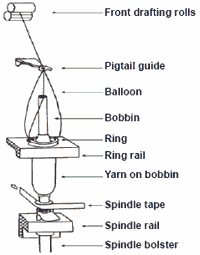
A ring frame is a long double-sided machine with the same spinning position repeated at every spindle. The diagram at the top of this page shows one position. Going down the machine:
- Creel: holds the roving bobbins.
- Drafting system: bottom steel rollers, top rollers covered with rubber cots and pressed down by weighting arms, and the aprons of the main draft zone. On some machines a compacting device sits after the front rollers.
- Thread guide (pigtail or lappet): centres the yarn over the spindle.
- Balloon control ring and separators: limit the size of the balloon and keep yarns apart.
- Ring and ring rail: one ring per spindle, all mounted on a rail that moves up and down to build the cop. Ring diameter matters: on the G 38 the rings are 34 to 45 mm on a 70 mm spindle gauge and up to 51 or 54 mm on a 75 mm gauge.
- Traveller: a small C-shaped steel clip that runs on the ring flange; see the next section.
- Spindle, tube and drive: each spindle carries a tube (180 to 250 mm long on the G 38) and is driven by a tape from a cylinder running along the machine, with a main motor of 55 to 110 kW on that frame.
- Doffer and cop transport: automatic doffing and, on linked systems, a conveyor to the winder.
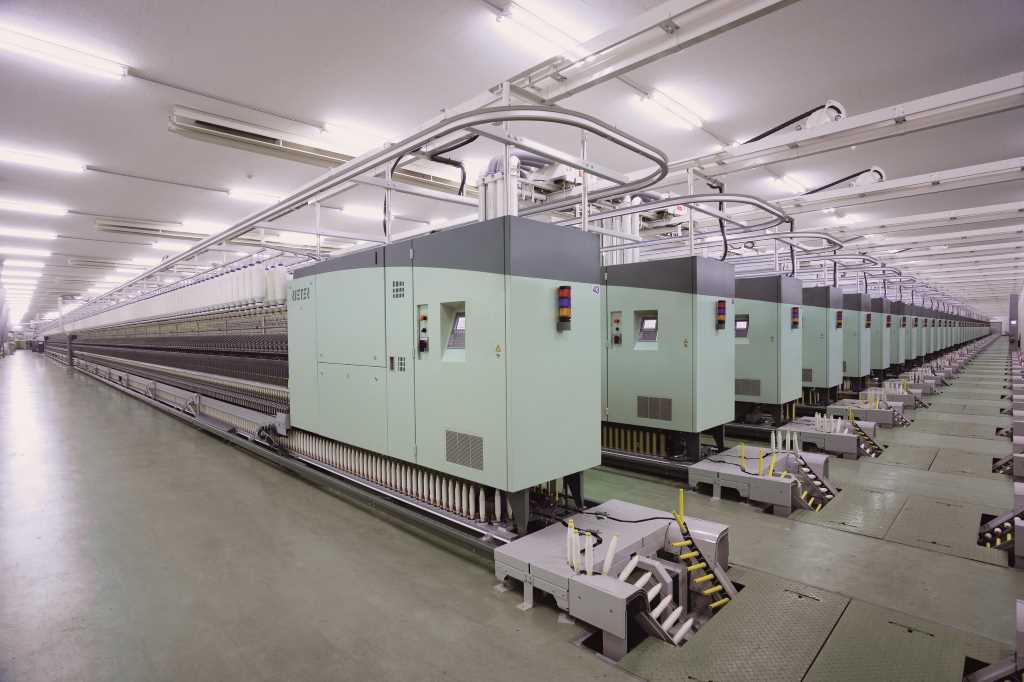
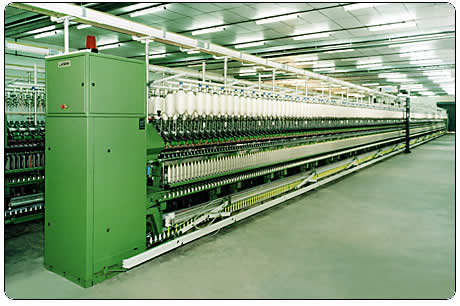
How big is a ring frame? The Rieter G 38 holds up to 1,824 spindles on a 70 mm gauge, or 1,632 on a 75 mm gauge, and runs at up to 28,000 rpm with its high-speed package (Rieter G 38 brochure, technological data). Data for other current frames are in the site’s machinery register: Rieter G 38, Rieter G 37, Rieter K 48 (compact), Toyota RX300, Saurer Zinser 51 and Zinser 670. The site’s article on the arrangement of the ring frame has a larger labelled diagram.
Ring and traveller: what limits the speed
The traveller is a few milligrams of steel wire bent into a C, with a toe and a yarn passage, clipped over the flange of the ring (Bräcker short-staple manual, page 9). It slides round the ring at almost the spindle’s speed, so its speed is set by the ring diameter. Bräcker, Rieter’s ring and traveller maker, gives the formula as:
traveller speed (m/s) = ring diameter (mm) × π × spindle speed (rpm) ÷ (1,000 × 60)
and the force with which the traveller presses outward on the ring, the ring load, as L = m × v² ÷ r, with L in millinewtons, the traveller mass m in milligrams, its speed v in m/s and the ring radius r in millimetres. That pressure, at that speed, turns into heat where the traveller touches the ring. Bräcker’s manual says traveller speeds have to be limited when spinning polyester and acrylic because excessive speed causes thermal fibre damage “that is only visible after the dyeing process”, and it recommends 25 to 28 m/s for soft-core yarns with an elastane core and 20 to 25 m/s for hard-core (polyester filament) sewing-thread yarns. Its speed tables for regular yarns run up to about 50 m/s on rings of 36 to 38 mm.
Worked example: why mills fit smaller rings. At 18,000 rpm a 45 mg traveller on a 42 mm ring runs at 39.58 m/s and presses on the ring with 3.36 N. If the planning limit is 40 m/s, that ring allows no more than 18,189 rpm. On a 34 mm ring the same spindle speed gives only 32.04 m/s and 2.72 N, and 40 m/s would allow 22,469 rpm. (The 40 m/s and the traveller mass are assumptions for the example; the real ceiling comes from the ring and traveller supplier for the fibre and count.) Open the 42 mm case or the 34 mm case in the traveller limit calculator.
This is exactly the trade Rieter describes for its high-speed G 38: a 34 mm ring shortens the traveller’s path, which “opens up potential for an increase in spindle rotation”, from 25,000 to 28,000 rpm. A smaller ring holds less yarn, so the tube’s inside diameter was reduced to keep the cop’s content, because more frequent doffing would cancel the gain (Rieter G 38 brochure, page 12). Ring diameter, cop size and spindle speed are always traded against one another.
Ring and traveller types. Rings are made in several flange widths (Bräcker’s T-flange rings come as flange ½, 1 and 2, with flange 2 recommended for coarse counts) and in designs with a larger contact area, such as the ORBIT ring, meant to reduce thermal damage at high traveller speeds. Travellers differ in wire profile, bow height and finish; coatings exist to lengthen their service life or to suit man-made fibres. Choosing the traveller is a compromise. Bräcker points out that the balloon changes so much as the cop fills that a traveller is usually too light at the bottom of the cop and too heavy at the top, and that a wrong choice of wire profile, material or finish leads to “roughness, yarn hairiness, slub formation, thread breaks and melting points (in synthetics)”. The traveller is also a wearing part: a worn or overheated (“burnt”) traveller runs unevenly and raises hairiness and end breaks, so mills replace travellers on a schedule.
Related calculators: traveller friction heat, ring spinning tension and end breakage, cop building and traverse and spindle tape slip.
Twist: how much, and which way
A finer yarn needs more turns per inch to hold together, and the twist it needs rises with the square root of the count. So mills specify a twist multiplier (TM, or αe in the English system) and the frame is set to the turns it implies. Bräcker’s formula sheet gives the relationships:
- turns per inch = αe × √Ne
- turns per metre = αm × √Nm, with αm = αe × 30.3
- αtex = turns per metre × √tex
The multiplier depends on the fibre and the end use. Rieter’s own trials quote 100% cotton at TM 4.3 for Ne 20 carded, TM 3.9 to 4.0 for Ne 30 and TM 4.2 for Ne 60 (Rieter G 38 brochure, page 24). A ring frame can spin either twist direction, Z or S; on an electronic frame it is a setting changed at the operating panel, like the count and the twist level.
Worked example: twist. Ne 30 cotton at TM 3.9 needs 3.9 × √30 = 21.36 turns per inch, which is 840.99 turns per metre and an αtex of 3,731. Open this example in the twist multiplier calculator. For the count systems themselves, see yarn count conversions and the count converter; for the formulas in one place, yarn spinning formulas.
How much a ring frame produces
On a ring frame twist and delivery are locked together. Each spindle turn is one turn of twist, so the front rollers can deliver only one inch of yarn for every TPI turns of the spindle: delivery (inches per minute) = spindle rpm ÷ TPI. Converting length to weight through the count gives the classical production formula used in the calculator: grams per spindle hour = 60 × rpm ÷ (36 × 840 × TPI × Ne), converted from pounds and multiplied by the efficiency.
Worked example: one frame, one shift. Rieter’s G 38 brochure illustrates its spindle monitoring with Ne 30 carded cotton at 18,000 rpm on a 1,824-spindle machine. At the twist worked out above (21.36 TPI) and an assumed 95% efficiency, that frame delivers 21.40 m/min per spindle and makes 24.02 g per spindle hour: 43.81 kg an hour, or 350.45 kg in an 8-hour shift. Open this example in the ring frame production calculator. For comparison, Rieter reports 29.5 g per spindle hour for 100% cotton Ne 30 at TM 3.9 with its short-balloon setting; at this twist and efficiency that corresponds to about 22,100 rpm.
Two things follow. A finer count is much slower in kilograms, because the yarn weighs less per metre and needs more twist per inch. And raising twist without raising spindle speed cuts output directly, so every turn of twist the yarn does not need is output gained. Output per spindle is also what a mill’s costing starts from: see yarn realisation for the fibre side and the site’s cotton yarn and cotton price series for the market side.
What is ring-spun yarn?
Ring-spun yarn is simply yarn made on a ring frame. Its structure comes from the way twist reaches the fibres at the spinning triangle: the fibres lie in concentric helices and migrate in and out between the core and the surface of the yarn, which locks them in place. The yarn is compact, with the fibres well aligned, and has essentially none of the loose wrapper fibres found on rotor yarn. That self-locking structure is why ring yarn is strong for its count and soft to handle. Rieter, which builds ring, rotor and air-jet machines, puts it this way in its G 38 brochure, writing about yarn from recycled cotton: “Due to the better integration of the fibers during ring spinning, ring yarn has a higher tenacity.”
The weakness of a conventional ring yarn is hairiness: fibre ends at the edges of the drafted ribbon are not caught into the yarn at the spinning triangle and stick out of it. Compact spinning attacks exactly this (see below), and singeing burns the hairs off afterwards; see the hairiness to singeing calculator.
“Combed ring-spun cotton” on a label means the cotton was combed to remove short fibres before spinning (step 4 in the process flow) and then spun on ring frames, rather than carded only, or spun on rotor machines. It is a marker of a finer, smoother and stronger yarn, and it is why the phrase appears on better T-shirts, shirting, knitwear and towels. Ring spinning is also where many speciality yarns are made: slub yarns, core-spun yarns with an elastane or polyester filament core (see core-spun yarns), and two-strand siro yarns. Denim yarn is spun on both ring and rotor machines; see denim spinning.
Ring, compact, rotor and air-jet spinning compared
Ring spinning has three industrial alternatives for staple yarn. Compact spinning is a ring frame with an extra condensing zone; rotor (open-end) and air-jet spinning are different principles that spin straight from sliver. The figures below are each maker’s own maxima for one current machine, not typical mill speeds, and they are reached at different counts.
| System (machine) | Fed with | Yarn count range | Speed, maker’s maximum | Source |
|---|---|---|---|---|
| Ring (Rieter G 38) | Roving | Ne 4.5–160 (132–3.7 tex), all raw materials; cotton Ne 6.5–160 | Spindle 28,000 rpm; delivery up to 40 m/min | G 38 brochure |
| Rotor, open-end (Rieter R 70) | Sliver | Ne 3–60 (200–10 tex) | Delivery up to 300 m/min | R 70 brochure |
| Air-jet (Rieter J 70) | Sliver | Ne 16–70; combed cotton, cellulosics and their blends with polyester | Delivery up to 600 m/min | J 70 product page |
On these maxima rotor delivers up to about 7.5 times, and air-jet up to 15 times, the ring frame’s speed, and both wind directly onto a large cross-wound package, so they also save the roving frame and the separate winding stage. What they give up is range and strength: neither reaches the fine counts a ring frame spins, and Rieter itself credits ring yarn with higher tenacity. Ring spinning keeps the fine counts, the strongest and softest yarns, and the flexibility to spin almost any staple fibre in small lots. See rotor spinning, air-jet spinning, and twist insertion in the different spinning techniques.
Compact spinning keeps the ring frame but condenses the drafted ribbon, usually by suction through a perforated apron or drum, before the twist reaches it, so the spinning triangle almost disappears and the edge fibres are tied in. Bräcker’s manual sums up the result: compact yarns “have significantly lower yarn hairiness” and “a higher yarn tenacity, which makes it suitable for higher spindle speeds”. Compacting devices can be fitted to many existing frames and switched in and out, so the same machine spins conventional ring yarn one day and compact yarn the next (Rieter ring spinning portfolio). The suction costs energy; the compact suction energy calculator prices it. See also compact ring-spun yarn.
Advantages and disadvantages of ring spinning
Advantages
- The widest count range of any staple system, from very coarse to very fine: Ne 4.5 to 160 on a current frame, against Ne 3 to 60 for rotor and Ne 16 to 70 for air-jet.
- Strong yarn. The self-locking helical structure gives a high tenacity for the count, which is why ring yarn is the reference for fine shirting and knitwear.
- A wide range of fibres: cotton, man-made fibres and blends up to 63 mm staple on the G 38.
- Flexible in lot size and product: each spindle is independent, count and twist are settings, and the same frame spins compact, slub, core and twin yarns.
- Combed yarn: with combing, the ring system makes combed yarns that are smoother, brighter and more compact.
- Well-known technology: the machine and its settings are understood in every spinning country, and spares and skilled staff are easy to find.
Disadvantages
- Low production speed. The traveller sets a ceiling on spindle speed, and twist then fixes delivery; up to 40 m/min against 300 for rotor and 600 for air-jet.
- More process stages. A roving frame before and a winding machine after are needed; rotor and air-jet spin from sliver onto a finished package.
- Small packages. The ring diameter limits how much yarn a cop holds, which means frequent doffing and many splices at the winder.
- End breaks. Tension peaks between ring, traveller and balloon break yarns, and every break stops a spindle until it is pieced; Rieter names yarn tension peaks and the ring and traveller interaction as “the limiting factors in ring yarn production”.
- Heat and wear. High traveller speed can damage heat-sensitive fibres, and travellers and rings wear and must be replaced.
- Energy and cost per kilogram. Turning thousands of spindles for a few grams each per hour makes energy a large part of the cost of ring yarn. Rieter presents its 40 m/min delivery speed as “particularly important for the efficient production of coarse yarns”, which is where ring spinning competes hardest with rotor. See power consumption in spinning mills.
The makers’ answer to these weaknesses has been automation and speed rather than a new principle: individual spindle monitoring, piecing robots, faster doffing, links to the winder, smaller rings and compacting. The day-to-day problems mills face, from count variation to end breaks, are covered in problems and success factors in ring spinning.
Yarn quality on the ring frame, and how it is tested
The ring frame is the last point at which the yarn itself is formed, so much of its quality is decided here. The usual levers are these:
- Spindle speed: higher speed raises tension, end breaks and hairiness, and tends to raise imperfections (thin places, thick places and neps).
- Traveller condition and weight: a worn traveller raises hairiness, and the traveller weight has to keep the balloon stable from the bottom of the cop to the top.
- Drafting settings and cots: roller settings, top-arm pressure and the state of the cots and aprons decide evenness. See ring drafting stability, cot buffing and evenness and evenness to imperfections.
- Count and twist variation: the ring frame is the last stage where count variation can be held down, and spindle-to-spindle speed differences (slipping tapes) show up as twist variation.
Tests on ring yarn (each links to the site’s standards register): linear density by the skein method, ISO 2060 and ASTM D1907; twist, ISO 2061 (direct counting) and ISO 17202 (untwist and retwist); single-end strength and elongation, ISO 2062 and ASTM D2256; unevenness, ISO 16549 and ASTM D1425; hairiness, ASTM D5647. For what the strength results mean in use, see the yarn strength distribution calculator.

Ring spinning with recycled fibre
Recycled cotton is heterogeneous and has a high share of short fibre, which Rieter says “brings new challenges” for ring yarn. It states that ring yarns from recycled cotton “can rarely be found on the market up to now”, and that its ring spinning system makes high-quality ring yarns with a 38% share of recycled cotton (Rieter G 38 brochure, page 23). How old garments become fibre again is covered in recycling and re-spinning post-consumer fibres, and blending in fibre blending in spinning.
Ring spinning calculators
- Roving hank to yarn count draft: total, break and main draft.
- Twist multiplier to TPI and TPM.
- Ring frame production: delivery, grams per spindle hour, kilograms per shift.
- Traveller speed and ring diameter limit.
- Ring spinning tension, end breakage and efficiency loss.
- Cop building and traverse.
- Compact spinning suction energy.
- Yarn count converter.
- Roving twist, flyer speed and production, for the stage before.
- All of them: spinning and yarn calculators.
Related articles
- Yarn spinning: the formation of yarn and basics of yarn spinning
- Arrangement and schematics of the ring frame
- Machinery used in ring spinning and spinning machinery manufacturers
- Problems and success factors in ring spinning
- Cotton, the fibre most ring yarn is made from
- Setting up a spinning mill
Sources
- Rieter, Ring Spinning Machine G 38, brochure 3236-v5, 2024.
- Rieter, The Rieter Ring Spinning Portfolio, brochure 3421.
- Bräcker (Rieter), Short Staple Manual: Products, Technology and Application.
- Rieter, Rotor Spinning Machine R 70, brochure 3313-v4.
- Rieter, Automated Air-Jet Spinning Machine J 70, product page.
- J. Thorp, US 3,766, Whirling and rotary ring and revolving-hook spinner and twister, 27 September 1844, citing his patent of 20 November 1828.
How this page is kept
Last verified: 18 November 2026. Machine figures are quoted from the makers’ current brochures and are each maker’s own maxima for one machine, not mill averages. The four worked examples use the site’s calculators as they stood on this date; each prefilled link was opened to check that it shows the figures quoted, and the assumptions in them (roving hank, traveller mass, traveller speed limit, efficiency) are labelled where they are used.
Change log. 18 November 2026: rewritten in full as the site’s main ring spinning page, and two overlapping articles, on ring spinning as a yarn formation technique and on its pros and cons, were merged into it. Corrected from the earlier versions: the traveller is a C-shaped steel clip running on the ring, not “a small metal or plastic ring”; twist direction is a machine setting, not Z for knitting and S for weaving; ring spinning is the final spinning stage, not the first stage after spinning. Production speeds now come from the makers’ data, and unsourced energy savings and case studies were removed.
Found an error, or a newer figure? Please tell us through the contact page, naming the section and the source that disagrees.



Ring spinning is a remarkable process that revolutionized textile production. Its efficiency and versatility have paved the way for high-quality yarns. Kudos to the ingenuity behind this method and for perfectly summarizing the process in this article!